Quint Computing Lands €9.1M Led by Vsquared for Quantum Chips That Suppress Errors in Hardware
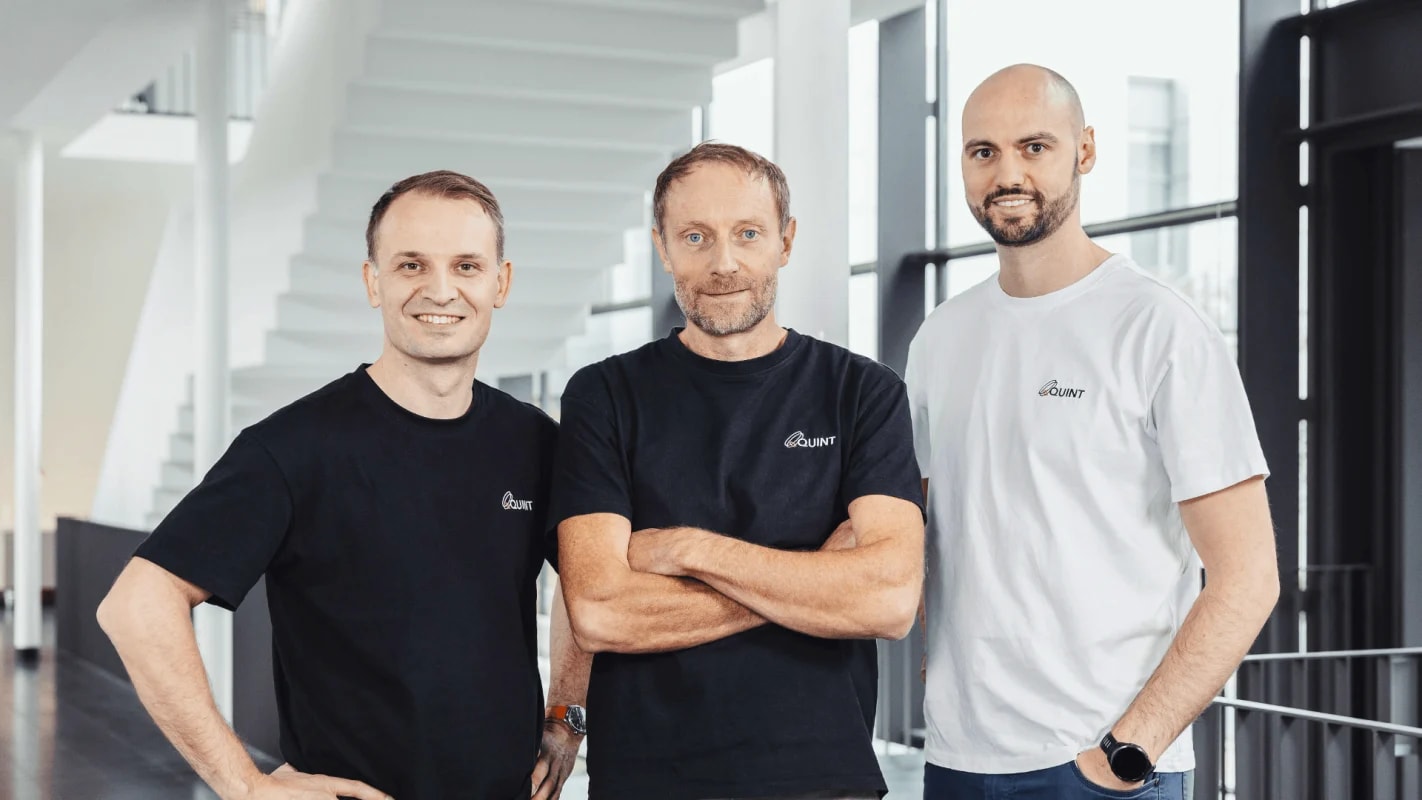
Quint Computing founder Prof. Christopher Eichler, Prof. Michael Hartmann, and Dr. Jona Stinner
Image credit: Quint Computing
Quint Computing, a German quantum computing startup, has raised €9.1 million in its first funding round. Vsquared led the round, with participation from Quantonation, Nucleus Capital, Faber, Vanagon Ventures and ZOHO.VC. Industry experts also invested, including Prof. Mikko Möttönen, founder of IQM and QMill. Quint has separately been awarded a €2.2 million Pathfinder grant by the European Innovation Council.
The company was founded in October 2025 by quantum physicists Prof. Michael Hartmann and Prof. Christopher Eichler, together with economist Dr Jona Stinner. Eichler is chief executive and Hartmann is chief technology officer. Quint emerged from research at Friedrich‑Alexander‑Universität Erlangen‑Nürnberg and is part of the Munich Quantum Valley ecosystem.
Quint is developing a superconducting quantum chip architecture aimed at one of the main barriers to industrial use of quantum computers, high error rates. Quantum computers could in principle solve problems beyond the reach of conventional supercomputers, but their sensitivity to disturbances makes the operations needed for practical applications hard to carry out. Existing error‑correction methods often need additional hardware, add computational complexity or slow processing, which makes quantum systems difficult to scale.
The company's patented architecture is designed to prevent a significant share of errors directly in the hardware. According to Quint, once the technology is fully implemented it could reduce system complexity, hardware requirements and energy consumption by a factor of 100 while keeping computing speed high.
Eichler explained the scale of the problem with a comparison to Google's Willow processor, which has 105 physical qubits. The dominant approach today is the surface code, which combines many physical qubits into one reliable logical qubit, and a commercially useful machine built that way would need around a million physical qubits. Rather than perfecting the qubits first and adding error correction later, Quint builds a fault‑tolerant system with all of the components integrated from the start. Its chip uses a hierarchy of error probabilities that allows more efficient error‑correcting codes, and the qubit design is matched to the control system. Eichler expects this to cut resource overhead by a factor of 100.
He noted that Paris‑based Alice & Bob also uses an error hierarchy and described the two approaches as similar but different in circuit design. In his view the main challenge is carrying out two‑qubit gates while preserving the hierarchy.
The founders bring academic and industry backgrounds. Before joining the university in Erlangen, Eichler worked at ETH Zurich, where, according to Hartmann, he built the first error‑corrected qubit in superconducting technology, a result announced in 2022. Hartmann worked at Google Quantum AI and has led projects with German companies that Eichler expects to become Quint's first customers. The founders have already tested use cases with Bosch, BASF and Boehringer Ingelheim. The advisory board includes Prof. Florian Marquardt of the Max Planck Institute for the Science of Light, Dr Reinhard Ploss, former chief executive of Infineon Technologies, and Dr Markus Hoffmann, former partnerships lead at Google Quantum AI.
The technology could support applications in pharmaceuticals, chemicals, logistics and manufacturing. Eichler described the race to build commercially viable quantum computers as gaining momentum and said the architecture reduces complexity while keeping a high clock speed, which leads to more computing power, lower operating costs and a shorter route to commercialisation.
Dr Michael Jobst, investment partner at Vsquared, said major players including Google, AWS, Microsoft and IBM are investing heavily and the industry has made significant progress, but that fault tolerance at scale remains the decisive challenge. He said Quint is addressing that bottleneck and that the team is what makes it possible.
Other companies work on error correction as well. London‑based Riverlane raised $75 million for its error‑correction technology, and Munich‑based planqc secured €50 million to build scalable quantum computers. The McKinsey Quantum Technology Monitor 2026 estimates that quantum technologies could be worth between $1.3 trillion and $2.7 trillion by 2035.
Quint currently has 10 employees and plans to add about 15 more by the end of 2027, aiming for a team of 40 to 50 within two years. It is recruiting specialists in quantum chip design, fabrication, error correction and applications. The new funding will go toward expanding the research and engineering team, advancing the quantum processor technology and pursuing initial industrial deployment projects, including an ongoing project to deploy processors at universities. The company says its milestones in the coming years include demonstrating quantum error correction with record‑high efficiency. Eichler named development speed in Germany as the company's biggest risk.
Topics
Sources
Stay informed
Startup news in your inbox
Get important funding rounds, founder stories, and startup updates.
No spam - only important startup updates.
Comments
Text only. No links or images.
No comments yet.