
London Deep Tech Startup AcouBatt Lands £1.1M To Cut Battery Scrap Rates
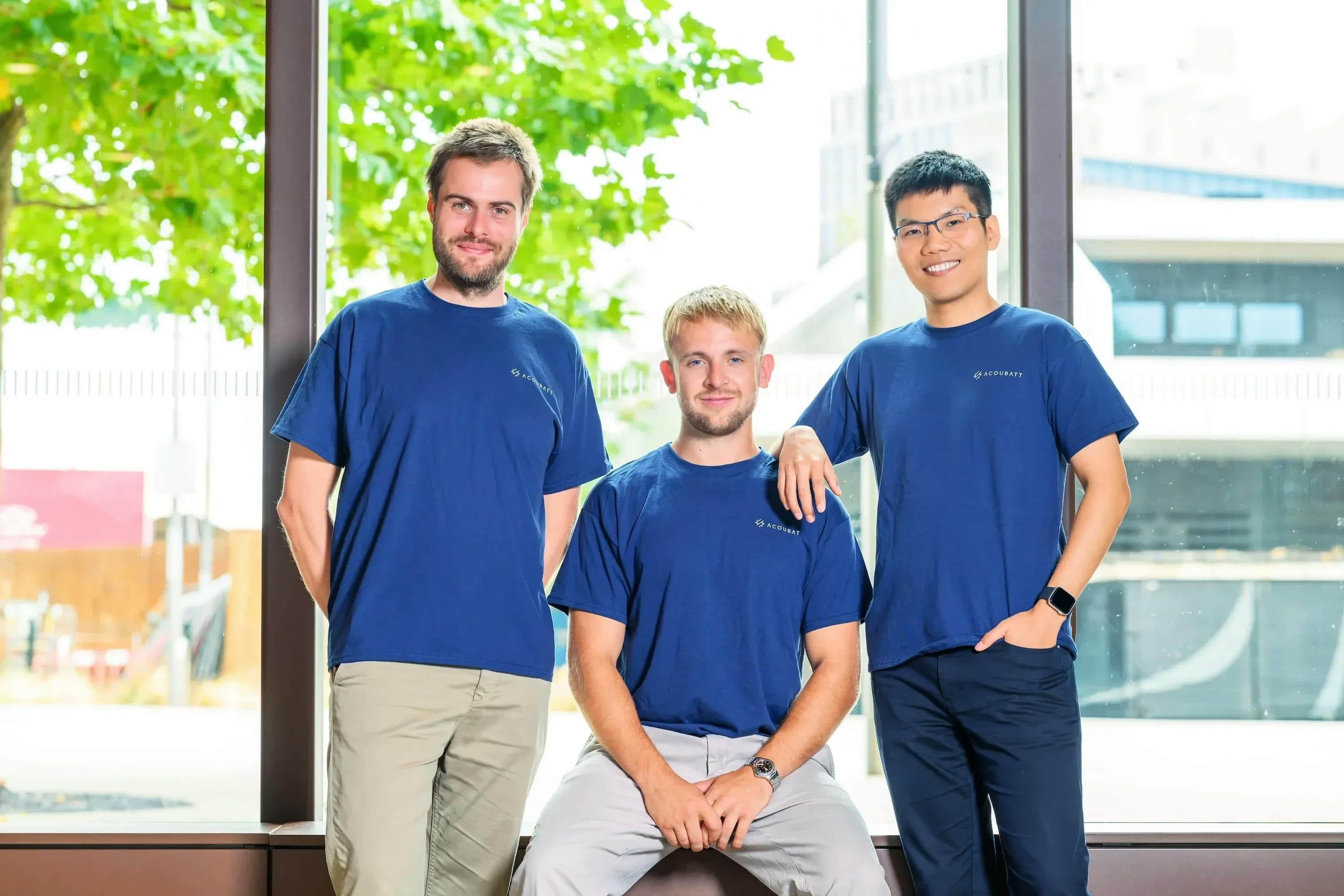
AcouBatt team
Image credit: AcouBatt
AcouBatt, a London based deep tech startup, has raised 1.1 million pounds in pre‑seed funding to scale a platform that lets battery manufacturers listen to cells as they are made, aiming to fix a step in production that today runs almost entirely blind.
The company was founded by Arthur Fordham, a battery scientist with a research background spanning University College London and the Faraday Institution, and Chris Haoxin Xu, a commercial specialist who previously held regional business development roles at sleep products company Emma. The pair met through the Innovation to Market venture building course at London Business School, where deep tech researchers are paired with students to help commercialise early stage technology, and built AcouBatt around Fordham's doctoral research into applying acoustic emission monitoring to lithium‑ion battery production.
The problem the company is targeting sits at one of the most costly and least visible steps in making a battery. Cell formation, the initial charge and discharge cycle every new battery cell goes through before it is ready for use, is currently carried out with very little real‑time insight into what is actually happening inside the cell. That lack of visibility contributes to scrap rates that run as high as 20 to 30 percent on new production lines, according to figures cited by the company, a level of waste that is both expensive and increasingly hard to justify as global demand for batteries continues to climb. Fordham has estimated that even a single percentage point reduction in scrap across the battery industry would save manufacturers in the region of 1 billion dollars a year.
AcouBatt's answer is a non‑destructive acoustic emission monitoring system that fits onto existing production lines and, combined with a proprietary neural network model, extracts formation specific acoustic signatures that are otherwise invisible to standard manufacturing sensors. In practice, that means listening to the physical and chemical processes taking place inside a cell as it forms, translating those acoustic patterns into data manufacturers can act on before a batch turns into scrap, rather than discovering a defect only after formation is complete. The company has described its offering as a software as a service model built around this sensing layer, positioning it as an add‑on manufacturers can integrate into existing lines rather than a wholesale change to how formation itself is carried out.
AcouBatt's traction ahead of this round has been built substantially through the European academic and startup competition circuit. The company represented London Business School at the INNOVA Europe 2025 Grand Finale, hosted at ESMT Berlin in September 2025, where it won the Rising Stars category, a prize awarded to startups already moving toward implementation rather than still at the idea stage. That win came with 20,000 euros in prize money and a year of incubation support, credentials that have helped the company build relationships ahead of its first institutional funding round. AcouBatt has also been backed through The Creator Fund, an investor focused on student and early career founders building deep tech and hard science companies.
Luisa Alemany, academic director of the Institute of Entrepreneurship and Private Capital at London Business School, has pointed to AcouBatt's progress as a marker of how quickly a strong technical and commercial pairing can move from a classroom project to a genuine venture, noting that the company's journey began in the school's Innovation to Market elective only months before it reached the European competition stage.
The new pre‑seed funding will go toward further developing AcouBatt's sensing hardware and machine learning models, and toward securing pilot deployments with battery manufacturers willing to validate the technology inside a live production environment. The company has previously described finding that first willing pilot partner as one of its biggest early challenges, given how concentrated the battery manufacturing industry is among a small number of major players and how long sales cycles with those companies tend to run.
AcouBatt enters a market where a number of other companies are also targeting battery safety and manufacturing quality using different technical approaches, including Germany's ACCURE, which uses predictive analytics on operational battery data to catch safety issues after cells are already in the field, and Boston based Glimpse, which focuses on detecting latent defects during manufacturing. What differentiates AcouBatt within that field is its focus specifically on the formation stage and its use of acoustic sensing as the primary data source, a lower cost and non‑destructive approach compared with methods that require more invasive testing. Whether that acoustic approach can match the reliability battery manufacturers already get from established quality control methods, at the production scale and consistency large manufacturers require, will likely become the central question as AcouBatt moves from competition wins and early backing into its first real pilot deployments.
Topics
Stay informed
Startup news in your inbox
Get important funding rounds, founder stories, and startup updates.
No spam - only important startup updates.