Trace Raises $3 Million Seed Backed by Y Combinator to Solve the Real Problem Blocking Enterprise AI Adoption
The enterprise AI story of 2026 has two competing narratives. The first is the one dominating headlines: billion‑dollar foundation model raises, trillion‑dollar infrastructure buildouts, and AI companies achieving valuations that rival the GDP of small nations. The second narrative is quieter but arguably more important for the average company trying to benefit from AI right now: despite years of investment and enthusiasm, most large enterprises have not successfully deployed AI agents at scale inside their actual operations.
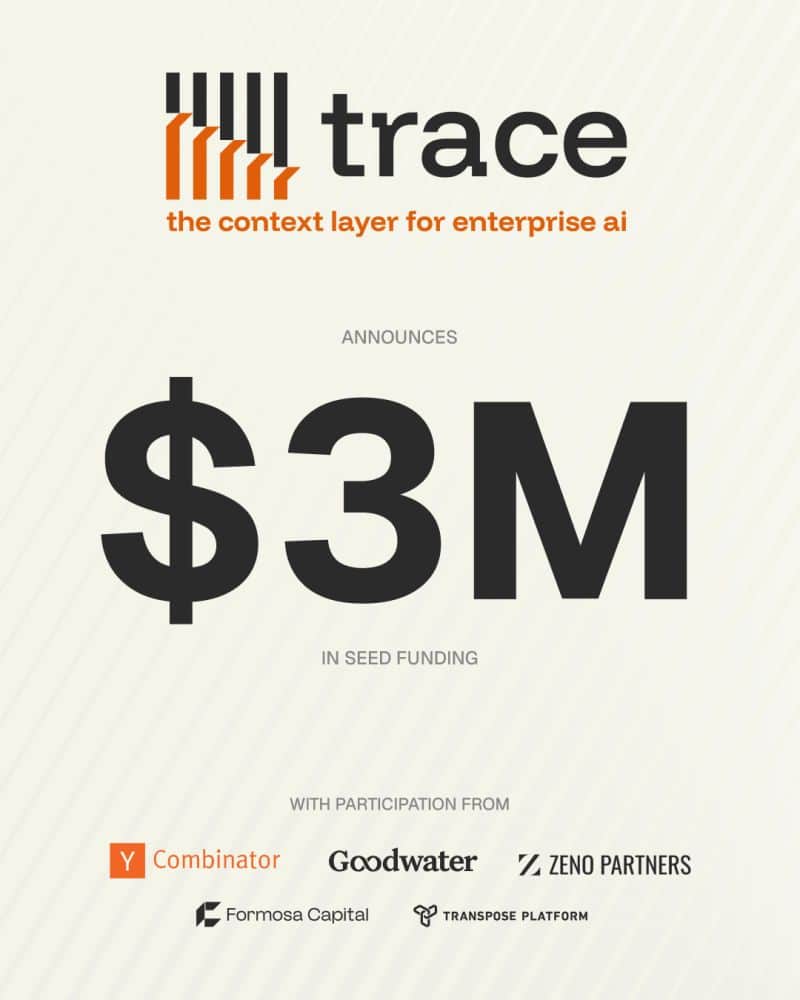
Trace, a London‑based startup that launched as part of Y Combinator's Summer 2025 cohort, was built to fix exactly this problem. On February 26, 2026, the company announced a $3 million seed round backed by Y Combinator, Zeno Ventures, Transpose Platform Management, Goodwater Capital, Formosa Capital, and WeFunder. The round is small relative to the mega‑deals dominating the March 2026 funding landscape. But the problem Trace is solving sits at the foundation of every AI adoption journey that matters.
Why AI Agents Keep Failing in the Enterprise
The core insight that motivated Trace's founding is this: AI agents from OpenAI, Anthropic, and every other foundation model provider are becoming genuinely capable. The tools work. But deploying them effectively inside a large organization requires something that no foundation model provider builds, and that most enterprise software vendors have not addressed: a deep, structured map of how the organization actually works.
Large companies are not simple environments. They have overlapping workflows built across dozens of software systems. They have legacy processes that exist for regulatory, historical, or organizational reasons that are not documented anywhere. They have implicit knowledge living in the heads of long‑tenured employees that has never been written down. And they have compliance requirements that constrain what can and cannot be automated in ways that are specific to their industry, geography, and internal policy.
AI agents dropped into this environment without context struggle. They complete simple, well‑defined tasks reasonably well. They fail at complex, context‑dependent workflows because they do not understand the organizational environment well enough to navigate it safely.
What Trace Builds
Trace's platform addresses this gap with a workflow orchestration system that maps corporate environments comprehensively before any agent is deployed. The company's CEO Tim Cherkasov described the approach in terms that any enterprise leader can understand: OpenAI and Anthropic are building brilliant interns that can be leveraged inside companies. Trace is building the manager that knows exactly where to put them.
The platform's core functions include:
- Organizational workflow mapping, which creates a structured representation of how work actually flows through an enterprise, across systems, teams, and processes, in a form that AI agents can reference and navigate.
- Process context injection, which provides agents with the organizational knowledge they need to complete complex tasks correctly, including which systems to query, which approvals to seek, and which constraints to respect.
- Agent orchestration and routing, which determines which agents should handle which tasks based on their capabilities and the requirements of each specific workflow.
- Deployment and monitoring infrastructure, which tracks agent performance across enterprise workflows and provides visibility into where agents are succeeding and where they need additional context or refinement.
The fundamental bet Trace is making is that AI agents will become the dominant way enterprises automate knowledge work, and that the bottleneck preventing this from happening at scale is not agent capability but organizational context. If that bet is correct, the company that solves the context problem becomes essential infrastructure for every enterprise AI deployment in the world.
Why Y Combinator Backed Trace
Y Combinator's decision to include Trace in its Summer 2025 batch and to back the seed round reflects the accelerator's assessment that enterprise AI adoption is one of the largest commercial problems in the current technology landscape.
The data supports that assessment. Surveys of enterprise technology leaders consistently find that AI pilot programs fail to reach production deployment at high rates. The most commonly cited reason is not that the AI is not capable enough. It is that integrating AI into existing enterprise workflows is more complex than anticipated, and that the tools currently available do not adequately bridge between AI capability and organizational reality.
Trace is a direct solution to that specific, documented problem. At $3 million in seed funding, the company is at the very beginning of what could become a substantial commercial journey if the thesis plays out.
The Bigger Picture for Enterprise AI Adoption
Trace's raise is representative of a category of seed‑stage companies that are building the connective tissue between AI model providers and enterprise deployments. These companies are not competing with OpenAI or Anthropic. They are building the layer between foundation models and enterprise operations that makes foundation models commercially useful at scale.
Other companies in this adjacent category include:
- Agent orchestration platforms building scheduling and routing infrastructure for multi‑agent systems.
- Enterprise AI governance tools providing oversight, logging, and compliance frameworks for AI deployments in regulated industries.
- Knowledge graph startups building organizational memory systems that give AI agents persistent, queryable representations of enterprise knowledge.
- Integration platform startups connecting AI agents to the hundreds of software systems that large enterprises operate simultaneously.
The enterprise AI adoption gap that Trace is addressing is real, widely documented, and commercially significant. The $3 million seed round is the beginning. The market opportunity, if Trace's thesis proves correct, is orders of magnitude larger.
Stay informed
Startup news in your inbox
Get important funding rounds, founder stories, and startup updates.
No spam - only important startup updates.