The Physicist Who Said Canada's Quantum Moment Cannot Go the Way of AI Just Raised $200 Million
Editorial Team
Canada produced a disproportionate share of the researchers who created the theoretical foundations for modern AI. Geoffrey Hinton trained at the University of Toronto. Yoshua Bengio runs his lab at the Université de Montréal. Yann LeCun spent foundational years in Canadian institutions before building his career in the United States. The commercial value from their collective work accrued almost entirely to American companies: Google, Meta, and OpenAI captured the AI era's economic upside while Canadian institutions and investors largely watched from the sidelines.
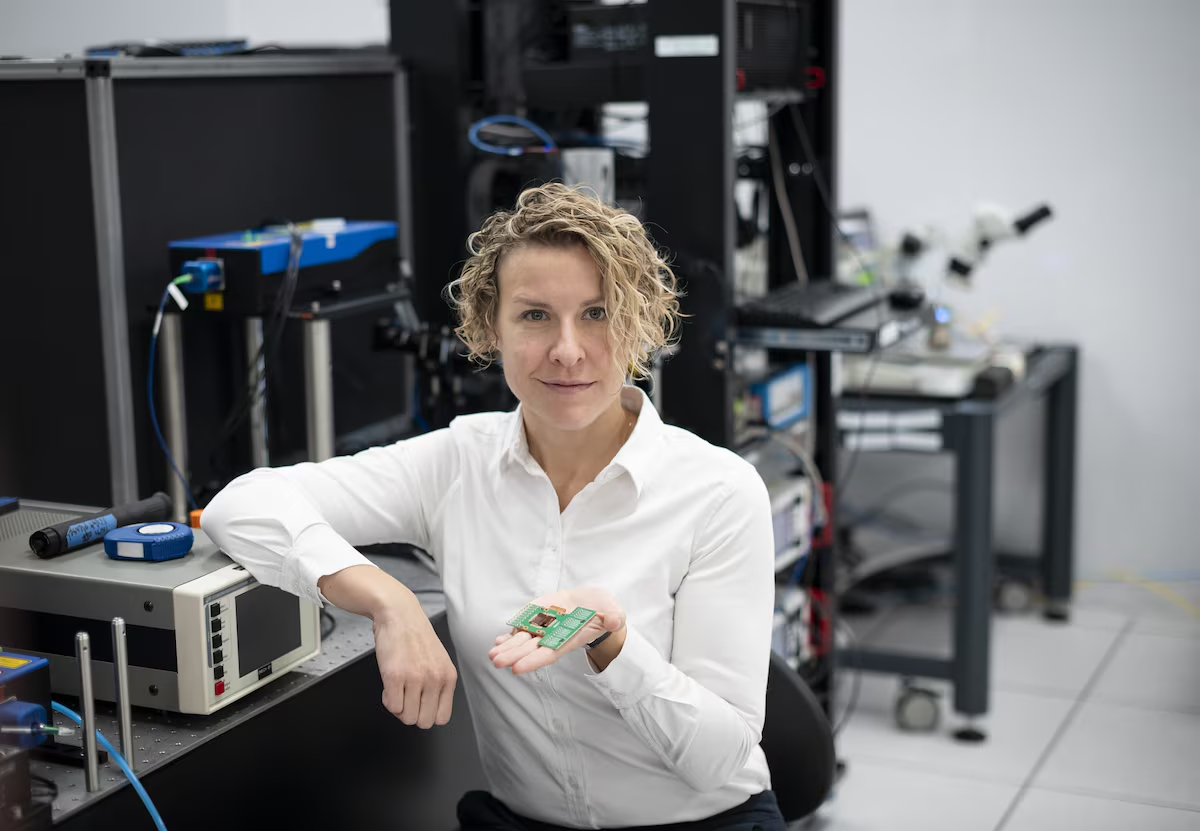
Dr. Stephanie Simmons has decided this will not happen with quantum computing.
The founder and Chief Quantum Officer of Photonic, the Vancouver‑based distributed quantum computing company she built from her research at Simon Fraser University, put the stakes plainly in an interview published alongside the company's latest funding announcement: "Canadians are learning quickly from the AI experience. This is our spot and if we play it right it won't go the way of AI. I think there has been an awakening, and I'm grateful because right now is where the market is made, it's not after the ChatGPT moment."
On May 12, 2026, Photonic announced the final close of more than $200 million USD in its latest funding round, giving the company a post‑money valuation of $2 billion USD, or $2.7 billion CAD. The round was led by Planet First Partners, a UK‑based sustainable technology growth equity firm. It brings Photonic's total capital raised to over $350 million USD since founding, with Canadian investors providing more than half of the capital in the latest round and now owning more than half of the company.
New investors in the final close include the Business Development Bank of Canada via its StrongNorth Fund, Export Development Canada, Bell Ventures, Firgun Ventures, and InBC Investment Corp., alongside returning investor Mubadala Capital. The round's first close in January 2026 had attracted Royal Bank of Canada and TELUS as strategic investors, alongside returning backers British Columbia Investment Management Corporation and Microsoft.
The constellation of investors across this single funding round is itself a statement about how Canada has recalibrated its relationship with strategic technology development. Government‑backed capital, major national financial institutions, telecommunications infrastructure providers, and one of the world's largest technology companies are all simultaneously backing the same quantum computing platform. That combination of institutional actors does not happen by accident.
What Photonic Has Actually Built
The technical approach that Photonic has developed is distinct from every other major quantum computing platform in commercially important ways. Most quantum computers today face a version of the same fundamental problem: the qubits that perform quantum computations are extremely fragile. They decohere, meaning they lose their quantum states, within microseconds if not carefully isolated from thermal noise, vibration, and electromagnetic interference. This fragility is why most quantum computers must operate at temperatures near absolute zero in carefully shielded chambers. It is also why scaling quantum computers to the millions of qubits required for practical applications has proven so difficult: each qubit added to the system introduces new sources of decoherence that compound as the system grows.
Photonic's approach addresses this by using a specific type of qubit, the silicon spin qubit, that has native compatibility with photons, particles of light. The company's Entanglement First architecture uses optically‑linked silicon spin qubits: the qubits themselves are realized in silicon, which provides the high coherence times and CMOS manufacturing compatibility that make them practical, and they are connected to each other using photons traveling through optical fiber.
This photonic connectivity is the architectural choice that changes the entire commercial picture. Optical fiber is what the world's telecommunications infrastructure is built on. Data centers are already connected by fiber. Cloud networks are fiber‑connected. Instead of requiring a custom, exotic interconnect that only works inside a single refrigerated chamber, Photonic's qubits can communicate with each other over existing fiber infrastructure. This means a quantum computer built on Photonic's architecture is not constrained to the number of qubits that can fit inside one cryogenic system. It can be distributed across multiple connected nodes, growing in computational power as nodes are added to the network.
Tim Terry, Photonic's CEO, said in January that this round was expected to be the last financing the firm required to become cash‑flow positive. The commercial plan is to sell quantum computing access to corporations and, eventually, governments.
The external validation of Photonic's approach reflects both the technical quality of the underlying research and the company's execution. Photonic has advanced to Stage B of DARPA's Quantum Benchmarking Initiative, the US Defense Advanced Research Projects Agency's rigorous validation program aimed at determining whether a quantum approach can achieve "utility‑scale" operation, where computational value exceeds cost, by 2033. Stage B represents a significant milestone in a program designed to be highly selective, confirming that DARPA's technical evaluators have assessed Photonic's approach as among the most promising candidates for practical utility.
The company employs more than 160 people across Canada, the United States, and the United Kingdom, and is also a key participant in the Canadian Quantum Champions Program, receiving up to $23 million to anchor high‑value intellectual property and talent in British Columbia.
Simmons's framing of the commercial moment is precise and historically informed: "Imagine, in 2018, you could have predicted with accuracy the ChatGPT moment. That's what's happening inside the quantum space." The comparison captures why the timing of this fundraise matters beyond the individual company. The ChatGPT moment arrived years after the foundational research that enabled it was complete. For quantum computing, the foundational research is now meeting the manufacturing and engineering capability required to build commercial systems. The companies that establish commercial positions in this window, rather than waiting for the equivalent of a public ChatGPT launch, will capture disproportionate value from what follows.
More at photonic.com
Stay informed
Startup news in your inbox
Get important funding rounds, founder stories, and startup updates.
No spam - only important startup updates.