Startup News Today May 8, 2026: Ramp Eyes $40B, Lime Files IPO With Going-Concern Warning, Pit Exits Stealth With a16z Backing
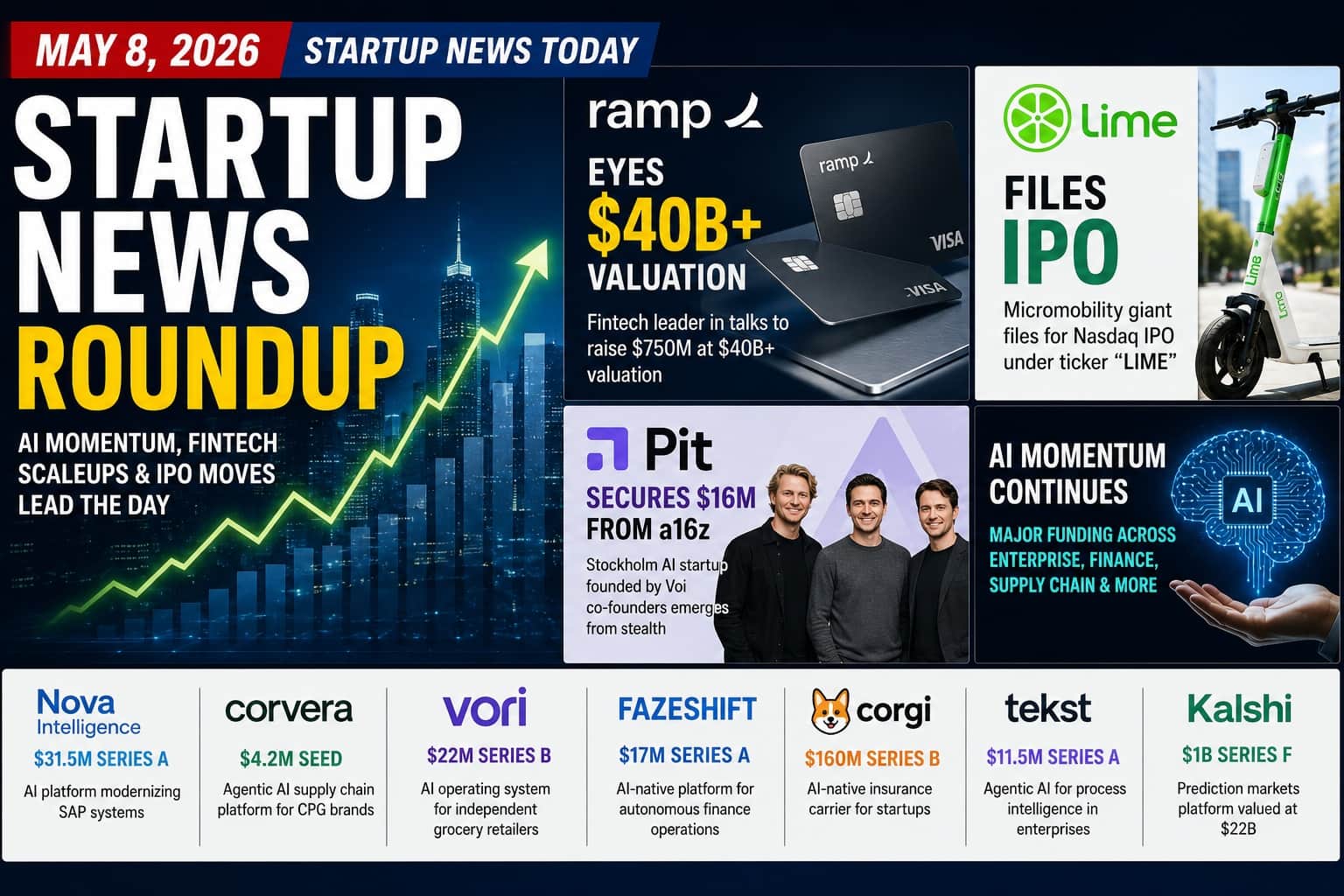
Three stories define this morning's startup landscape: a corporate spend management company targeting a $40 billion valuation six months after reaching $32 billion, a micromobility giant filing for a Nasdaq IPO while disclosing it cannot pay its debt without the proceeds, and a Stockholm AI startup founded by European scooter veterans that a16z backed without even seeing a competing term sheet. Below those three, a dense layer of agentic AI companies raised meaningful capital across finance, grocery, insurance, and enterprise operations. The theme connecting all of them is the same one that has been building since January: AI is no longer an experiment at the enterprise level. It is the operating system.
The Headline Story: Ramp Is Worth $40 Billion and Has Not Peaked
Ramp is in talks to raise $750 million at a pre‑money valuation of more than $40 billion, sources told The Wall Street Journal. The deal is not yet final and terms could change. The round would be co‑led by existing backers GIC and Iconiq Capital, and would mark a massive jump from its $32 billion valuation in November 2025.
The trajectory that produced this valuation is worth stating clearly. In November, Ramp raised $300 million at a $32 billion post‑money valuation led by Lightspeed. In July, it raised a $500 million Series E‑2 at a $22.5 billion valuation led by Iconiq, just a few weeks after its $200 million Series E at a $16 billion valuation led by Founders Fund. That is a progression from $16 billion to $40 billion in approximately 12 months, driven by a company that is genuinely generating revenue rather than speculative enthusiasm.
The spend management platform crossed $1 billion in annualized revenue in 2025, with CEO Eric Glyman confirming revenue had doubled year over year. With $3 billion in total equity raised across multiple rounds and a customer base exceeding 50,000 companies, Ramp sits in a position where the $40 billion valuation reflects a revenue multiple that is aggressive but not irrational for a company growing at this pace in a category with this much remaining market.
The competitive context matters. Brex, once valued at $12.3 billion, was acquired by Capital One in January 2026 for $5.15 billion. Ramp's survival and ascent while a major competitor exited the independent market reflects both product quality and the specific timing advantage of being AI‑native from the start rather than retrofitting AI onto a traditional expense management foundation. Ramp has told investors it plans to be IPO‑ready by the end of 2026, though no formal filing has been announced.
The $750 million, if closed at these terms, would fund continued expansion of Ramp's AI automation tools and its push into larger enterprise clients beyond the mid‑market base where it built its current revenue. The implicit message to the market is that Ramp has 98 percent of its total addressable market still ahead of it.
The IPO That Should Not Be Ignored — and Its Critical Warning
After years of hints and preparation, the Uber‑backed electric bike and scooter rental startup Lime has filed for an initial public offering. The company, incorporated as Neutron Holdings, Inc., intends to list on Nasdaq under the ticker symbol "LIME." Goldman Sachs and JPMorgan are leading the syndicate. Pricing terms, share count, and target valuation were not disclosed in the initial filing.
The financial profile in the S‑1 is not uniformly positive. Lime posted a 29% rise in revenue to $886.7 million and a loss of $59.3 million in 2025. Revenue growth and narrowing losses would normally be an encouraging picture. But buried deeper in the filing is a disclosure that every potential investor must reckon with directly.
Lime reported around $1 billion in current liabilities. Roughly $846 million of that is due 12 months from now. About $675.8 million is due by the end of 2026. The company wrote that it does not have "sufficient liquidity" to pay that. Lime reported having $261 million in cash on March 31, 2026. As a result, the company warned investors it has "substantial doubt" that it can continue as a going concern without IPO proceeds or alternative financing.
To understand why this is not necessarily fatal context, consider the operating metrics. Lime operates in roughly 230 cities across 29 countries. Average Monthly Active Users reached approximately 3.8 million in 2025. The average operational fleet stood at 325,137 vehicles. Revenue per vehicle per day reached $7.47. The company has recorded more than 705 million rides on its fourth‑generation vehicles as of year‑end 2025.
The business works. The debt structure does not. The IPO is the mechanism for resolving that imbalance, and the revenue profile gives Lime a credible case to make to public market investors. Whether $250 million in estimated IPO proceeds, per Renaissance Capital's analysis, is sufficient to resolve $846 million in near‑term obligations is the question that the roadshow will need to answer.
Renaissance Capital estimated the IPO could raise approximately $250 million. Lime's existing backers including Uber and Andreessen Horowitz, who each own more than 5% of the company, will be watching whether the public market agrees with that math.
Stockholm Produces Another a16z‑Backed AI Unicorn Candidate
Swedish startup Pit has become another Stockholm AI startup to watch. Pit is led by the co‑founders of European scooter giant Voi, including Voi CEO Fredrik Hjelm, and is backed by a16z, which is leading the startup's $16 million seed round.
The round includes participation from Lakestar and executives from OpenAI, Anthropic, Google, Deel, and Revolut, as well as the Stena and Lundin families.
Pit positions itself as an "AI product team as a service," enabling enterprises to build and run custom software tailored to their internal operations. Unlike traditional low‑code platforms or AI copilots, Pit delivers fully operational software systems rather than prototypes.
Adam Jafer, Pit's CEO, articulates the founding thesis directly: "For 20 years, enterprises have rented software that forces them to operate around it. With AI, that ends. For the first time, every company can run on systems they actually designed themselves."
The commercial evidence behind this seed round is unusually strong. Pit is already live across enterprise pilots in logistics, telecom, e‑commerce, and healthcare, including deployments with Voi, Tre, Stena Recycling, and Kry, with systems going live within days or weeks. Early results include an 85% reduction in campaign execution time, 10,000+ hours saved annually per deployment, and 99% invoice acceptance rates through automation.
Hjelm's account of how the a16z relationship formed confirms a dynamic worth noting for European founders seeking US institutional capital. He became acquainted with Ben Horowitz, Gabriel Vasquez, and Jen Kha "a few years ago when they came to Stockholm to understand what they could do for European tech. We stayed in touch. When it came to picking partners for Pit, we didn't need the money to get going, but we wanted the strongest backers we could find."
Stockholm, which also produced Lovable, is cementing its position as Europe's most concentrated source of a16z‑backed AI companies. Pit is the firm's latest bet that the European enterprise AI market will produce outcomes comparable to what it has backed in San Francisco.
The Enterprise AI Layer Continues to Attract Capital
Nova Intelligence: $31.5 Million to Modernize the SAP Stack
Nova Intelligence, the San Francisco‑based agentic AI platform that helps large enterprises modernize SAP systems, raised a $31.5 million Series A, bringing total funding above $40 million. The round was led by Chemistry, with participation from Accel, Conviction, and SAP.iO.
The SAP modernization market is large and chronically underserved by automation. Enterprise companies running SAP systems for ERP, finance, and supply chain typically carry decades of custom code, workflow integrations, and migration debt that conventional IT teams cannot address at the pace that business requirements demand. Nova Intelligence's AI agents automate the custom code analysis, workflow redesign, and migration validation that previously required large consulting engagements at multimillion‑dollar price points.
The SAP.iO participation is a direct commercial signal: SAP's own startup program backing an AI company that accelerates SAP modernization is the software equivalent of a channel partnership announcement embedded in a funding round.
Corvera: $4.2 Million to Put AI Agents Into Consumer Goods Supply Chains
YC‑backed Corvera raised $4.2 million in seed funding led by 6 Degrees Capital for its agentic AI supply chain platform targeting CPG brands. Consumer packaged goods supply chains involve a specific category of workflow fragmentation: demand signals, distributor orders, retail inventory reports, promotional calendars, and freight management each live in different systems, often managed by different teams using different tools. Corvera's agents connect these workflows, identifying gaps and executing routine coordination tasks that currently require human analyst time.
The Going‑Concern Details That Explain Lime's Urgency
Looking more closely at Lime's S‑1 reveals the specific mechanics of its debt situation. The company's current liabilities of approximately $1 billion are dominated by a senior secured term loan that Goldman Sachs is helping it refinance through the IPO. The $675.8 million due by year‑end represents the most time‑pressured obligation. Lime's $261 million cash balance as of March 31, 2026, covers roughly 39 cents of every dollar of debt due this year.
The revenue trajectory gives Lime a legitimate case to make to public market investors. Going from $686 million in 2024 revenue to $886.7 million in 2025, a 29 percent increase, while narrowing losses, describes a company on a path to profitability rather than one burning toward insolvency. The 3.8 million monthly active users and the 325,000‑vehicle operational fleet represent genuine consumer adoption that the debt structure does not erase.
What Lime needs is a public market that looks past the going‑concern disclosure and prices the revenue trajectory. Whether it gets that depends on the roadshow, the IPO pricing, and whether the equity market in June 2026 has the appetite for a consumer mobility story that has been waiting for its moment for nearly five years.
Other Notable Deals and Signals Today
Fazeshift $17M Series A
Fazeshift, whose full article appeared earlier this week, closed its $17 million Series A led by F‑Prime with Google Gradient, YC, and Wayfinder. The AI‑native accounts receivable platform grew revenue twelvefold in one year and now serves eight unicorn clients, including Snyk and Clipboard Health. The company collected $7.4 million in cash for one customer within weeks of deployment.
Corgi $160M Series B at $1.3 Billion
Corgi, the YC‑backed AI‑native insurance carrier for startups, announced its $160 million Series B led by TCV at a $1.3 billion valuation. The company closed its Series A at $630 million just four months ago and doubled its valuation through documented revenue growth and regulatory approval as a licensed insurance carrier. It is expanding from startup coverage into trucking next.
Vori $22M Series B
Vori, the AI grocery operating system, closed its $22 million Series B led by Cherryrock Capital with Greylock Partners. The platform processes payments, tracks inventory, places orders, and sets prices for 140‑plus independent grocery stores in 55‑plus cities. The company has processed $500 million in payments since launching in January 2024 and targets sevenfold growth in both 2026 and 2027.
Tekst $11.5M Series A — Belgium
Tekst, the Belgium‑based startup building agentic AI for process intelligence inside enterprises, raised $11.5 million in a Series A. The platform identifies inefficiencies in how enterprise teams actually work by analyzing communication patterns, escalation paths, and workflow bottlenecks, then deploys agents to address the highest‑impact gaps. The European enterprise AI market continues to generate material rounds below the headlines.
Kalshi at $22 Billion
Kalshi, the prediction market platform, has reportedly reached a $22 billion valuation following its $1 billion Series F close. The company operates regulated event contracts allowing users to bet on real‑world outcomes ranging from economic data releases to political events. Its growth reflects both the expanding commercial acceptance of prediction markets as an information aggregation tool and the growing institutional use of Kalshi's data for hedging and forecasting.
The Week's Pattern
The May 8, 2026 startup landscape confirms what the week's accumulating evidence has been describing. The AI market is not contracting, but it is bifurcating. At the top, companies with measurable enterprise revenue, Ramp with $1 billion ARR, Sierra with Fortune 500 penetration, Cursor with $2 billion ARR, are attracting capital at premiums that reward proven commercial velocity. In the middle, new entrants like Pit that arrive with customer deployments and documented results are accessing institutional capital from a16z at seed stage without competitive processes. At the bottom, companies without commercial traction are finding the market increasingly selective, as the fintech sector confirmed when Brex sold at a fraction of its peak valuation four months ago.
The IPO signal from Lime adds a fourth dimension. Public market windows are opening for companies with real revenue, even if their balance sheets carry legacy risk. The question that Lime's S‑1 poses to public market investors is the same one venture investors are asking: can you look past the structural complexity and price the trajectory? For the companies that have earned the right to ask that question, 2026's answer is increasingly yes.
Stay informed
Startup news in your inbox
Get important funding rounds, founder stories, and startup updates.
No spam - only important startup updates.