Weekly Startup Roundup May 10-17, 2026: Defense Broke Records, AI Went Into Orbit, and Cerebras Made IPO History
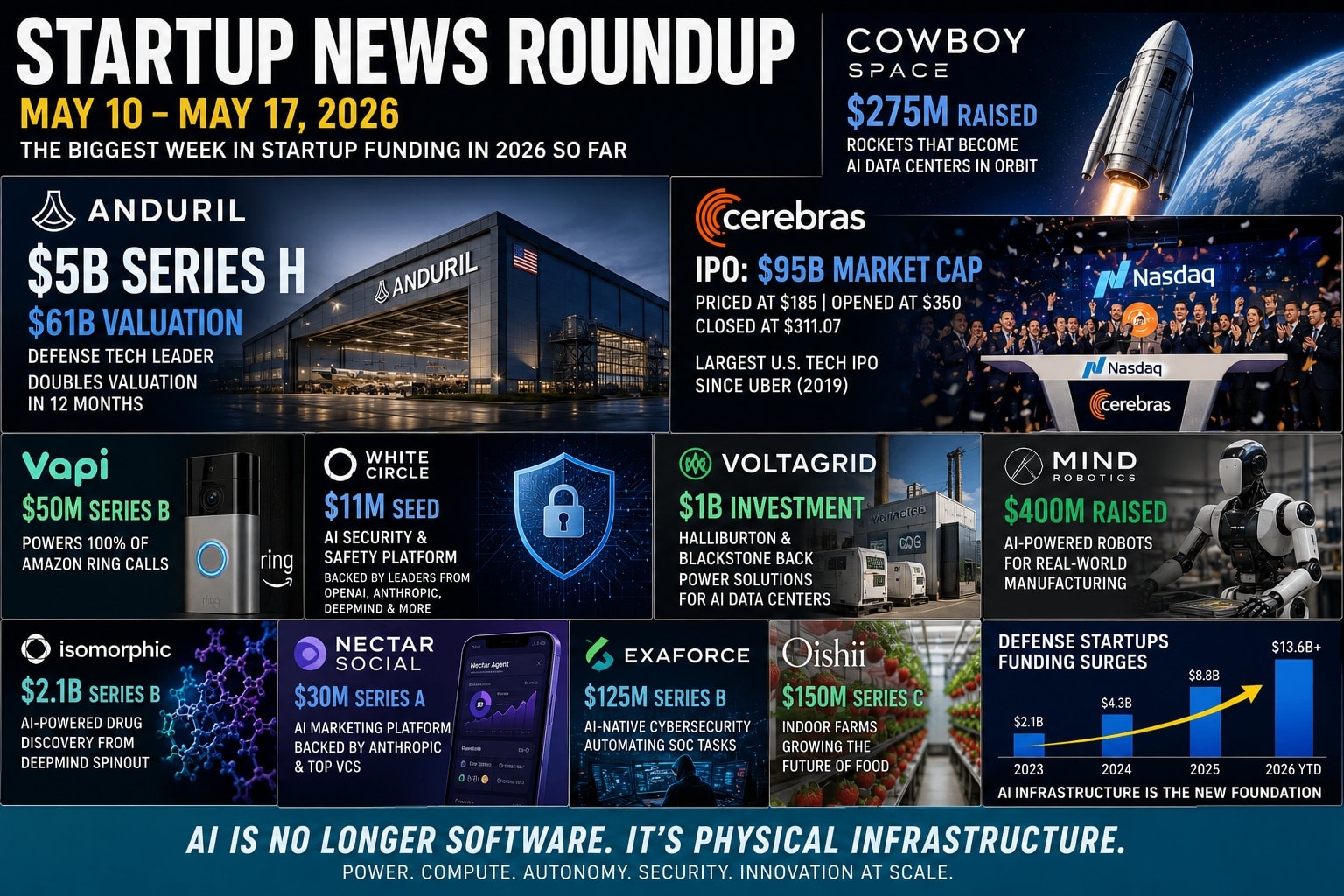
The week of May 10–17 was, by any defensible measure, the most consequential seven days for startup funding in 2026 to date. Defense startups broke every prior funding record. An AI chip company went public and added $95 billion in market cap on its first day of trading, triggering the IPO pipeline behind it. The co‑founder of Robinhood raised $275 million to put AI data centers in orbit. A $1 billion investment from Halliburton and Blackstone confirmed that energy for AI infrastructure is now institutional‑grade deal flow. And across all of this, the companies that most clearly reflect where durable enterprise AI value is being built in AI security, in marketing automation, in voice infrastructure, in sovereign cloud security each raised meaningful early‑stage rounds with investor coalitions that carry their own signals.
This is the complete record of what happened and what it means.
THE DEFINING STORY: ANDURIL DOUBLED ITS VALUATION AGAIN
Anduril Industries | $5 Billion Series H | $61 Billion Valuation
Anduril raised another $5 billion in a Series H led by Andreessen Horowitz and Thrive Capital at a $61 billion valuation, more than doubling from its $30.5 billion valuation less than twelve months ago. Total capital raised now exceeds $11.4 billion.
Revenue doubled in 2025 to $2.25 billion, driven by the Army's $20 billion 10‑year enterprise contract signed in March, the Golden Dome space interceptor program, and expanding Lattice AI deployments. Arsenal‑1, the Ohio manufacturing facility, spans more than five million square feet - one of the largest industrial facilities in the state.
According to Crunchbase, defense‑related startups had raised nearly $13.6 billion through mid‑May 2026, already on track to more than double 2025's record $8.8 billion. Anduril is not the only name in this story. Shield AI raised $1.5 billion at $12.7 billion in March for autonomous aircraft. Saronic raised $1.75 billion led by Kleiner Perkins for unmanned naval vessels. True Anomaly raised $650 million for orbital defense, appearing earlier this month on the Golden Dome prototype contractor list alongside Anduril itself.
Palmer Luckey, who founded Anduril in 2017 when most of Silicon Valley was deliberately avoiding the defense sector, said he would "definitely" take the company public. At $61 billion with real revenue, the IPO conversation is no longer speculative.
THE IPO OF THE WEEK: CEREBRAS WENT PUBLIC AND NEVER LOOKED BACK
Cerebras Systems | NASDAQ: CBRS | $95 Billion Market Cap
Cerebras priced at $185 per share, raised $5.55 billion in the largest US tech IPO since Uber in 2019, opened at $350, peaked intraday at $385, and closed at $311.07 on its first day of trading, Wednesday May 14. Market cap at close: approximately $95 billion.
Benchmark's stake is now worth $5.5 billion. Foundation Capital's is worth $4.8 billion. CEO Andrew Feldman became a billionaire at $3.2 billion; CTO Sean Lie at $1.7 billion. Arm and SoftBank reportedly tried to acquire Cerebras before the IPO; Cerebras declined.
The revenue story behind the debut: $510 million in 2025 revenue, up 76 percent year‑over‑year, with a 47 percent net margin. OpenAI accounts for 24 percent of that revenue through a $20 billion multi‑year compute agreement. At 187 times trailing revenue, the stock is priced for aggressive growth and the 20x oversubscription on the original offering before repricing from $115-$125 to $150-$160 confirmed the public market demand was there.
What Cerebras' debut means for the pipeline: SpaceX is reportedly targeting a June IPO at a $1.75 trillion valuation with BlackRock seeking a large stake. OpenAI and Anthropic are both in IPO preparation stages. Cerebras just provided investment bankers advising each of them with the most useful data point available: a September 2024 S‑1 filing to May 2026 trading is a journey of roughly 20 months, and at the end of it, a profitable AI hardware company with real enterprise customers priced at $95 billion and opened higher.
THE INFRASTRUCTURE STORY: AI DATA CENTERS NEED POWER AND THEY NEED IT NOW
VoltaGrid | $775M Capital + $225M Secondary = $1B Total | Halliburton + Blackstone
The gap between when a data center is ready to operate and when utility power arrives at the site is creating a commercial opportunity that two of the world's largest energy and infrastructure investors have now officially entered. Halliburton and Blackstone provided $1 billion in strategic investment to VoltaGrid, Houston's mobile natural gas generator and microgrid company, specifically to address the AI data center power shortage.
The $775 million in capital funding plus $225 million secondary purchase of existing investor shares is one of the largest energy infrastructure deals of the week. For Halliburton, this is also a customer acquisition: VoltaGrid's generators consume natural gas at precisely the kinds of industrial sites where Halliburton's oilfield services are active.
GridCare | $64M Series A | Sutter Hill Ventures
Separately, GridCare raised $64 million from Sutter Hill Ventures to develop technology that makes power delivery to AI data centers more efficient once connected. While VoltaGrid solves the gap before grid connection, GridCare addresses the efficiency of power delivery after connection. Both are addressing the same root constraint from different angles.
Star Catcher | $65M Series A | B Capital, Shield Capital, Cerberus
Star Catcher, which is building what it describes as the first power grid in space by beaming concentrated solar energy to satellites on demand, raised $65 million. The Jacksonville‑based startup was founded less than two years ago and is pursuing a complementary trajectory to Cowboy Space: where Cowboy wants to use power in orbit for compute, Star Catcher wants to supply power to existing satellites that are running low on energy.
THE ORBITAL STORY: COWBOY SPACE BUILT A ROCKET INTO ITS DATA CENTER
Cowboy Space Corporation (formerly Aetherflux) | $275M Series B | $2B Valuation | Index Ventures
Baiju Bhatt, who co‑founded Robinhood and spent the last two years building a space startup that kept pivoting, announced the most coherent version of his vision yet. Cowboy Space Corporation raised $275 million led by Index Ventures, added IVP, Blossom Capital, and SAIC as new investors, and disclosed plans to build rockets whose upper stages do not return to Earth but remain in orbit as one‑megawatt AI data centers housing ~800 GPUs.
The rocket‑as‑data‑center design eliminates the mass inefficiency of separate launch vehicle and satellite architectures. The NVIDIA Space‑1 Vera Rubin Modules will provide the compute; solar panels will provide the power; the rocket stage structure itself serves as a thermal radiator. A demonstration satellite launch aboard a SpaceX Falcon 9 is planned for later in 2026. The first proprietary rocket launch is targeted for late 2028.
Bhatt's summary of the market: "I see the demand for AI getting more and more acute, and I see the options on Earth getting more and more limited." With $365 million raised in total and one of the most technically ambitious product visions in the space industry, the question is execution, timeline, and whether Cowboy can hire and retain the rocket engineering talent required to deliver a first launch before the funding runway requires another raise.
THE PHYSICAL AI STORIES: ROBOTS AND AUTONOMY ATTRACTED SERIOUS CAPITAL
Mind Robotics | $400M | Kleiner Perkins Led | Total Funding: $1B+
Mind Robotics, the Rivian spinout founded in 2025 by RJ Scaringe's team, raised $400 million led by Kleiner Perkins to build AI‑enabled industrial robots for real manufacturing environments starting with Rivian's own factories. Total funding now exceeds $1 billion, validating Kleiner Partner Ilya Fushman's claim that Mind Robotics has "unique access to all the ingredients required to make general‑purpose robotics work in real‑world manufacturing." The week's TechCrunch analysis confirmed that RJ Scaringe has now raised more than $12.3 billion across Rivian, Mind Robotics, and Also.
HavocAI | $100M Series A | Providence, Rhode Island
HavocAI raised $100 million to provide tools for developing military and commercial‑grade autonomous systems across sea, air, and land environments. Total funding now stands at $200 million for the two‑year‑old company. The raise arrived in the same week as Anduril's $5 billion, confirming that the autonomous systems category is broad enough to support multiple well‑capitalized companies simultaneously.
THE AI SECURITY AND SAFETY STORIES
White Circle | $11M Seed | OpenAI/Anthropic/DeepMind Leaders
Paris‑based White Circle raised $11 million backed by Romain Huet (OpenAI), Dirk Kingma (Anthropic), Thomas Wolf (Hugging Face), François Chollet (Keras), Paige Bailey (DeepMind), and Olivier Pomel (Datadog). CEO Denis Shilov went viral in 2024 for jailbreaking every major AI model with one prompt. The company has already processed more than 1 billion API requests for customers including Lovable and two of the world's largest digital banks.
The KillBench study that White Circle published, running more than one million experiments across 15 AI models to document systematic biases in structured output contexts, is the most empirically grounded AI safety research associated with any seed‑stage company's funding announcement this year.
Exaforce | $125M Series B | $725M Valuation | HarbourVest, Peak XV, Khosla, Mayfield
Exaforce raised $125 million at a $725 million valuation for its AI‑native security operations platform. Its Exabots automate SOC tasks, reduce false positives by up to 90 percent, and enable natural language threat investigation described as "vibe hunting." Customers include Replit and Guardant Health, with 40‑50 enterprise customers expected by year‑end. The round positions Exaforce as one of the best‑capitalized AI‑native cybersecurity companies outside the public markets.
THE APPLICATION LAYER STORIES
Vapi | $50M Series B | $500M Valuation | Peak XV, M12, Kleiner, Bessemer
Vapi raised $50 million led by Peak XV Partners at a $500 million post‑money valuation. The voice AI infrastructure platform handles 100 percent of Amazon Ring's inbound calls after beating more than 40 competitors in a formal evaluation. Enterprise customers include Intuit and New York Life alongside 1 million developers on its self‑serve platform. ARR is in healthy eight figures. Peak XV's lead confirms that Southeast Asian capital is increasingly present in US‑founded infrastructure plays with demonstrated enterprise traction.
Nectar Social | $30M Series A | Menlo Ventures Anthology Fund + Anthropic
Nectar Social raised $30 million led by Menlo Ventures' Anthology Fund, created in partnership with Anthropic, with participation from GV, True Ventures, and Gwyneth Paltrow's Kinship Ventures. Founded by ex‑Meta sisters Misbah and Farah Uraizee, who built Facebook Groups to 1 billion users and led News Feed, the company launched its Nectar Agent alongside the funding announcement. Customers include Liquid Death, e.l.f. Beauty, Figma, and 300‑plus Fortune 500 brands. Five official data partnerships spanning Meta, TikTok, LinkedIn, Reddit, and X give the platform a data depth that competitors building without first‑party API access cannot replicate.
THE BIOTECH AND AGTECH STORIES
Oishii | $150M Series C | SPARX Asset Management Led
Oishii, the New Jersey‑based operator of highly automated indoor farms growing strawberries, raised $150 million in a Series C led by Japan's SPARX Asset Management. The company has now raised $370 million total since 2016, building vertical farms that combine Japanese agricultural science with controlled‑environment automation.
Create Medicines | $122M Series B | Newpath, ARCH Venture, Hatteras
Create Medicines, a biotech focused on in vivo immunotherapies for autoimmune diseases and cancer, closed $122 million in a Series B. The approach, delivering therapeutic payloads directly to cells inside the body rather than extracting and modifying cells externally, represents a potentially more scalable path to cell therapy than ex vivo approaches that require individual manufacturing for each patient.
THE IPO PIPELINE AND WHAT COMES NEXT
Cerebras' $95 billion debut validates the market appetite for AI infrastructure companies at scale. The companies watching most closely from the pipeline:
SpaceX is reportedly targeting a June 2026 IPO at a $1.75 trillion valuation, with BlackRock in discussions about a significant anchor stake. The Golden Dome contracts and the Starship program provide the growth narrative.
OpenAI is in IPO preparation with Goldman Sachs and JPMorgan advising, targeting $400‑500 billion though secondary market prices have reached $1 trillion. The week's Weights.gg acquisition, reported Friday, removes one liability that could have complicated S‑1 review. The ChatGPT personal finance launch adds a new product revenue line.
Ramp confirmed it is IPO‑ready by year‑end. The $750 million raise at $40 billion‑plus remains in advanced talks.
Anthropic is exploring a public debut as early as late 2026 with a $400‑500 billion IPO target, having just crossed $1 trillion in secondary market pricing.
THE WEEK'S MACRO SIGNAL
The seven days from May 10 to May 17 produced one clear message that cuts across every category of deal reported above. AI is no longer a software story. It is a physical infrastructure story, and the physical infrastructure required to support it spans rockets, power generators, military weapons systems, industrial robots, orbital compute satellites, mobile microgrids, and on‑site power delivery systems.
The companies that are building toward that physical layer raised more capital this week than at any comparable period in venture capital history. Anduril is building autonomous weapons and software that ties them together. Cowboy Space is building rockets to carry AI data centers to orbit. VoltaGrid is providing the power that gets data centers operational before the grid arrives. Mind Robotics is building the robots that manufacture all of it. The application layer companies, Vapi, Nectar, White Circle, and dozens of others that raised this week, sit on top of this physical infrastructure and convert it into commercial software outcomes.
The question for the next twelve months is not whether this wave continues. The question is whether the physical infrastructure companies delivering the foundational capabilities, the power, the compute, the autonomy, the security, can execute on timelines that match the capital commitments they have received. Cerebras answered that question for AI hardware. Anduril is answering it for defense. The others are still building toward their moments of verification.
Stay informed
Startup news in your inbox
Get important funding rounds, founder stories, and startup updates.
No spam - only important startup updates.
Comments
Text only. No links or images.
No comments yet.