OpenAI Acquires Weights.gg 2026 | Celebrity Voice Cloning Startup Shutdown IPO Liability Analysis
Editorial Team
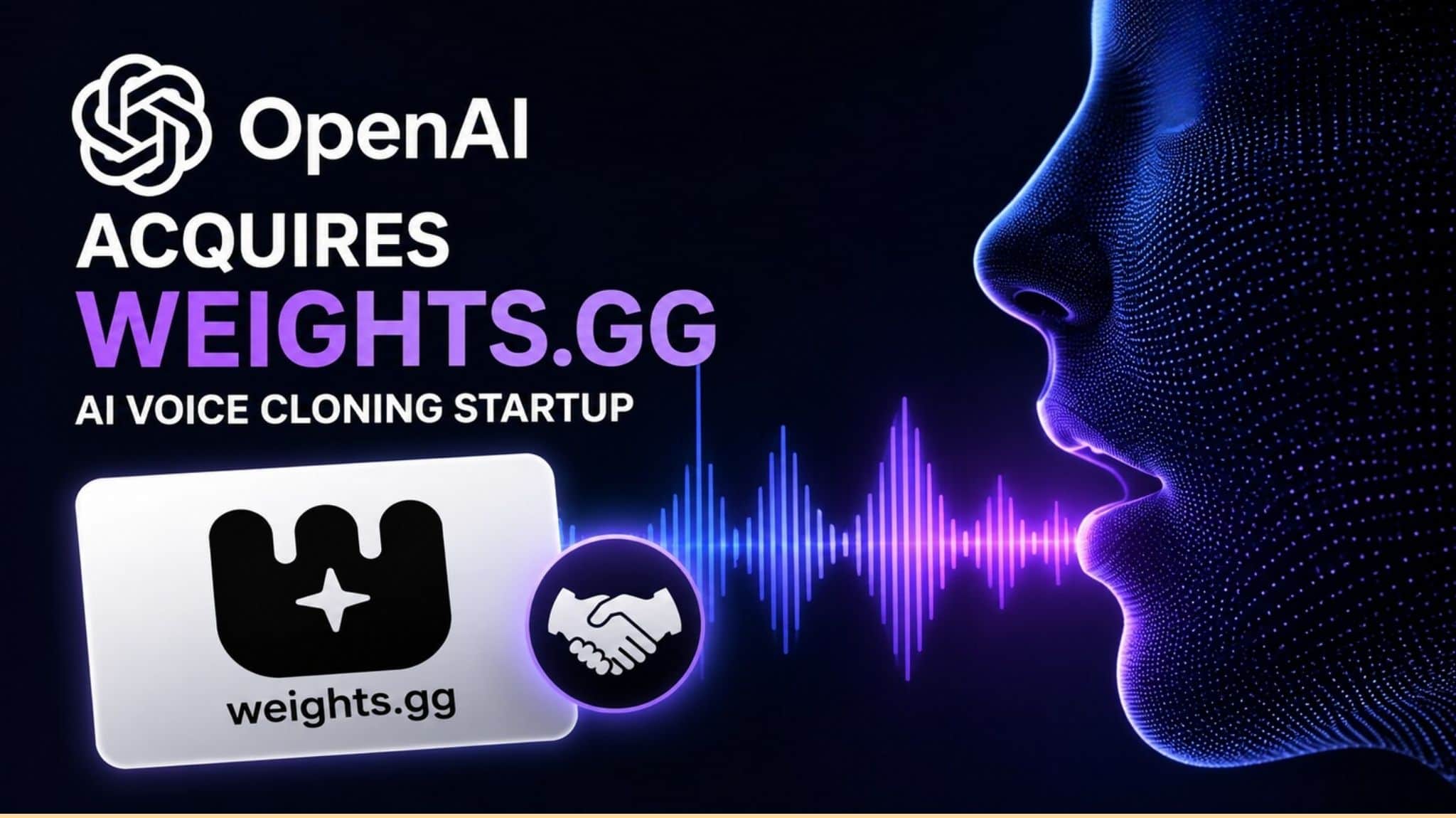
Most acquisitions are announced with a press release. OpenAI's acquisition of Weights.gg was announced by the startup's own website on April 1, 2026, in a brief message saying goodbye to its community. There was no OpenAI announcement. No disclosed price. No product roadmap for what would happen to the technology. The New York Times broke the story on May 15, 2026, citing two anonymous sources familiar with the transaction.
Weights.gg was a small startup, fewer than six employees, approximately $4 million in venture capital raised, and a product that was best described as a social network for creating and sharing AI algorithms. Its most notable feature was the Replay catalog, which hosted a large collection of user‑generated AI voice models, many of which replicated the voices of celebrities and public figures without any authorization from the individuals whose voices were being cloned.
The catalog included voice models for Taylor Swift, Samuel L. Jackson, Kanye West, members of K‑pop group Blackpink, Donald Trump, Joseph Biden, and dozens of other named figures. Bugs Bunny was in there. So was a voice model from the Harry Potter universe. Users could generate audio using these models, creating content that sounded like celebrities saying things they had never said.
OpenAI doesn't plan to release a product similar to Weights.gg, according to the sources who spoke to the NYT. The team that was acquired has been dispersed across different groups within OpenAI.
That sentence, combined with everything else known about the transaction, has led multiple analysts to a specific interpretation: this was not an acqui‑hire for talent or a technology acquisition for capabilities OpenAI lacked. It was a removal operation.
What OpenAI Already Has and Why It Did Not Need Weights.gg
OpenAI's Voice Engine, the company's own voice cloning system that can replicate a person's voice from as few as 15 seconds of audio, was demonstrated publicly in 2024 but has remained in what the company describes as a limited preview with API access restricted to a small group of vetted partners. The reason for the restriction is precisely the risk that Weights.gg embodied in fully public form: the same technology that enables powerful creative and assistive applications also enables the unauthorized reproduction of any person's voice, including celebrities who have not consented to digital reproduction.
The competitive landscape for voice cloning in 2026 is dense. ElevenLabs, which crossed $500 million in ARR this week and counts BlackRock and Deutsche Telekom among its investors, has professional voice cloning with consent frameworks built into its API. xAI shipped Custom Voices in May 2026 from reference clips of up to 120 seconds. Open‑weight models like Voxtral and SWivid's F5‑TTS can clone a voice from short reference clips on consumer hardware, without any centralized control or removal mechanism.
OpenAI did not need Weights.gg for its voice cloning capability. It had already built its own.
The IPO Timeline That Explains the Timing
OpenAI is targeting a public listing by the end of 2026, per reporting by The New York Times's own April 2026 investigation. Goldman Sachs and JPMorgan are reportedly advising. A realistic IPO valuation target based on current secondary market pricing would be between $400 billion and $500 billion, though secondary prices have reached $1 trillion.
Any company preparing for a public offering goes through a process of liability reduction in the months before the S‑1 filing. Securities lawyers, investment bankers, and company counsel look for anything that could become a legal or reputational problem during the IPO process and either resolve it or disclose it. An active, publicly accessible catalog of unauthorized celebrity voice clones, operated by a company that had received funding from investors and was therefore traceable, is exactly the kind of liability that an IPO preparation process would flag.
As one analyst summarized it: What OpenAI bought, by all available evidence, was the removal of a public catalog of unauthorized celebrity voices, ahead of an expected S‑1.
The legal exposure is specific. Multiple states and the federal government have considered or passed legislation creating rights of publicity for AI‑generated content using a person's voice or likeness without consent. California's AB 2602 established posthumous likeness rights for performers. The NO FAKES Act, introduced federally, would create federal liability for unauthorized AI replicas. A publicly accessible catalog of named celebrity voice models, maintained by a company with a known investment history, creates a documented chain of potential liability that goes beyond the abstract.
The price OpenAI paid has not been disclosed, and given the six‑person team and $4 million in prior funding, the total consideration was almost certainly modest relative to OpenAI's capital position. Buying the intellectual property, closing the public catalog, and dispersing the team across internal groups eliminates a public embarrassment at a cost that rounds to zero on OpenAI's balance sheet.
Whether the Weights.gg acquisition is more accurately described as a talent acquisition, a technology acquisition, or a liability clearance operation, the outcome is the same: a publicly accessible catalog of unauthorized celebrity voice models is gone, and the team that built it is now working inside the company most likely to be scrutinized for AI deepfake risks in the largest technology IPO of 2026 or 2027.
Stay informed
Startup news in your inbox
Get important funding rounds, founder stories, and startup updates.
No spam - only important startup updates.