Deccan AI Raises $25 Million to Power AI Post-Training From India: The Startup That Is 10x in One Year
Editorial Team
Every AI model that reaches the public has been through two phases of development. The first is pre‑training, where a foundation model is trained on enormous datasets to build its baseline capabilities. The second is post‑training, where that raw capability is refined, evaluated, corrected, and aligned with the specific outputs that make a model useful, trustworthy, and safe for real‑world deployment. Post‑training is less visible than pre‑training, generates fewer headlines than foundation model launches, and is substantially harder to execute than most people outside the AI industry understand.
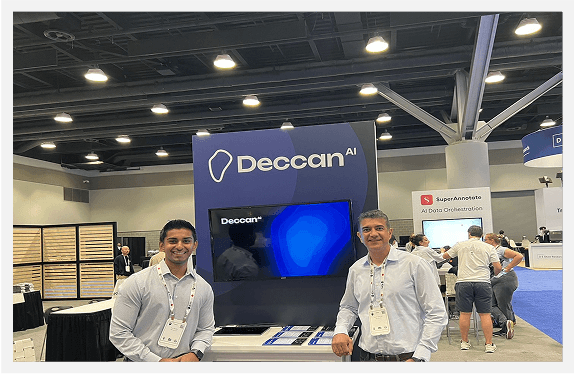
It is also the category that Deccan AI has built its entire business around. On March 25, 2026, the San Francisco‑headquartered startup with its primary workforce in India announced a $25 million Series A funding round, its first major institutional financing since founding. The round was led by A91 Partners, with participation from Susquehanna International Group and Prosus Ventures. The capital reflects investor conviction in a company that grew its revenue tenfold in the past twelve months and is now at a double‑digit million‑dollar annual run rate, serving some of the largest AI labs in the world.
What Deccan AI Does and Why It Matters
Deccan AI was founded in October 2024 by Rukesh Reddy, who previously built and sold companies in the data and outsourcing space before turning his attention to the specific problem of AI post‑training. The company provides three interconnected services to frontier AI laboratories.
The first is post‑training data generation, where Deccan's contributor network creates the high‑quality human‑generated data that AI labs use to improve model behavior in specific domains. This includes generating examples of correct responses, identifying failure modes, and creating the diverse, accurate, domain‑specific datasets that reinforcement learning processes require.
The second is model evaluation, where Deccan contributors test AI models against complex, expert‑level prompts designed to expose weaknesses in reasoning, factual accuracy, and domain‑specific knowledge. These are not simple quality‑assurance tests. They are adversarial evaluations conducted by people with advanced domain expertise, including masters and PhD holders, who understand enough about a subject area to construct questions that will expose genuine model limitations.
The third is agent capability training, where Deccan helps AI labs teach their models to interact reliably with external systems including APIs, software tools, and multi‑step workflows. As AI agents become increasingly central to enterprise deployment, the training data required to make them reliable in complex, real‑world tool interactions has become a distinct and growing product category.
Reddy has been direct about the commercial stakes of this work. Tolerance for errors in post‑training is close to zero, he said, because mistakes at this stage directly affect model performance in production. A factual error in a pre‑training dataset is diluted across billions of training tokens. A factual error in a post‑training evaluation dataset goes directly into the feedback loop that shapes model behavior. The difference in consequence is not incremental. It is categorical.
The India‑First Strategy That Is Driving Quality
Where most of Deccan's competitors in the AI training services market operate across 100 or more countries, Deccan has made a deliberate choice to concentrate its contributor workforce in India. Reddy's reasoning is straightforward and commercially significant: when you operate in just one country, quality management becomes dramatically simpler.
Managing a geographically dispersed workforce of thousands of contractors across dozens of countries simultaneously, each operating under different labour laws, different communication norms, different educational systems, and different interpretations of quality standards, introduces coordination costs and quality variance that compound at scale. Deccan has decided that the competitive advantage of focus outweighs the addressable workforce advantages of global distribution.
India's position in the global AI training value chain is substantial and growing. The country's large population of engineers, scientists, and domain experts in technical fields, combined with its deep penetration of English‑language higher education, makes it a uniquely capable talent pool for the kind of expert‑level AI training work that Deccan specializes in. Approximately 10 percent of Deccan's active contributor base holds masters or PhD degrees, with the share rising significantly for specific project types requiring domain expertise in areas including law, medicine, mathematics, physics, and software engineering.
The company has begun selectively expanding beyond India for niche expertise that is not sufficiently available domestically, specifically in geospatial data analysis and semiconductor design, two highly specialized technical domains where the US talent pool has advantages that Deccan's India‑first strategy cannot fully address. But the core operational model remains India‑centered, and Reddy has been clear that this is a quality decision, not a cost decision.
That clarity matters. The AI training market has a history of cost‑optimization leading to quality degradation, and the downstream effects of low‑quality training data on model performance are severe. Deccan is positioning itself specifically against that pattern, arguing that focused quality management in a single high‑capacity market is the correct tradeoff for a company serving clients whose products are used by hundreds of millions of people.
The Competitive Landscape and What $25 Million Changes
Deccan operates in a market defined by well‑capitalized, rapidly growing incumbents. Scale AI, which Meta acquired a 49 percent stake in for over $14 billion in 2025, remains the largest player in AI data services globally. Turing, Mercor, Surge AI, and CloudFactory all compete in adjacent areas of the AI training and evaluation market. Mercor alone has raised $492 million across four rounds, most recently closing a $350 million Series C in October 2025.
Deccan's competitive differentiation is not scale. It is focus. The company is not trying to be Scale AI. It is building a specialized post‑training platform with superior quality for a specific subset of the most demanding customers in the market, the frontier AI labs whose model quality sets the standard for every downstream application.
The revenue concentration confirms this positioning. Approximately 80 percent of Deccan's revenue comes from its top five customers, a figure that reflects both the concentrated nature of the frontier AI market and Deccan's deliberate choice to build deep relationships with a small number of high‑value clients rather than distributing across a broad, lower‑commitment customer base.
The $25 million from A91 Partners, Susquehanna, and Prosus Ventures funds three immediate priorities. First, engineering investment in the platform infrastructure that manages contributor workflows, quality scoring, and project delivery at scale. Second, contributor network expansion within India, including specialist recruitment in domains including law, finance, medicine, and advanced science. Third, business development capacity to expand Deccan's customer base beyond its current five‑customer concentration, reducing revenue risk while maintaining the quality standards that its existing clients have come to depend on.
India has been discussed as a potential AI superpower for years. Deccan AI's trajectory, tenfold revenue growth in twelve months, $25 million from institutional investors with global reach, and deep relationships with the labs building the world's most capable AI systems, is one of the clearest live examples of that potential being realized. Not at the frontier model level, which remains concentrated in the United States and China, but at the equally essential layer of post‑training infrastructure that makes frontier models worth using.
Stay informed
Startup news in your inbox
Get important funding rounds, founder stories, and startup updates.
No spam - only important startup updates.