Alibaba Cloud Unveiled Its Full Bet on the Agentic Era in Singapore. The Model That Drives It Runs for 35 Hours Without Stopping.
Most technology companies announce one significant product at a time and let the news cycle absorb it before moving to the next announcement. Alibaba Cloud's approach in Singapore this month was categorically different: a simultaneous, coordinated upgrade across every layer of its AI stack - foundation models, enterprise platforms, AI chips, and cloud infrastructure - positioned explicitly around a single strategic thesis: the agentic era has arrived, and Alibaba Cloud intends to be the full‑stack provider that runs it.
At the Alibaba Cloud Summit held in Singapore, the company unveiled what it describes as a comprehensive full‑stack AI upgrade spanning cloud infrastructure and model services, AI chips, and foundation models. The announcement covers four distinct product areas that together describe Alibaba's commercial positioning as the AI market transitions from assistive tools toward autonomous agents capable of executing complex tasks with minimal human oversight.
Qwen 3.7‑Max: The Foundation Model Built Around Sustained Autonomous Work
The centerpiece of the announcement is Qwen 3.7‑Max, Alibaba's latest large language model, engineered for advanced agentic coding, complex reasoning, and long‑horizon task execution.
The specifications that distinguish Qwen 3.7‑Max from the model generation it succeeds are specific and commercially relevant. The model can autonomously execute long‑horizon agentic tasks — sustaining continuous operation for up to 35 hours and managing over 1,000 tool calls without performance degradation. That combination, sustained operation measured in days rather than minutes and tool call capacity measured in thousands, describes a model designed for the kind of extended autonomous workflow execution that enterprise AI deployments actually require rather than the short‑burst interactions that most current AI tools are optimised for.
As a frontier‑level coding assistant, it supports coding tasks from rapid frontend prototyping to complex, multi‑file software engineering. To enhance office work productivity, it reliably orchestrates multi‑agent workflows to tackle sophisticated operations.
The benchmarking profile Alibaba claims positions Qwen 3.7‑Max as competitive with leading frontier models across coding, general‑purpose agents, general capabilities, and multilingualism. The multilingual dimension is commercially significant for Alibaba's international customer base: a model that performs well in non‑English languages covers the Southeast Asian, South Asian, and Middle Eastern enterprise markets that Singapore serves as a gateway to more effectively than English‑first models.
Deeply optimized for leading agent frameworks including OpenClaw, Hermes Agent, Claude Code, Qwen Paw and Qoder, it serves as a reliable backbone for different agent systems. The explicit compatibility with Claude Code is an interesting signal: rather than positioning Qwen as a replacement for Anthropic's tooling, Alibaba is framing it as infrastructure that works alongside and underneath other AI systems, an architectural bet on open interoperability over closed ecosystems.
Qwen 3.7‑Max will be made accessible through Alibaba's Model Studio platform for global developers and enterprises.
Wukong: The Enterprise Platform Where the Agents Live
The model capability is only useful if enterprises can deploy it into their actual workflows. Wukong, the AI‑native enterprise platform that Alibaba Group unveiled earlier this year in Singapore, is the commercial layer that connects Qwen's model capability to business operations.
The platform can coordinate multiple agents to handle complex tasks within a single interface, and is built on enterprise‑grade security infrastructure, positioning it as a productivity tool purpose‑built for the demands of business environments. The launch follows Alibaba Group's reorganisation under the newly established Alibaba Token Hub (ATH) Business Group. As the flagship enterprise AI platform developed by the Wukong Business Unit under ATH, the launch signals a company‑wide commitment to advancing AI agents for the enterprise market.
Wukong's multi‑agent coordination architecture addresses the specific challenge that makes enterprise AI deployment genuinely difficult rather than just technically complex: tasks that matter commercially rarely fit within the capability boundary of a single AI agent. A procurement workflow involves approval chains, supplier database lookups, contract analysis, and budget system updates — each requiring different data access, different reasoning patterns, and different output formats. Wukong's design allows these multi‑step, multi‑system tasks to be executed by coordinated agent networks under a single orchestration interface rather than requiring separate AI tools for each component.
The latest Qwen3.6‑Plus model will be integrated into Alibaba's ecosystem, including Wukong, an AI‑native enterprise platform that automates complex business tasks using multiple AI agents, and Qwen App, Alibaba's flagship AI application.
Panjiu AL128 Supernode: The Hardware That Makes Scale Possible
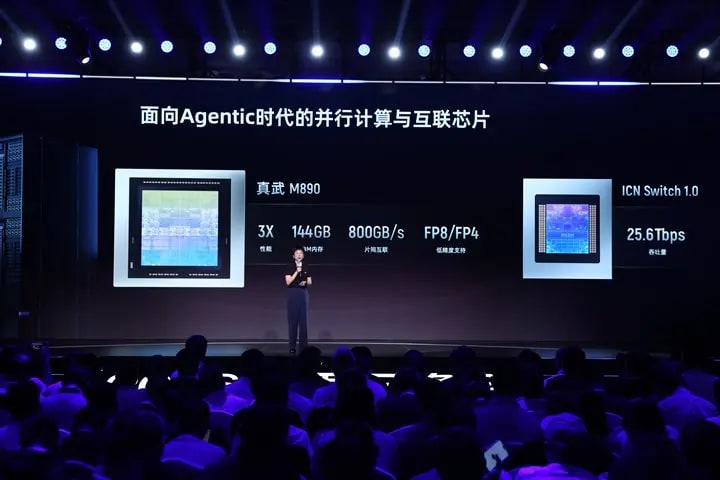
The third component of the announcement is the infrastructure layer that determines whether the model and platform capabilities are commercially viable at enterprise scale rather than only in controlled demos. To empower scalable AI Agent inference and large‑scale model training, Alibaba Cloud has launched the Panjiu AL128 Supernode Server, powered by the Zhenwu M890 AI processor and ICN Switch 1.0 networking chip.
The Zhenwu M890 is Alibaba's proprietary AI processor. In building its own silicon alongside its cloud infrastructure and model capabilities, Alibaba is replicating the vertical integration strategy that Google has pursued with its TPU series and that AWS has pursued with Trainium and Inferentia. The commercial logic is consistent across all three companies: a hyperscaler that controls its own AI chip can optimise the full stack from silicon to model to cloud service in ways that are impossible when the chip is sourced from a third party at market prices.
The ICN Switch 1.0 networking chip, which accompanies the Zhenwu M890 in the Panjiu AL128 configuration, addresses the interconnect bottleneck that constrains performance in large‑scale AI training clusters. As model training jobs grow to use thousands of accelerators simultaneously, the bandwidth and latency of the connections between those accelerators becomes as important as the raw performance of each individual chip.
What Singapore Represents for Alibaba's International Strategy
The choice of Singapore as the venue for this announcement reflects a considered decision about where Alibaba Cloud's international growth story needs to be told. Singapore is simultaneously Alibaba's regional headquarters for Southeast Asia, the financial and technological gateway for the broader APAC market, and the location from which international customers across Australia, Japan, South Korea, India, and the Gulf Cooperation Council access its services.
Selina Yuan, President of International Business, Alibaba Cloud Intelligence, said: "We are launching a series of Platform‑as‑a‑Service (PaaS) and AI capability updates to meet the growing demand for digital transformation from across the globe. These upgrades allow us to deliver even more secure and high‑performance services that empower businesses to scale and innovate in an AI‑driven world. As cloud and AI become essential for global growth, we are committed to enhancing our core product offerings to address our customers' evolving needs."
The competitive context that frames why this announcement matters globally is one that Alibaba does not name explicitly in its official communications but that every technology journalist covering the company understands implicitly. Alibaba's Qwen model series has been among the most downloaded open‑source model families on Hugging Face for over a year. The February 2026 data point that Chinese AI models surpassed American models in weekly API call volume on OpenRouter - with Kimi from Moonshot AI as the second most‑used LLM on the platform - confirmed that the global developer community is actively using and evaluating Chinese AI models as production infrastructure.
Alibaba's full‑stack announcement in Singapore is the enterprise commercial expression of the same competitive momentum. Where the open‑source model releases build developer community and research credibility, the Wukong platform, the Panjiu supernode infrastructure, and the Model Studio API access are the products through which Alibaba converts that model quality into enterprise revenue. The Singapore launch positions all of these products for international enterprise customers simultaneously, covering the complete journey from foundation model to production deployment to hardware infrastructure in a single coordinated announcement.
More at alibabacloud.com
Stay informed
Startup news in your inbox
Get important funding rounds, founder stories, and startup updates.
No spam - only important startup updates.
Comments
Text only. No links or images.
No comments yet.