
WhatsApp Lets You Reserve a Username Now as Phone Number Privacy Feature Nears Launch
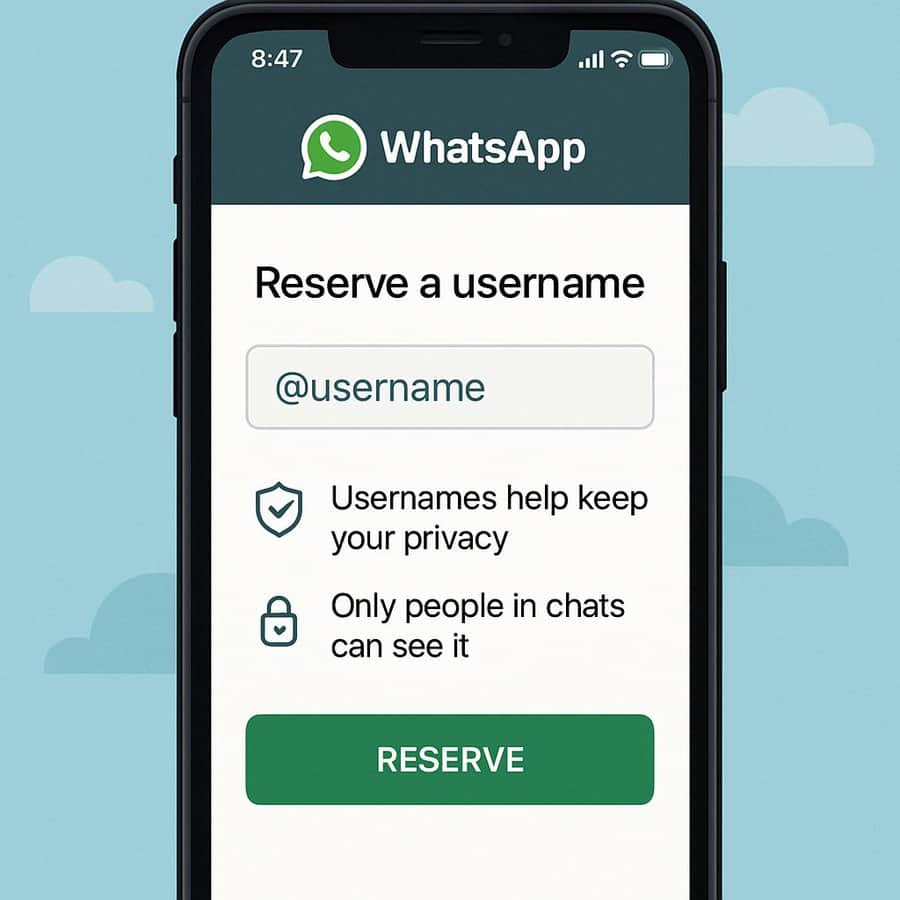
WhatsApp has spent years building one of the most used messaging platforms on the planet around a single identifier: the phone number. That is about to change. On June 29, 2026, Meta announced that WhatsApp users can now begin reserving usernames, with the full feature set to launch gradually later this year. The move brings WhatsApp in line with rivals like Telegram, Signal, and Wire, all of which have offered username‑based contact for years, and it marks one of the most significant changes to how the app handles personal identity since end‑to‑end encryption was introduced a decade ago.
The reservation window opened to allow the platform's more than 3 billion users a fair chance to claim preferred names before the feature goes live at scale. With a user base that size, name collisions were always going to be a problem, and WhatsApp chose to get ahead of it rather than launch into a first‑come, first‑served scramble.
What Usernames Do and How They Work
The core purpose of the feature is privacy. Right now, connecting with someone on WhatsApp requires sharing a phone number, which is personally identifying information tied to far more than just a messaging app. A phone number links to banking alerts, two‑factor authentication, medical accounts, and a wide range of services that have nothing to do with chatting with a new contact. For many users, handing out their number to someone they just met has always felt disproportionate to the situation.
Usernames solve that. Once the feature launches, users will be able to share a handle instead of a phone number to initiate contact. Existing contacts will no longer see the phone number in the chat interface either. The person on the other end of a new conversation never needs to know the number at all.
There are important constraints to understand before reserving. Usernames must be between 3 and 35 characters. Only lowercase letters from a to z, numbers from 0 to 9, periods, and underscores are permitted. Every username must include at least one letter, ruling out handles made entirely of numbers or symbols. Usernames cannot begin with the string "www." and cannot end with a domain extension like .com or .net, a rule designed to prevent usernames that could be mistaken for official websites. And crucially, a username must be available across Meta's family of apps, meaning Instagram, Facebook, and WhatsApp, to be claimed on any one of them.
That last rule creates a meaningful advantage for users who already have established handles on Instagram or Facebook. Businesses, creators, and anyone with an existing Meta presence can carry their username across to WhatsApp rather than starting from scratch or discovering that someone else has already taken their preferred name.
How to Reserve a Username
The reservation process runs through the app's settings. Users who have access can navigate to Settings, then Account, then Username. WhatsApp has reserved top‑level handles for celebrities, verified public figures, and major organizations, preventing impersonation of well‑known identities. Outside of that reserved tier, the username space is open to anyone on a first‑come basis during the reservation period.
Alice Newton‑Rex, vice president and head of Product at WhatsApp, described the privacy motivation directly, noting that sharing a phone number with someone new, whether a classmate, a neighbour, or someone met at an event, can feel like a significant step because a phone number is tied to so many other parts of a person's life. Usernames give users a way to make that first connection without that level of disclosure.
Once live, users will also have the option to set a username key. This adds an additional layer of control by requiring that anyone who wants to message using a username must know both the handle and the key. It functions as a simple gate for people who want the privacy benefits of usernames without fully opening themselves up to unsolicited contact.
No Search, Exact Match Only
One of the more notable design decisions WhatsApp made is that usernames will not be searchable within the app. There is no directory to browse and no way to search for a handle and discover who holds it. To message someone by username, the sender must know the exact handle in advance, with no partial match or suggested results. This is a deliberate privacy choice that separates WhatsApp's approach from platforms like Twitter or Instagram, where usernames are publicly discoverable. On WhatsApp, a username is a contact method to be shared intentionally, not a public presence to be found.
Users will also be able to turn the feature off entirely or change their username at any point after it is set. There is no permanent commitment, which makes the reservation process now genuinely low‑risk. Whatever name is claimed during the reservation window can be updated once the full feature rolls out.
Why It Took So Long
WhatsApp has been working on username functionality for several years. The delay was not a product philosophy disagreement but an engineering challenge of significant scale. The app's entire codebase was built around phone numbers as the primary user identifier, and every feature added over more than fifteen years was built on top of that assumption. Retrofitting a second identity layer without breaking existing functionality, including group messaging, call routing, notification systems, and business API integrations, required extensive testing and gradual code updates across hundreds of interconnected components.
For businesses using the WhatsApp Business API, the shift introduces a new identifier called the Business‑Scoped User ID, or BSUID. This is a unique ID generated per business relationship, meaning a user who contacts a brand over WhatsApp will have a different BSUID with that brand than with any other business on the platform. It is designed to prevent businesses from pooling user identifiers across brand relationships or sharing them with third parties. Business API partners have been given a deadline to update their systems to handle BSUIDs before the username feature becomes mandatory infrastructure, and WhatsApp has updated its developer documentation with transition guidance and sample workflows.
A Meaningful Shift for Three Billion Users
The username launch will not change how WhatsApp handles account creation. A phone number is still required to sign up for the service. What changes is how that number is used in day‑to‑day communication. For existing conversations, nothing automatically changes. Contacts already in a user's phone book will still see the number. The username layer applies primarily to new connections made after the feature goes live, and only when the user chooses to share it.
Telegram built a significant portion of its growth story on the privacy appeal of usernames, and Signal has positioned number‑free contact as a core feature for its security‑conscious audience. WhatsApp arrives later to this specific feature but with an installed base that neither rival comes close to matching. Even a gradual rollout to a fraction of its user base represents hundreds of millions of people gaining the ability to manage their personal contact information with considerably more control than the platform has historically offered.
Stay informed
Startup news in your inbox
Get important funding rounds, founder stories, and startup updates.
No spam - only important startup updates.