AI Startup Intropy Raises $11M to Bring Autonomous Decision-Making to the Spare Parts Industry
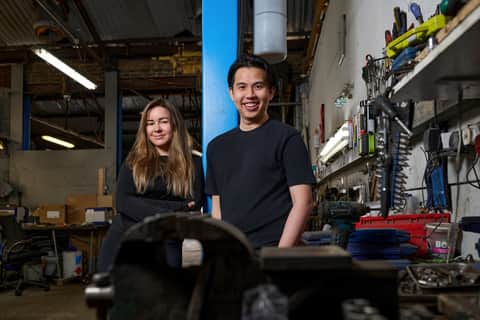
Intropy co-founders Franziska Kirschner and YihKai Teh.
Image credit: Intropy
Intropy, a London based startup building what it calls an AI native operating system for the spare parts industry, has raised 11 million dollars in seed funding led by Felix Capital, with participation from Quiet Capital and existing investors General Catalyst and firstminute capital.
The company was founded in 2024 by YihKai Teh and Franziska Kirschner, both former researchers at UK based AI insurtech company Tractable. Kirschner, who serves as chief executive, previously studied superconductors and magnetic monopoles as part of a physics PhD program at Oxford, research that was published in the journal Nature before she left academia to build Intropy.
The company targets an industry that remains almost entirely dependent on spreadsheets and manual review despite representing a market worth more than 1.1 billion dollars in software spend alone. Distributors, manufacturers, and recyclers of spare parts routinely rely on employees manually checking stock levels, adjusting prices, and reviewing thousands of individual stock keeping units, a process that scales poorly as product catalogs and customer networks grow larger and more fragmented.
Intropy's platform is designed to replace that manual review cycle entirely. Rather than surfacing recommendations for an employee to evaluate and approve, as most traditional inventory software does, Intropy's AI integrates directly into a customer's existing enterprise resource planning system and executes pricing, stocking, and replenishment decisions on its own. The platform continuously updates those decisions as market conditions shift, allowing businesses to move away from periodic manual reviews toward what the company describes as real time optimization.
"We're building the intelligence layer that understands the extraordinary complexity of spare parts: what fits, how it performs, and when it is needed, so parts businesses can make better decisions," said Teh, who serves as chief technology officer.
The complexity Teh references is not incidental to the business, it is the core challenge Intropy is built around. Every machine composed of multiple components, whether a car currently on the road, an autonomous vehicle still in development, or industrial equipment operating far from easy resupply, will eventually need spare parts. Determining which parts fit which machines, how those parts perform under different conditions, and when replacement will actually be needed requires reconciling fragmented data that most legacy software was never designed to handle at scale.
Since launching, Intropy says its technology has processed more than 10 billion dollars in spare parts demand across its customer base, with some customers reporting returns on investment exceeding ten times their initial deployment cost, according to the company. That processing volume suggests the platform has already moved well past early pilot stage deployments into meaningful production use among distributors and manufacturers.
Intropy's funding history includes an earlier, undisclosed pre‑seed round led by General Catalyst, which returned as a participating investor in this latest seed raise alongside firstminute capital, another early backer. Felix Capital's decision to lead the round signals growing venture interest in AI systems that take autonomous action within existing enterprise software rather than simply layering recommendations on top of it, a distinction the company has emphasized as central to its pitch to customers.
The new capital will go toward three main priorities: accelerating product development, expanding the company's engineering and machine learning teams, and establishing a New York office as part of a broader push into the United States market. Intropy said it will continue expanding its presence across Europe at the same time, with active hiring underway for engineers and AI researchers in both London and New York.
Kirschner has framed the company's ambitions in terms broader than software efficiency alone. "The physical economy is sustained not only by what we build, but by our ability to keep it working," she said. "Spare parts make that possible, yet many of the industry's most important decisions still rely on fragmented systems and manual work. We are not interested in adding another dashboard on top of that complexity. We are building an AI native operating system that can make and execute decisions autonomously, at scale and speed."
Intropy's raise arrives amid a broader wave of startups applying autonomous AI agents to traditionally manual back office functions across legal, finance, and operations. Where many of those companies remain focused on surfacing better recommendations for human teams to act on, Intropy's bet is that spare parts businesses are ready to hand over execution entirely, a wager that will be tested as the company scales its US presence and takes on larger distributors and manufacturers over the coming year.
Topics
Stay informed
Startup news in your inbox
Get important funding rounds, founder stories, and startup updates.
No spam - only important startup updates.