Startup News Roundup May 1-2 2026: AI Funding Frenzy, Robotics Acquisitions, Non-Dilutive Deals & Blue-Collar AI Breakthroughs
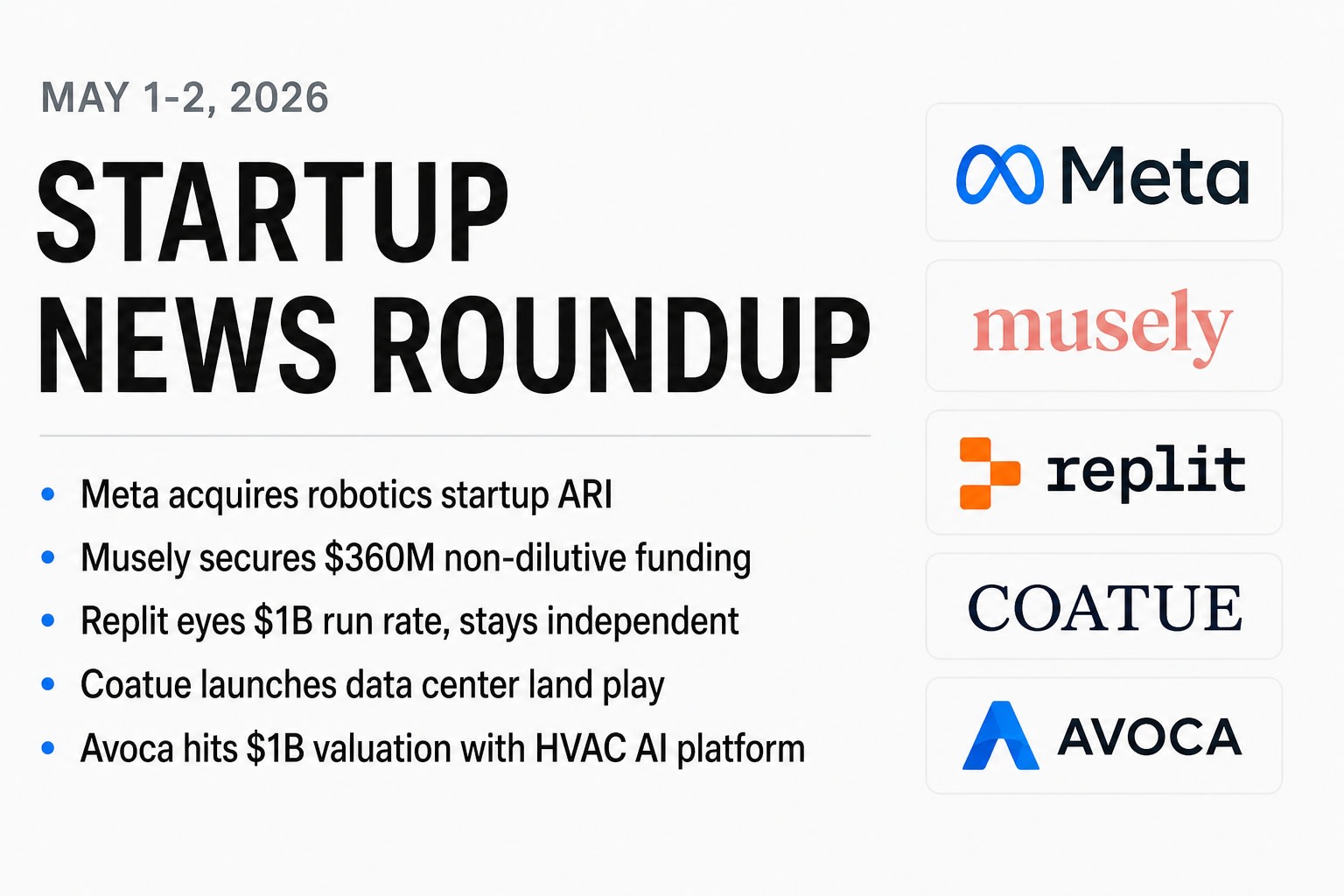
The startup landscape on May 1, 2026, continues to be defined by explosive AI innovation, strategic acquisitions, creative financing, and expansion into traditional industries. With global venture funding still riding the wave of record Q1 2026 totals exceeding $300 billion, heavily skewed toward AI, today's updates highlight maturing AI companies achieving massive scale, Big Tech doubling down on robotics and infrastructure, and efficient capital strategies like non‑dilutive funding.
Key themes include humanoid robotics for AGI progress, AI agents transforming service businesses, data center land grabs to fuel compute demands, and founder‑led independence amid acquisition speculation. This roundup covers authenticated developments from the past 24‑48 hours, optimized for entrepreneurs, investors, and tech enthusiasts tracking "startup funding news May 2026," "AI acquisitions 2026," and "daily startup roundup."
Replit's Amjad Masad Prioritizes Independence Amid AI Coding Boom
Replit, the AI‑powered coding platform, is tracking toward a billion‑dollar annual run rate after surging from $2.8 million in 2024 revenue. In a May 1 interview at TechCrunch’s StrictlyVC event, founder Amjad Masad discussed the Cursor‑SpaceX acquisition rumors, strong net revenue retention reaching as high as 300%, and his preference to remain independent.
Replit differentiates itself through full‑stack security, end‑to‑end deployment, and accessibility for non‑technical users. Masad highlighted positive gross margins, enterprise wins with companies such as Zillow, Meta, and Bain, and potential plans to invest in startups built by customers using Replit.
He also criticized Apple’s App Store ecosystem while remaining open to future collaboration opportunities. The story reinforces how AI coding startups continue resisting acquisition pressure as demand for developer automation platforms accelerates.
Musely Secures $360 Million Non‑Dilutive Funding from General Catalyst
In one of the most notable healthtech developments of the week, telemedicine platform Musely secured over $360 million in non‑dilutive capital from General Catalyst’s Customer Value Fund (CVF).
The direct‑to‑consumer healthcare company focuses on compounded treatments for skin care, hair loss, and menopause support. Unlike many fast‑growing startups, Musely has remained cash‑flow positive and avoided major equity dilution since its early $20 million funding round.
CEO Jack Jia explained that the revenue‑share‑like structure allows Musely to aggressively scale customer acquisition without sacrificing ownership or control. The company has already served more than 1.2 million patients while maintaining over 50% year‑over‑year growth.
The deal highlights growing investor interest in alternative startup financing models. Non‑dilutive funding has become increasingly attractive for profitable AI, SaaS, and healthtech startups seeking scale without reducing founder equity.
Meta Acquires Robotics Startup ARI for Humanoid AI Push
Meta acquired Assured Robot Intelligence (ARI), a frontier humanoid robotics startup, to accelerate its long‑term AI and robotics ambitions.
ARI’s founding team, which includes talent with Nvidia and NYU research backgrounds, will join Meta’s Superintelligence Labs division. The company specialized in AI systems enabling robots to predict, understand, and adapt to human behavior in real‑world environments.
The acquisition follows a broader industry trend where major technology companies are aggressively pursuing robotics infrastructure and embodied AI research. Similar recent deals include Amazon’s acquisition of Fauna and continued investments across autonomous systems and physical AI.
Industry experts increasingly believe humanoid robotics could become one of the largest markets of the coming decades, potentially reaching multi‑trillion‑dollar scale by 2050.
For Meta, the acquisition strengthens its positioning in consumer robotics, spatial computing, and AGI training environments using real‑world physical interactions.
Coatue Expands Into AI Infrastructure Through Data Center Land Strategy
Venture capital giant Coatue is making a major infrastructure play through its Next Frontier initiative, focused on acquiring land near major power sources for future AI data center development.
Reports suggest the effort may involve relationships with portfolio companies such as Anthropic and infrastructure provider Fluidstack.
The strategy reflects the enormous infrastructure demand being created by large‑scale AI training and inference workloads. Across the United States, more than 1,500 new data center projects are reportedly under development as companies race to secure power, cooling, and compute capacity.
The AI boom has triggered increasing competition not only for GPUs and semiconductors but also for electricity, land, networking infrastructure, and energy‑efficient compute facilities.
This trend is rapidly turning AI infrastructure into one of the most important investment categories of 2026.
Avoca Reaches $1 Billion Valuation With AI for HVAC and Blue‑Collar Services
One of the most interesting startup stories this week came from Avoca, an AI agent startup focused on HVAC and blue‑collar service industries.
Founded by MIT alumni Tyson Chen and Apurva Shrivastava, the company recently surpassed a $1 billion valuation after raising more than $125 million from investors including Kleiner Perkins.
Avoca builds AI systems that automate:
- Customer calls
- Appointment scheduling
- Dispatch coordination
- Lead qualification
- Follow‑up workflows
The platform specifically targets industries such as:
- HVAC
- Plumbing
- Roofing
- Home services
- Field operations
These sectors often lose significant revenue due to missed calls and inefficient front‑office operations.
Early customers, including Rescue Air, reportedly achieved major improvements in booking rates and operational efficiency after deploying Avoca’s AI systems.
The company represents a broader trend where AI adoption is rapidly expanding beyond Silicon Valley software into traditional industries with massive operational inefficiencies.
Blue‑collar AI may become one of the largest untapped startup opportunities of the decade.
Broader Context: AI Dominance Continues Across Startup Funding
The latest May 1 developments continue reinforcing the broader venture capital narrative established throughout Q1 2026.
Global startup funding exceeded approximately $300 billion during the first quarter, with roughly 80% of that capital flowing into AI‑related companies.
Mega‑rounds from:
- OpenAI
- Anthropic
- xAI
- Waymo
set the tone for the market, while smaller but fast‑scaling startups like Replit and Avoca demonstrate that strong product execution and vertical specialization remain highly attractive to investors.
At the same time, governments and large enterprises continue increasing AI adoption across:
- Defense
- Infrastructure
- Healthcare
- Financial services
- Industrial automation
- Robotics
Private markets remain highly active despite slower IPO momentum and ongoing macroeconomic uncertainty.
Major Startup Trends Emerging in May 2026
1. Vertical AI Is Becoming More Valuable
AI applications focused on specific industries like healthcare, HVAC, legal services, finance, and logistics are attracting strong investor demand because they solve clear operational pain points.
2. Non‑Dilutive Funding Is Gaining Momentum
Alternative financing models are becoming increasingly popular among profitable startups seeking growth without sacrificing ownership.
3. Robotics and Physical AI Are Accelerating
Big Tech companies are heavily investing in humanoid robotics and embodied AI as the next frontier after generative AI.
4. Infrastructure Is the New Battleground
Data centers, energy access, networking, and compute optimization are becoming strategic assets in the AI race.
5. Founder Independence Is Increasing
Startups with strong growth metrics and healthy margins are choosing to remain independent rather than pursuing early acquisitions.
Outlook for the Startup Ecosystem
The startup ecosystem entering May 2026 remains one of the fastest‑moving innovation environments in recent history.
AI continues driving:
- Venture funding
- Product innovation
- Infrastructure expansion
- Enterprise transformation
- Robotics adoption
At the same time, competition is intensifying rapidly across every layer of the stack:
- Foundation models
- AI agents
- Developer tools
- Infrastructure
- Robotics
- Industry‑specific automation
Founders who combine:
- strong technical differentiation,
- operational efficiency,
- scalable infrastructure,
- and real‑world business outcomes
are increasingly positioned to win investor confidence and enterprise adoption.
Meanwhile, investors remain focused on companies capable of delivering measurable ROI rather than speculative AI hype alone.
The momentum surrounding AI, robotics, and infrastructure suggests that 2026 may become one of the most transformative years ever for the global startup ecosystem.
Stay informed
Startup news in your inbox
Get important funding rounds, founder stories, and startup updates.
No spam - only important startup updates.
Comments
Text only. No links or images.
No comments yet.