Startup News Roundup - May 24, 2026 Washington Deploys $2 Billion Into Quantum Computing. A Nuclear Startup Goes Public. A Pizza Robot Runs Out of Dough.
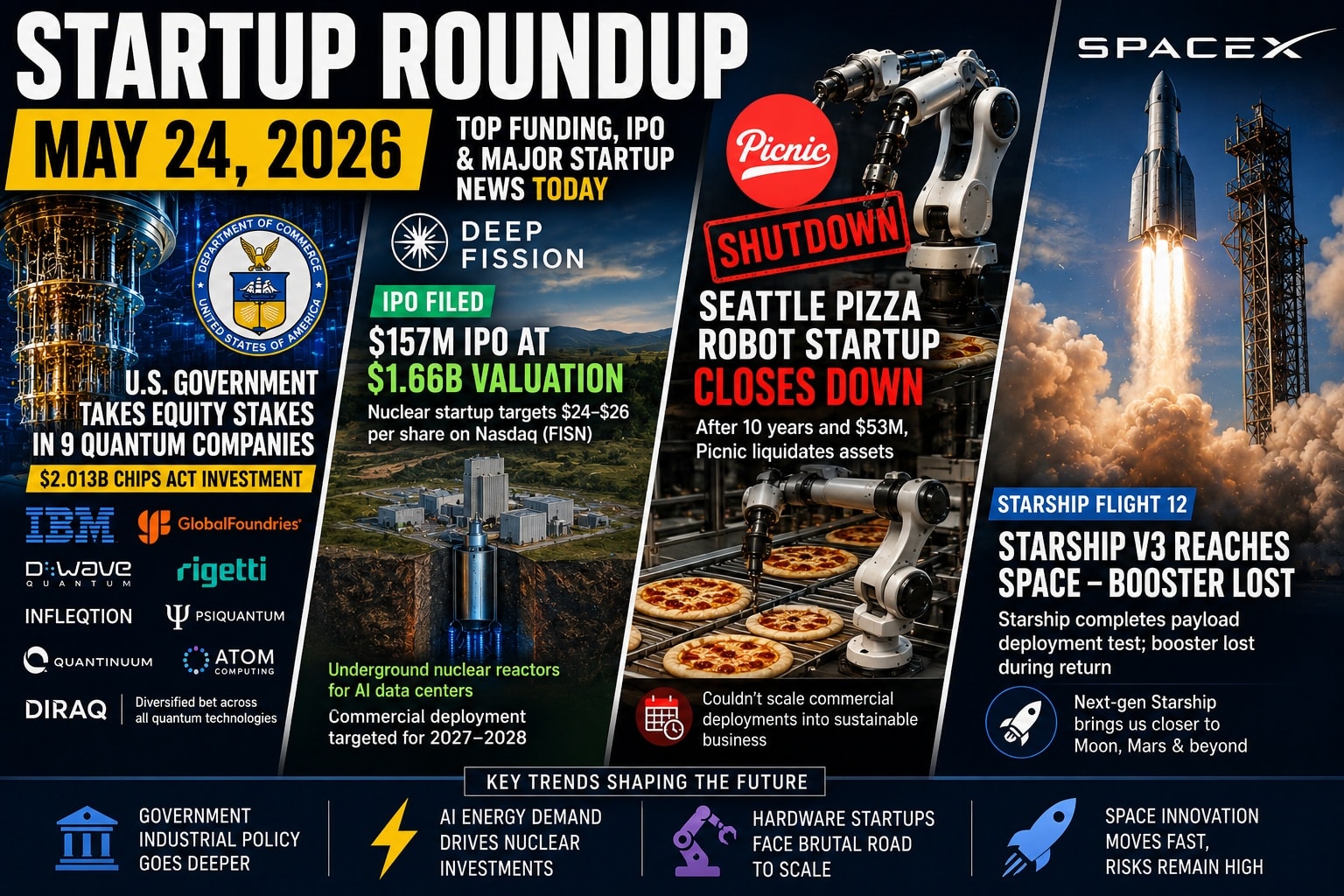
The week ended with a cluster of announcements that sit at the intersection of frontier technology, government industrial policy, and the cold reality of hardware startups running out of capital. The federal government is now a minority equity stakeholder in nine quantum computing companies. A Berkeley nuclear startup is asking public market investors to pay $24 to $26 per share for a business that one year ago was struggling to raise $15 million. A Seattle robot pizza company that spent a decade and $53 million proving the concept closed its doors on May 11. And SpaceX flew the next‑generation Starship, got the ship into space, and lost the booster on its way home.
Story One: Washington Becomes a Minority Shareholder in Nine Quantum Companies
The US CHIPS Act just made a $2.013 billion bet that quantum computing cannot be left to the market alone.
The US Department of Commerce announced on May 21, 2026 that it will distribute $2.013 billion in CHIPS and Science Act incentives across nine quantum computing companies. Administered through the National Institute of Standards and Technology, the awards come with a condition that is unprecedented in the program's history as applied to startups: the federal government will take a minority equity stake in every recipient company in exchange for the funding.
This equity‑for‑incentive structure, previously used only with Intel in August 2025 and with rare‑earth miner MP Materials, is now being applied across nine companies spanning every major qubit modality simultaneously. Commerce Secretary Howard Lutnick has made clear this is deliberate industrial policy: rather than picking a winning technology, the government is buying diversified exposure across the entire quantum stack.
The full allocation breakdown:
- IBM: $1 billion — the anchor of the portfolio. IBM will use the capital to launch Anderon, a new standalone subsidiary it describes as America's first pure‑play quantum wafer foundry. IBM is matching the federal contribution dollar‑for‑dollar with cash, intellectual property, assets, and staff. Anderon is expected to attract outside investors as it scales. Its launch customers include Diraq, PsiQuantum, Quantinuum, Google, Microsoft, and Nvidia.
- GlobalFoundries: $375 million — to launch Quantum Technology Solutions, a new quantum hardware manufacturing business built on GlobalFoundries' decade of cryogenic CMOS and advanced packaging investment. The new division will manufacture the full hardware stack across superconducting, trapped ion, photonic, topological, and silicon spin architectures.
- D‑Wave Quantum, Rigetti Computing, Infleqtion, PsiQuantum, Quantinuum, and Atom Computing: $100 million each — across six companies spanning quantum annealing, superconducting qubits, neutral atom systems, photonic quantum computing, and trapped‑ion architectures.
- Diraq: Up to $38 million — the smallest individual allocation and among the most technically specific. Diraq, spun out of the University of New South Wales in 2022, builds quantum processors using silicon quantum dot technology, the same CMOS manufacturing process that produces conventional semiconductors. Its approach directly addresses the manufacturing scalability challenge that most other qubit architectures face.
Both Diraq and PsiQuantum are Australian‑founded companies, making the announcement a notable signal of the US government's willingness to fund quantum development by non‑American founders operating on American soil. Diraq CEO Andrew Dzurak acknowledged the connection explicitly: "The US Government has played an important role for over 25 years in funding silicon quantum research through entities such as the US Army Research Office and more recently DARPA. The foundational advancements that came from this work underpin Diraq's technology today."
The timing carries an additional commercial dimension: Quantinuum, one of the $100 million recipients, is separately preparing for a Nasdaq IPO. The CHIPS Act funding arriving alongside a public listing process gives Quantinuum institutional credibility from a federal source at exactly the moment it needs to make its case to public market investors.
The CHIPS R&D Office's description of the portfolio approach is precise: the awards are structured to strengthen US leadership across multiple quantum modalities simultaneously, while focusing each award on discrete technological problems of real consequence. The framing acknowledges that the correct qubit technology for the 2040 era is not yet known, and that a portfolio hedge is the rational policy choice given that uncertainty.
Story Two: Deep Fission's Nuclear IPO Has Questions Attached
A Berkeley nuclear startup filed for a $157 million Nasdaq IPO at a $1.66 billion valuation. One year ago, it was struggling to raise $15 million.
Deep Fission, Inc., a Berkeley, California company developing underground small modular reactors using deep borehole technology, filed its S‑1 registration statement with the SEC on May 20, 2026, targeting a Nasdaq listing under the ticker FISN. William Blair, Stifel, and Canaccord Genuity are underwriting the offering.
The company plans to sell 6 million shares at $24 to $26 per share, raising approximately $135.9 million in base proceeds, or up to $156.9 million if underwriters exercise their full overallotment option. At the top of the range, the implied valuation is $1.66 billion.
The technology is genuinely novel. Deep Fission's Gravity Nuclear Reactor design installs small modular reactors in deep underground boreholes rather than purpose‑built above‑ground facilities, using the earth itself as the primary containment structure. The company claims this approach can reduce construction costs by 70 to 80 percent compared to conventional reactor builds. It has signed a pilot reactor agreement with the Department of Energy in Kansas and a strategic partnership with Endeavour Energy to supply up to 2 gigawatts of power specifically for AI data centers. Commercial deployment is targeted for the 2027 to 2028 timeframe.
The financial history demands context. Deep Fission completed a SPAC reverse merger with Surfside Acquisition Corp in September 2025, landing on the OTCQB marketplace at $3 per share after raising $30 million. That placement price implies a valuation roughly one‑eighth of the current IPO target range. An $80 million financing round in February 2026 appears to have supported the interim valuation that now anchors the Nasdaq offering.
TechCrunch, reviewing the S‑1 filing, noted that the picture painted in the current document is arguably bleaker than the December 2025 filing it supersedes. The timeline for achieving criticality, the point at which a nuclear chain reaction becomes self‑sustaining, has slipped from a July 2026 target to a date the company now declines to estimate. Deep Fission is drilling a test well and has lost significant money. Revenue is pre‑commercial.
The nuclear AI energy narrative is real, and investor appetite for it has been demonstrated by X‑Energy's recent IPO success and the broader surge in clean energy infrastructure investment driven by AI data center power demand. Deep Fission's partnership with Endeavour Energy for AI‑specific power supply positions it squarely within that narrative. Whether the valuation progression from $3 per share SPAC price to $24 to $26 IPO range in under a year reflects genuine technology de‑risking or is primarily a function of favorable market sentiment is the central question for institutional investors evaluating FISN.
Story Three: Seattle's Pizza Robot Just Ran Out of Dough After $53 Million
Picnic Works, the 10‑year‑old food automation startup, shut down and liquidated its assets on May 11, 2026.
The shutdown of Picnic, first reported by GeekWire on May 22, is the kind of story that every food robotics investor and founder will study carefully for the rest of the decade. The company raised approximately $53.4 million across a decade of development, built robotic pizza assembly systems that were genuinely capable of topping hundreds of pizzas per hour, and inked commercial partnerships with Domino's, Ethan Stowell Restaurants, stadium operators, and convenience store chains. None of it was enough.
According to legal documents and an email to creditors and investors seen by GeekWire, Picnic was unable to pay its debts and on May 11 executed a General Assignment for the Benefit of Creditors, a state law process that allows an insolvent company to liquidate assets outside of formal bankruptcy proceedings. CMBG Advisors Inc., a Santa Monica‑based liquidator, was named to handle the wind‑down. A mystery buyer acquired the company's intellectual property and remaining assets for an undisclosed price.
The Picnic story is a specific chapter in a longer story about food automation hardware. Zume, the SoftBank‑backed pizza robot company once valued at $4 billion, exited the category in January 2020. Picnic specifically positioned itself as the company that had learned from Zume's mistakes. For several years, the positioning held: the pandemic accelerated demand for contactless food production, the 2021 $16 million Series A came with credible strategic partners, and the Domino's partnership in 2022 provided the enterprise customer validation that food robotics startups depend on.
The challenges that ultimately proved fatal were not unique to Picnic. Hardware‑heavy food automation companies face customer concentration risk when deployments are slow and expensive. Long sales cycles into foodservice operators consume capital faster than software‑equivalent businesses. The step between a functional demo and a scaled commercial operation requires a customer base willing to pay for hardware that is still being refined in production. Picnic appears to have run out of the runway required to complete that transition.
For founders in physical AI, robotics, and food tech, the Picnic shutdown arrives during a period of heightened investor scrutiny of hardware startups at all stages. The week's other major hardware story, Cowboy Space raising $275 million to build rocket‑born orbital data centers, demonstrates that hardware investment is not dead. The distinction is that Cowboy Space is targeting infrastructure demand that is clearly growing faster than supply, while Picnic was targeting an operational convenience that foodservice operators considered but rarely committed to at scale.
Story Four: SpaceX Flew Starship Version 3. The Ship Made It. The Booster Did Not.
SpaceX launched Starship's 12th test flight on May 22, debuting the Starship V3 from a new launch pad. The booster had issues.
SpaceX launched Starship Flight 12, the debut of Starship Version 3, on May 22, 2026. The flight marked several firsts: the first use of Launch Complex Pad 2 at the Starbase facility in Boca Chica, Texas, the first flight of Raptor 3 engines, and the first test of payload deployment operations in low Earth orbit simulating Starlink satellite deployment sequences.
The V3 architecture incorporates design changes aimed at improved reusability, greater payload capacity, and the increased thrust profile required for the Artemis lunar landing missions and future Mars trajectories. The Raptor 3 engines running on both the Super Heavy booster and the upper‑stage Starship represent the most powerful propulsion system in any operational launch vehicle.
The mission outcome was partial. The Starship upper stage successfully reached the target trajectory and completed the payload deployment test sequences. The Super Heavy booster did not successfully return for landing, experiencing anomalies during the return burn phase that resulted in a loss of the vehicle before the catch attempt. SpaceX described the booster anomaly as generating significant test data.
For the space tech startup ecosystem, Starship's development trajectory matters as a dependency. Cowboy Space's roadmap to launching its own proprietary rocket in 2028 exists in a competitive context where Starship's eventual commercial viability affects the supply and pricing of launch capacity. Every successful Starship test moves the launch market's long‑run pricing expectations lower, which affects the business cases of every company currently building new launch vehicles.
This Week's Macro Context
The four stories above share a structural theme that is worth naming explicitly as the week closes.
The US government is deploying industrial policy at scale into the technology sectors it believes will define national competitiveness over the next two decades. The $2.013 billion in CHIPS Act quantum funding represents the same political logic as the earlier semiconductor manufacturing commitments: identify a strategic technology, deploy capital with equity upside, and ensure the manufacturing and research base does not shift entirely to foreign competitors. The equity stakes attached to the quantum awards are a new expression of this logic, signalling that Washington intends to participate in the commercial upside of the technologies it funds rather than simply subsidising private companies.
The nuclear IPO pipeline, Deep Fission joining X‑Energy on the Nasdaq runway, reflects the same AI‑energy demand narrative that drove Fluidstack to an $18 billion valuation discussion, VoltaGrid to a $1 billion investment from Halliburton and Blackstone, and Blue Energy to a $380 million raise for prefabricated nuclear plants. Energy infrastructure for AI data centers is the most structurally consistent investment theme of 2026.
The Picnic shutdown is the counterweight. Not every hardware startup that identified a real problem and raised credible capital builds a business that scales to commercial viability. Food automation, for a decade, has been the category that seems perpetually one partnership away from a breakout and has consistently demonstrated that the distance between a working prototype and a commercially sustainable operation is longer than hardware‑focused investors can sustain.
Stay informed
Startup news in your inbox
Get important funding rounds, founder stories, and startup updates.
No spam - only important startup updates.
Comments
Text only. No links or images.
No comments yet.