Amazon Acquires Fauna Robotics: The $50,000 Sprout Robot That Could Change How We Think About Machines at Home
Editorial Team
Amazon has made no secret of its ambition to put robots in homes. It tried with Astro, the wheeled home assistant it launched by invitation in 2021 at $1,600. Astro never found a mass market. It tried with iRobot, the Roomba maker, agreeing to a $1.7 billion acquisition in 2022 before regulators on both sides of the Atlantic killed the deal in 2024. It cancelled Blue Jay, a multi‑armed warehouse robot, less than six months after launching it. The track record in consumer and home robotics was, to be direct, not strong.
Against that backdrop, Amazon's acquisition of Fauna Robotics, confirmed on March 24, 2026, looks less like an opportunistic deal and more like a deliberate course correction. The company that built Sprout, a $50,000 bipedal humanoid robot designed to be safe, approachable, and genuinely useful in spaces shared with people, is joining Amazon at precisely the moment that humanoid robots have crossed from speculative hardware demos to commercially relevant platforms. Bloomberg first reported the deal. Terms were not disclosed.
What Fauna Built and Why Sprout Is Different
Fauna Robotics was founded in 2024 by Rob Cochran and Josh Merel, two engineers who met at Meta. Cochran led product at CTRL‑labs, the neural interface startup that Meta acquired in 2019 for a reported $500 million to $1 billion, before spending time at Goldman Sachs and returning to hardware. Merel brought deep expertise in motor control and embodied AI. Together, they set out to build a robot that solved a problem none of their competitors in the humanoid category had seriously addressed: what does a robot look like when safety in human‑occupied spaces is the primary design constraint, rather than an afterthought?
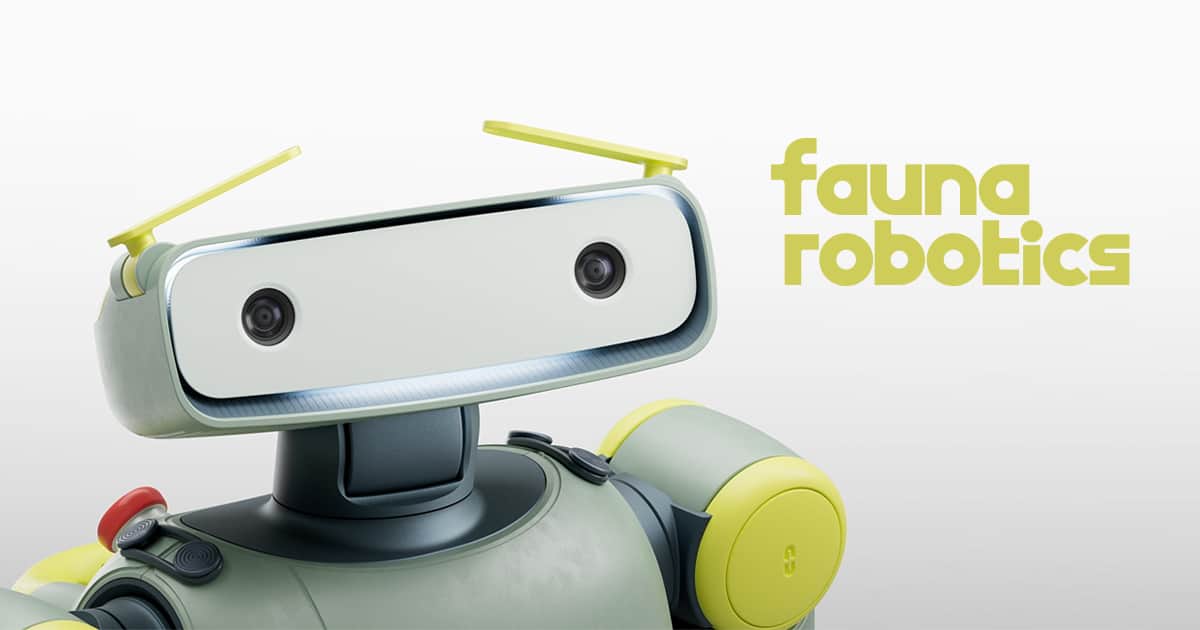
Sprout emerged from that question. The robot stands 3.5 feet tall and weighs approximately 50 pounds, closer in scale to a ten‑year‑old than the six‑foot industrial machines that Tesla's Optimus and Boston Dynamics Atlas represent. Its exterior is padded in soft green foam. Its motors are governed by compliant control systems with torque limits specifically designed to prevent injury on contact. Its joints are engineered to minimize pinch points. Every design decision was made around the assumption that this machine would be operating in environments with children, elderly people, and general public audiences who would not tolerate a robot that felt industrial or threatening.
The technical foundation is serious. Sprout runs on an Nvidia Jetson AGX Orin, the 64GB version of Nvidia's AI supercomputer for edge robotics. It carries dual speakers, one terabyte of onboard storage, and an LED facial display capable of expressing emotion through articulated eyebrow movements. The battery lasts approximately three hours per charge and is designed to be swappable without tools. The developer platform that ships with Sprout includes a modular AI architecture allowing researchers to plug in their own models at any layer of the system, trained motor control policies that remove the need to build locomotion from scratch, and built‑in simultaneous localization and mapping capabilities that allow Sprout to navigate new environments autonomously.
Fauna launched Sprout to research and development partners in January 2026, less than two months before the acquisition closed. Early customers at launch included Disney, Boston Dynamics, New York University, and the University of California San Diego, a mix of entertainment, industrial, and academic partners that reflects Sprout's positioning as a development platform for human‑centric robotics applications rather than a finished consumer product.
The Acquisition Context: Amazon's Robotics Rebuilding Month
The Fauna deal is Amazon's second robotics acquisition in a week, which makes the strategic direction unusually legible. The previous week, Amazon confirmed the acquisition of Rivr, a Zurich‑based startup that makes a four‑legged stair‑climbing robot designed to help delivery drivers navigate the last mile to front doors. Where Rivr solves a logistics problem, Fauna solves a consumer and research problem. Together they describe an Amazon that is rebuilding its robotics portfolio across both its operational supply chain and its consumer ambitions simultaneously.
The context of this rebuilding effort is important. In early March 2026, Amazon announced layoffs within its own internal robotics division, following the cancellation of the Blue Jay multi‑arm warehouse sorting project. These were cuts inside Amazon's proprietary robotics team, not the customer‑facing robotics businesses. The combination of internal cuts and external acquisitions suggests Amazon has made a deliberate judgment that acquiring proven hardware platforms and engineering teams is more capital‑efficient than building from scratch in categories where startups have already validated the technology.
Fauna's 50 employees, including both founders, will join Amazon's Personal Robotics Group, a division that Amazon has confirmed but has previously kept low‑profile. The company will continue operating as Fauna Robotics, an Amazon company, and will continue shipping Sprout to external developers and research partners.
Amazon's official statement captured the strategic logic with notable specificity: "Together with Amazon's robotics expertise and decades of experience earning customer trust in the home through our retail and devices businesses, we're looking forward to inventing new ways to make our customers' lives better and easier." The phrase "earning customer trust in the home" is a direct reference to Alexa, which is present in tens of millions of households globally. The implication is that Amazon is thinking about a robot in the home not as a standalone product but as a physical extension of an AI ecosystem it already manages.
What This Means for the Broader Humanoid Robot Market
Amazon's entry into the humanoid robot category through acquisition rather than internal development has meaningful implications for the competitive landscape.
The humanoid robotics market in 2026 is crowded with well‑capitalized participants. Tesla's Optimus program is targeting one million units annually at its Fremont factory. Figure AI, backed by Microsoft, OpenAI, and Nvidia, is deploying robots in BMW manufacturing facilities. 1X is developing humanoids for logistics. Agility Robotics is operating in Amazon's own warehouses under an existing supply agreement. Boston Dynamics continues to evolve Atlas. Chinese manufacturers including Unitree are producing lower‑cost alternatives that have found rapid adoption in domestic markets.
Fauna's differentiation in this field is its consistent focus on the consumer and social environment rather than the industrial one. Sprout cannot lift heavy objects. It is not designed for a factory floor or a warehouse aisle. It is designed for a classroom, a hospital corridor, a living room. The Boston Dynamics chief strategy officer said at Sprout's January 2026 launch that the robot let you see the future a little bit in terms of machines that could be welcomed into homes rather than confined to industrial environments behind safety barriers.
Fauna raised approximately $30 million before its acquisition, from Kleiner Perkins, Quiet Capital, and Lux Capital. That capital funded the development of a robot platform sophisticated enough to attract Disney and NYU as customers before a product had been commercially shipped. The acquisition gives Amazon a validated hardware design, an experienced founding team, an active developer ecosystem, and a safety‑first design philosophy that its previous consumer robotics efforts never successfully established.
Stay informed
Startup news in your inbox
Get important funding rounds, founder stories, and startup updates.
No spam - only important startup updates.