Quantum Motion Raised $160 Million to Do for Quantum Computers What TSMC Did for Regular Ones
Editorial Team
Every major approach to building a quantum computer shares one structural problem: the hardware required to make it work is fundamentally incompatible with the infrastructure that powers the rest of the computing industry.
IBM and Google use superconducting qubits that require cooling to temperatures near absolute zero, colder than deep space, in cryogenic chambers that take up entire rooms. IonQ and Quantinuum use trapped ion systems that require vacuum chambers, precision lasers, and environments free of electromagnetic interference. Neutral atom systems from PsiQuantum and others require similarly exotic operational conditions. These are not engineering inconveniences. They are fundamental physical constraints that mean quantum computers built on these approaches cannot be deployed in standard data center racks alongside the classical computing infrastructure they are designed to augment.
Quantum Motion, the London‑based company spun out of University College London and the University of Oxford in 2017, was founded on the conviction that this architectural problem is solvable, and that the solution was already sitting inside every smartphone and laptop on earth.
On May 7, 2026, the company announced a $160 million Series C funding round, co‑led by DCVC, the deep‑tech and defense‑focused US venture firm, and Kembara, the new Spanish deep‑tech fund from Mundi Ventures that completed a €750 million first close in February 2026. New investors British Business Bank and Firgun also participated. Returning backers Oxford Science Enterprises, Inkef, Bosch Ventures, Porsche Automobil Holding SE, and Parkwalk Advisors all added to their positions. Total funding raised by Quantum Motion now exceeds $200 million, making it the UK's best‑funded quantum computing company.
The CMOS Qubit Thesis That Changes Everything About Deployment
The insight behind Quantum Motion is precise and, once understood, difficult to argue against on first principles. Silicon CMOS transistors, the same components manufactured by TSMC, Samsung, and GlobalFoundries at billions per chip for smartphones, laptops, and servers, can be configured not only as classical computing bits but as qubits, the quantum computing equivalent.
This matters because CMOS manufacturing is the most mature, most scaled, most cost‑optimized manufacturing process in the history of human technology. A CMOS fab can produce transistors in configurations of hundreds of billions per chip, at costs measured in fractions of a cent per device, at consistency levels that enable predictable device behavior across entire wafer runs. No other manufacturing technology in existence approaches this combination of scale, precision, and cost.
Quantum Motion's silicon qubit architecture inherits all of these manufacturing advantages directly. The company's chips are fabricated by GlobalFoundries, the commercial semiconductor manufacturer, using processes that GlobalFoundries already runs for classical chip production. There is no exotic material deposition. No specialized chamber construction. No manufacturing process that cannot be validated against the same quality standards applied to every other semiconductor product coming off that production line.
The performance consequences of this approach are the numbers the company publishes:
- 100‑fold reduction in cost and space requirements compared to alternative quantum computing architectures.
- 1,000‑fold reduction in energy consumption versus alternative approaches.
- Form factor that fits inside standard data‑center server racks, enabling deployment in existing facilities without new construction or specialized environmental infrastructure.
- Full‑stack quantum computer, including processor, control electronics, and readout systems, that the company has already delivered to its first customer.
That first customer, the UK's National Quantum Computing Centre at Harwell, received a full‑stack Quantum Motion computer in September 2025. The machine is the size of three server racks and contains a processor measuring a few millimeters across. It is, to the company's knowledge, the world's first commercial deployment of a full‑stack silicon‑based quantum computer.
The Founding Team That Built From First Principles
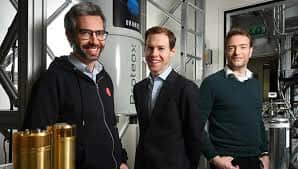
Quantum Motion's co‑founders are Professor John Morton and Professor Simon Benjamin, both of whom built their academic careers studying quantum physics and its potential applications to computing. Morton, CTO, holds a professorship at UCL. Benjamin, CSO, is based at Oxford. Their shared conviction, that silicon manufacturing was the correct substrate for scalable quantum computing, predates the company's 2017 founding by years of academic research.
Benjamin's description of the founding inspiration captures the intellectual momentum behind the company: "As founders we were inspired by the breathtaking accomplishments of silicon technology, with city‑like complexity delivered on centimetre scale chips. Now, Quantum Motion's chips can be used not only for bits but also for qubits, unlocking a future in which quantum computers are both fast and ubiquitous."
The trajectory since the company's 2023 Series B of $50.8 million reflects a systematic expansion of both technical capability and commercial credibility. Offices and labs were opened in Spain and Australia, creating an international research presence that allows the company to recruit talent beyond the UK's relatively constrained quantum physics academic pool. The GlobalFoundries manufacturing partnership was deepened, tying Quantum Motion's development roadmap directly to commercial semiconductor production timelines rather than research‑lab schedules.
And in April 2025, DARPA selected Quantum Motion as one of 18 companies for the first phase of its Quantum Benchmarking Initiative, the US Defense Advanced Research Projects Agency's program to identify quantum computing approaches with the greatest potential for practical military and national security applications. DARPA's participation confirms that the company's technical approach has passed scrutiny from the most demanding applied research evaluators in the world.
The Market Context That Makes the Timing Right
The $160 million Series C arrives at a moment when multiple converging factors are creating genuine urgency in quantum computing investment.
European quantum computing investment has already exceeded €800 million in 2026, placing the year on track for a record annual total by a significant margin. The UK announced a £2 billion investment package for quantum infrastructure in March. The European Union's Quantum Act is expected to be published this year, institutionalizing government funding commitments across member states. Finland's IQM and France's Pasqal both announced SPAC deals at billion‑euro valuations in 2026, creating public market exit precedents that encourage further venture investment.
At the infrastructure level, the energy demands of AI data centers are creating a secondary market for quantum computing that the industry's founders did not fully anticipate. AI training and inference are straining power grids globally. Quantum computing offers a path to computations that are fundamentally more energy‑efficient for certain problem classes than classical computing, and the alignment between quantum's energy advantages and AI's energy problems is increasingly visible in investor portfolios. Quantum Motion is the only company in the space that can offer data‑center‑rack deployment alongside those efficiency claims.
Dr. Prineha Narang, Operating Partner at DCVC, was direct about the investment rationale: "Quantum is critical infrastructure for the next century of computing, AI, and security, and leadership will go to whoever can industrialise it. DCVC led this investment in Quantum Motion because silicon is the foundation that scales, and this team is building on the CMOS advantage to turn quantum from a demonstration into a commercial success story."
The $160 million funds commercialization, R&D, and the international expansion required to bring the company's products to the data‑center buyers who need them.
More at quantummotion.com
Stay informed
Startup news in your inbox
Get important funding rounds, founder stories, and startup updates.
No spam - only important startup updates.