China's RISC-V AI Chip Moment: EVAS Intelligence Raises $211 Million to Mass-Produce Its Epoch Series
Editorial Team
The global AI chip market has two defining realities in 2026. The first is that Nvidia's H100 and H200 GPUs remain the dominant compute infrastructure for large model training at frontier labs. The second is that the combination of US export controls, geopolitical pressure, and the structural appeal of open‑standard architectures has created genuine demand for alternatives built on the RISC‑V instruction set, which is free to implement and carries no per‑unit licensing royalties.
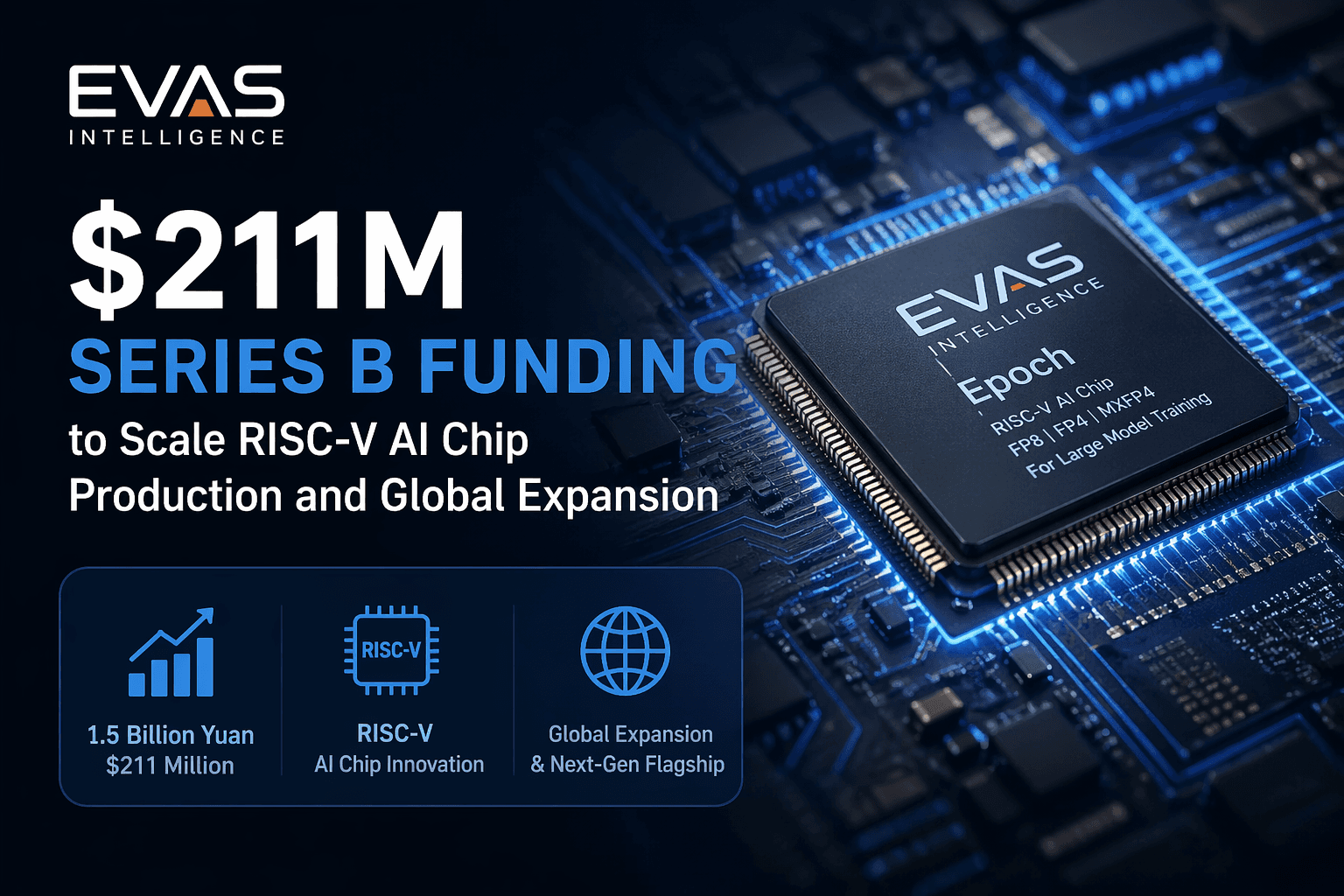
EVAS Intelligence, the Shenzhen‑based chip startup founded in 2022, is building one of the most technically credible of those alternatives. On April 22, 2026, the company announced it had raised 1.5 billion yuan, equivalent to approximately $211 million, in a Series B funding round. The capital is earmarked for four specific priorities: ramping up production and commercialization of the Epoch chip series, developing the company's next flagship product, strengthening the software‑hardware ecosystem surrounding the platform, and pursuing global expansion.
EVAS Intelligence specializes in what it describes as full‑stack, self‑developed RISC‑V AI computing chips and platform solutions. The company's technical differentiation is architectural: rather than simply adopting the RISC‑V instruction set as a licensing convenience, EVAS has combined a TPU‑like data‑flow architecture with RISC‑V's open instruction set to create a chip optimized specifically for the memory bandwidth and parallelism patterns that large model training demands.
The Epoch series, EVAS Intelligence's current chip family that is already in mass production, includes several specific technical capabilities that matter for large‑model training:
- Native support for FP8 quantization, the precision format that has become the standard efficiency improvement in frontier model training.
- Compatibility with lower‑precision formats including FP4 and MXFP4, enabling the kind of numerical precision flexibility that allows training teams to balance computational cost against model accuracy.
- A RISC‑V and RVV technical foundation that allows the chip to benefit from the growing open‑source software ecosystem around the RISC‑V architecture.
- Optimization specifically for deep learning workloads, as opposed to the general‑purpose computing origins that make GPU architectures more complex to optimize for AI‑specific tasks.
The mass production achievement is the most commercially significant milestone in EVAS Intelligence's current profile. Many AI chip startups have demonstrated capable silicon in small quantities. Reaching mass production means the engineering, manufacturing, and quality control processes have been validated at scale. The Series B capital now funds the commercial acceleration of a platform that already works.
The software‑hardware ecosystem investment is the less visible but equally important component of this raise. A chip without a mature software stack is an academic exercise. EVAS Intelligence's stated commitment to building out the development tools, compiler optimizations, and framework integrations that make its silicon accessible to model training teams reflects the lesson that has been learned repeatedly in the AI chip market: hardware performance alone does not win commercial traction. Developer experience and framework compatibility are often the deciding factors.
EVAS Intelligence's global expansion ambition situates the company within the broader geopolitical reality of the AI chip market in 2026. US export controls have limited Nvidia's ability to sell its highest‑performance chips into China. For Chinese AI labs training large models, domestically developed alternatives have moved from theoretical options to operational necessities. EVAS Intelligence's RISC‑V platform, built on an open architecture that carries no American intellectual property restrictions, is well‑positioned to serve that demand.
Stay informed
Startup news in your inbox
Get important funding rounds, founder stories, and startup updates.
No spam - only important startup updates.