They Quit Google, Apple, and a San Francisco Startup to Fix Germany's Power Grid. It's Already Paying Off
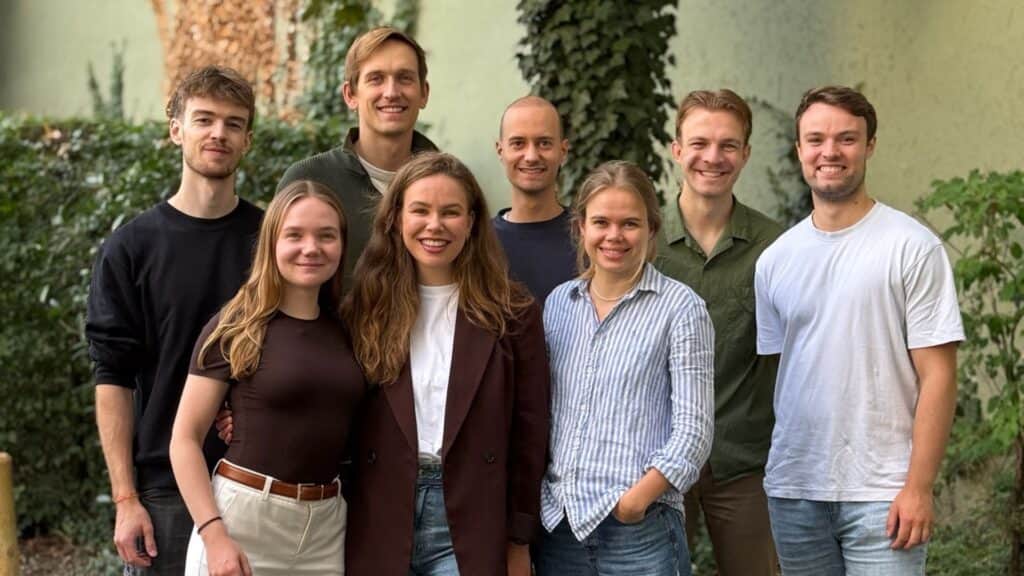
Furo founder Lena Sophia Voß, Leonie Wagner, and Simon Wittner
Image credit: Furo
Furo, a Munich based energy software company, has raised 3.44 million euros, roughly 4 million dollars, to scale its AI platform for controlling and optimizing commercial and industrial battery storage systems.
The round was led by New York based TQ Ventures, with participation from US accelerator Neo, Sandberg Bernthal Venture Partners, the fund run by Sheryl Sandberg, and CDTM Venture Capital. Furo was founded in 2025 as Lumera Energy by Lena Sophia Voß, Leonie Wagner, and Simon Wittner, who met during a joint master's program at the Centre for Digital Technology and Management, a partnership between LMU Munich and the Technical University of Munich that has produced a steady stream of German startups. The company rebranded from Lumera Energy to Furo in May 2026.
The founders' path to building the company involved a deliberate decision to leave established, high‑profile roles elsewhere. Two years ago, Wagner turned down an offer from Google's Moonshot Factory, Wittner resigned from Apple in Seattle, and Voß left a startup role in San Francisco. Rather than remaining in Silicon Valley, all three returned to Munich to address a problem they saw building in Europe's power grid. "We're currently moving faster in Europe than if we'd have stayed in the U.S.," Voß told TechCrunch.
The problem Furo is built to solve centers on a widening gap between how battery storage hardware has scaled and how intelligently that hardware is actually being used. Commercial and industrial companies are increasingly investing in battery storage, but according to co‑founder Voß, most of them still don't know what their system is currently doing, whether it's actually profitable, or how they could generate more revenue from it. Planning has traditionally happened in Excel spreadsheets, operations run through disconnected, isolated software tools, and marketing of unused storage capacity often doesn't happen at all, a combination Voß says costs returns and erodes trust in the underlying technology.
Furo's platform addresses that gap by combining three functions that the company says no single competitor currently offers together: economic planning before a storage system is even installed, real‑time operational monitoring once it's running, and automated flexibility marketing that sells unused capacity into energy markets. The system generates daily 24‑hour forecasts for electricity prices, consumption, and weather, then derives optimal charging and discharging schedules from those forecasts and controls the battery automatically, connecting directly to energy suppliers and direct marketers as part of that process. The platform is hardware‑agnostic, meaning it works across battery systems from different manufacturers rather than requiring customers to use a specific proprietary hardware partner. According to the company, this approach can lower a customer's electricity costs by up to 40 percent.
That value proposition has become increasingly urgent as European, and particularly German, electricity markets grow more volatile and expensive. Furo points to rising global energy demand from AI data centres as a factor putting additional pressure on energy‑intensive industrial companies, a dynamic hitting Germany especially hard given that the country already has among the highest electricity prices in the world. Battery storage offers a partial answer by storing surplus solar or wind power and releasing it when needed, but the company argues that most existing installations still operate on rigid, pre‑programmed rules rather than adapting intelligently to real‑time price and weather conditions.
Furo has moved quickly from an initial, narrower tool for installers managing battery economics manually in Excel toward a considerably broader operating platform. As of its May 2026 product launch, the company said more than 3,500 industrial sites were already being planned or optimized using its software; by this funding announcement in September, that figure had grown to more than 6,000 sites. The company sells through installers, project developers, manufacturers, and utilities rather than directly to end customers, with named partners and clients including Deutsche Bahn, Sonnen, Enpal, Fenecon, and major solar and storage wholesalers including BayWa, Segen, and IBC Solar. Enpal's Director of Commercial & Industrial, Ben Rohloff, credited the platform with tangible results: "We and our customers gain transparency about what our battery is actually doing and why. We have significantly more storage projects today than we did a year ago."
TQ Ventures co‑founding partner Schuster Tanger framed the firm's investment around the scale of the underlying market opportunity. "Combined with a global market for storage flexibility that is likely to multiply in the coming years, we see one of the biggest opportunities in Europe and beyond," Tanger said.
Furo enters a segment of the energy technology market that is drawing considerable capital right now: software layers built specifically to turn distributed battery hardware investments into recurring financial returns. Hamburg based Suena has raised 8 million euros for a similar AI‑driven trading solution for flexible energy assets, while Cologne based Einklang has raised 2.2 million euros combining dynamic electricity tariffs with storage optimization for medium‑sized businesses. With the new capital, Furo plans to continue product development, expand into further European markets beyond its current footprint across Germany, Austria, Switzerland, and Spain, and grow its team. Whether Furo's combination of planning, real‑time operation, and energy trading in a single platform proves durable against a field of well‑funded, similarly positioned competitors will likely depend on how quickly the company can convert its rapid site‑count growth into the kind of long‑term customer retention needed to make the underlying software model as reliable a source of return as the battery hardware itself.
Topics
Stay informed
Startup news in your inbox
Get important funding rounds, founder stories, and startup updates.
No spam - only important startup updates.