
Ex-Palantir Founders Raise €5M for Zeit AI, Backed by a World Cup Winner and Germany's Former Finance Minister
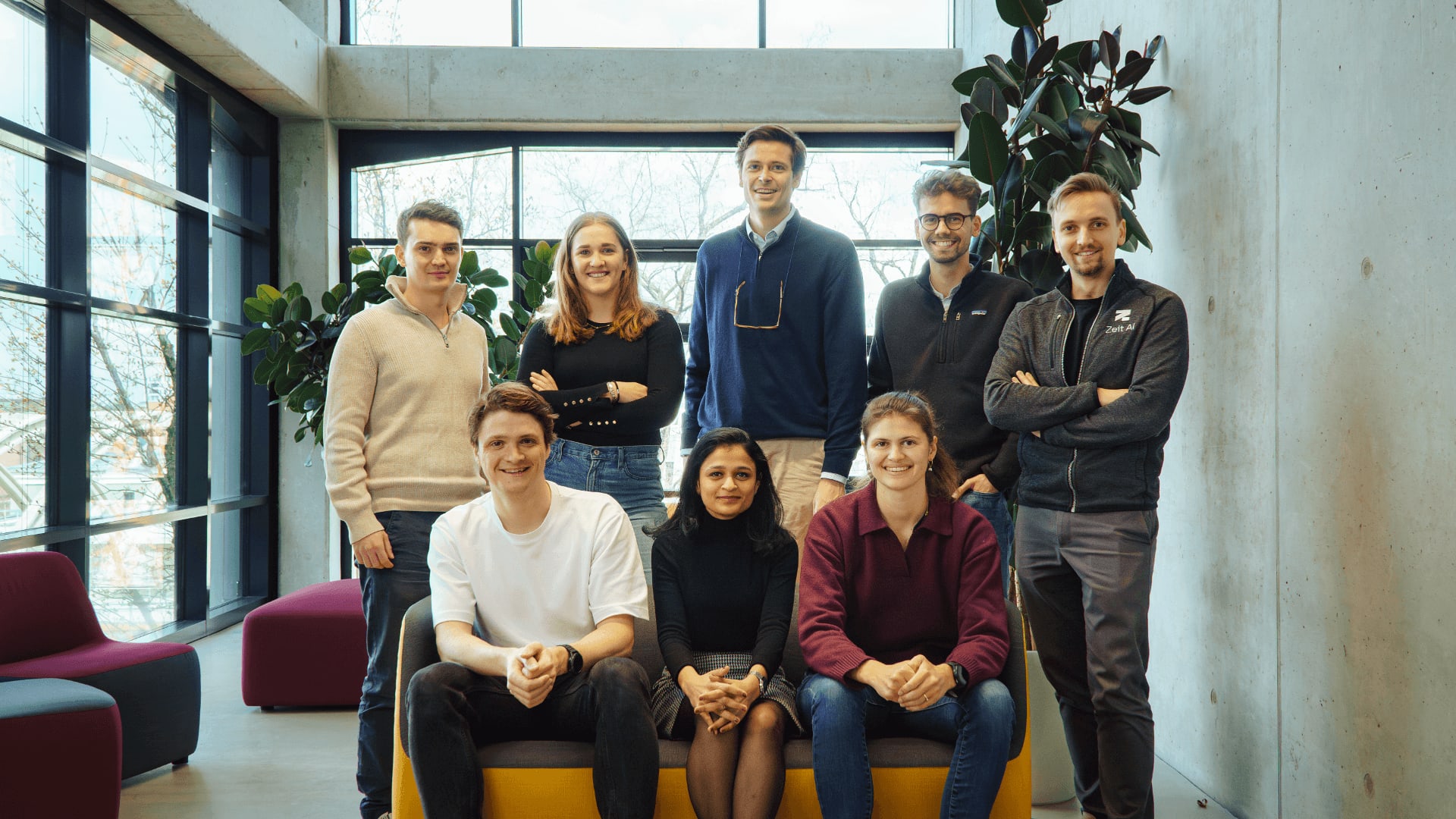
Zeit founder Leopold von Waldthausen (CEO) and Marvin Bornstein and team
Image credit: Zait AI
Zeit AI, a Munich based startup building what it calls the autonomous data engineer for Europe's mid‑market, has closed a 5 million euro seed funding round backed by a striking mix of institutional investors and high‑profile individual backers.
The round included Y Combinator, the University of Oxford's Oxford Seed Fund, the Sequoia Capital Scout Fund, ACE Ventures, and Hasso Plattner VC, the investment fund of SAP co‑founder Hasso Plattner. The angel investor list is unusually prominent even by the standards of well‑connected European tech rounds: former German federal minister of finance Christian Lindner, 2014 World Cup winner Mario Götze, Meta board member Charlie Songhurst, Martin Schoeller of the Schoeller Group, Helsing chief technology officer Robert Fink, and Leopold von Schlenk‑Barnsdorf, a researcher connected to the Schlenk SE family.
Zeit AI was founded in 2024 by chief executive Leopold von Waldthausen and Marvin Bornstein, both alumni of Palantir, where von Waldthausen was responsible for the company's existing business across the DACH region. That background shapes Zeit AI's core positioning directly: the company builds ZeitMind, an AI agent designed to connect a company's ERP, CRM, and hundreds of other internal systems, then automate the data cleaning, structuring, and analysis work that many mid‑sized companies still handle manually through Excel spreadsheets and dedicated analyst headcount. Rather than requiring a controller or analyst to manually build data models and custom applications for each new analysis request, Zeit AI's pitch is that users should be able to simply describe the analysis they need in plain language and have ZeitMind handle the underlying technical work.
Von Waldthausen described the company's unusual financial position ahead of the raise directly to Tech Funding News, noting Zeit AI could have continued operating profitably without external capital, but chose to raise regardless to accelerate a playbook the team had already spent two years refining. "We could run this company profitably, but we are now supercharging the playbook we have put together over the past two years and expanding the team in Europe across Munich and an office in London that is to come," he wrote in a LinkedIn post announcing the round.
That existing playbook has already produced substantial traction. According to Y Combinator's own profile of the company, Zeit AI went from zero to 1 million euros in annual recurring revenue within twelve months with a team of just six people, with customers live within weeks of onboarding and no dedicated IT support required on the client side. The company has since grown to roughly 12 engineers, builders, and operators split across Munich and a planned London office. Zeit AI's current customer base includes technology group Kolbenschmidt, agricultural machinery manufacturer Horsch, agricultural trading group Allgaier Agrarhandel, logistics company Wahl & Co, Munich based consultancy Stern Stewart & Co, and Luxembourg based aviation company Jetfly Aviation, a roster that spans several of the industrial and logistics sectors central to Germany's Mittelstand economy.
A central part of Zeit AI's pitch to these customers is explicitly tied to data sovereignty rather than raw automation capability alone. The company positions its platform as a European alternative for sensitive corporate data, with applications operated entirely within German data centers rather than on infrastructure controlled by non‑European providers. Hasso Plattner VC partner Jens Schmidt‑Sceery framed that positioning as central to the firm's investment thesis. "Europe's industrial base cannot outsource the decisions that run it," Schmidt‑Sceery said. "Zeit AI is one of the few companies making sovereign infrastructure the default rather than the compromise."
That sovereignty framing has become an increasingly important differentiator across European enterprise software more broadly, as companies weigh the operational benefits of AI automation against growing concern about how dependent business‑critical processes are becoming on individual, often non‑European, platform providers. For industrial companies in particular, questions about where sensitive operational and financial data is processed, and how much control a company retains over that data, have taken on added significance alongside the pure automation benefits AI tools promise.
With the new capital, Zeit AI plans to reach more businesses across its target European mid‑market segment while hiring additional engineers specifically focused on deploying ZeitMind at new customer sites, a deployment‑heavy hiring priority that reflects the hands‑on, customer‑specific configuration work still required to get the platform running effectively inside a given company's existing systems. Having already proven the model can generate meaningful revenue with a lean team, Zeit AI's next test will be whether that same efficient, deployment‑focused playbook can scale profitably across a much larger customer base as the company expands beyond its initial German industrial customer relationships into new markets and sectors across Europe.
Topics
Stay informed
Startup news in your inbox
Get important funding rounds, founder stories, and startup updates.
No spam - only important startup updates.
Comments
Text only. No links or images.
No comments yet.