
INLEAP Photonics Raises €20M to Scale Laser-Based Drone Defense Across Europe
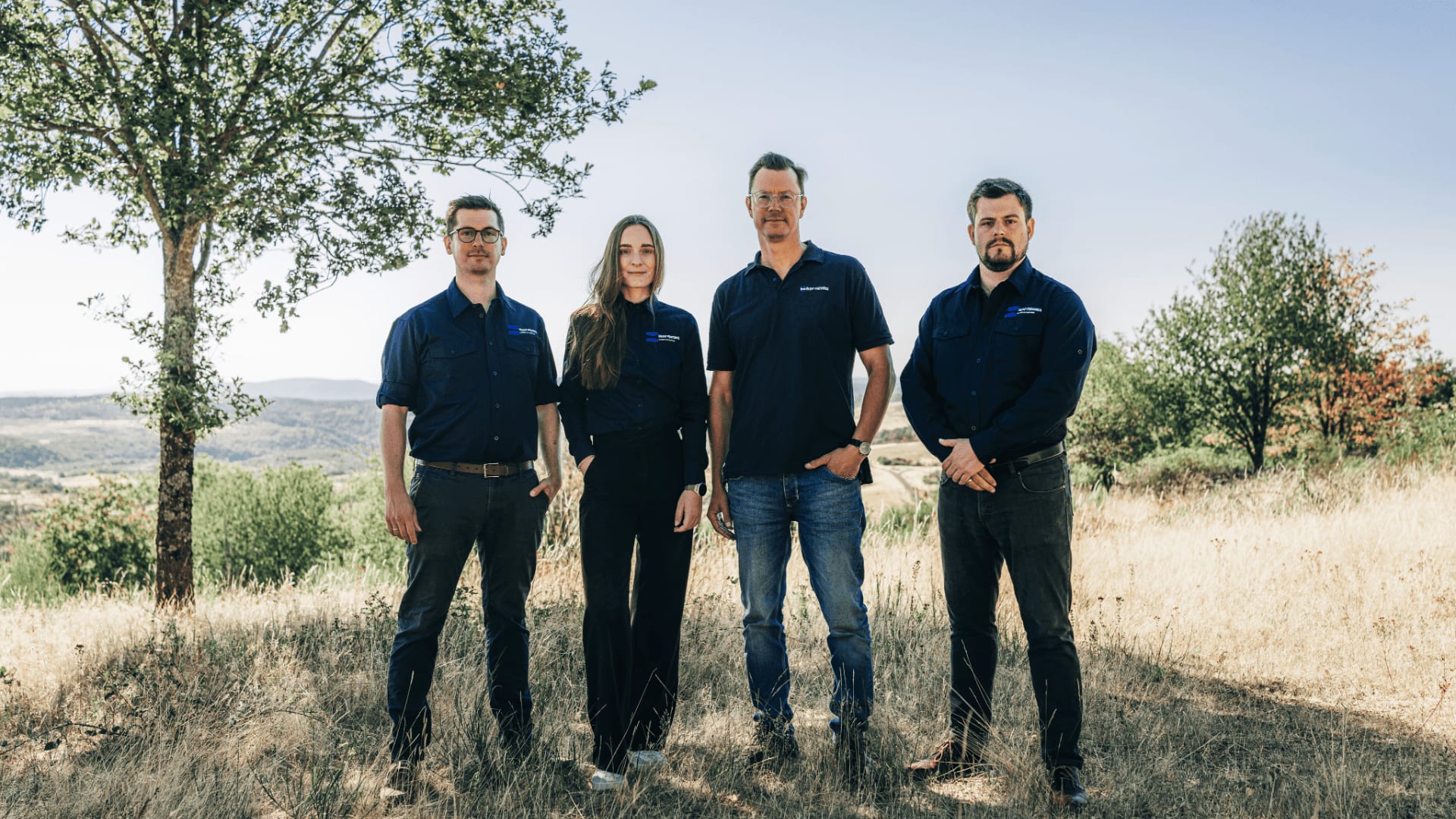
INLEAP Photonics CEO Marius Lammers and team
Image credit: INLEAP Photonics
INLEAP Photonics, a German deep‑tech company developing laser‑based drone defense systems, has closed a seed funding round of approximately 20 million euros to scale production and meet what the company describes as strong order intake from customers.
The round was led by UVC Partners, with additional investors from across Germany and Europe including High‑Tech Gründerfonds, or HTGF, alongside Balnord from Poland, Sentris from Estonia, and Scale Capital from Denmark. INLEAP Photonics originated as a spin‑off from Laser Zentrum Hannover, a leading German laser research institute, and was founded by chief executive Dr.-Ing. Marius Lammers alongside chief technology officer Dr.-Ing. Felix Wellmann and Katharina Haas. The company previously closed a pre‑seed round led by HTGF and Ventis Capital before emerging fully from stealth.
The company's core technology grew out of an unconventional starting point: high‑precision laser beam steering systems originally developed for industrial applications such as additive manufacturing and battery cell production. INLEAP has since adapted that industrial‑grade steering technology into an integrated counter‑drone system, built around the premise that the same precision and speed needed to direct a laser during industrial manufacturing translates directly into the split‑second targeting required to neutralize a fast‑moving drone.
That speed is central to the company's pitch. INLEAP says its Fastlight beam‑steering technology can direct laser beams up to 2,500 times faster than conventional systems, with a theoretical defense capability of up to 300 drones per minute, though the company has acknowledged that real‑world effectiveness also depends on visibility conditions such as fog, smoke, and rain, along with the robustness of the target tracking system feeding it. The company's core product, Fastlight Shield, is designed to neutralize drones within fractions of a second by directing concentrated laser energy at identified weak points on a target, an approach INLEAP describes as eye‑safe, allowing it to be deployed in urban and other security‑sensitive environments where traditional kinetic weapons would pose unacceptable risk. A second system, Fastlight HELD, or High Energy Laser Drone, combines the laser effector with an all‑terrain unmanned ground vehicle and a counter‑UAS software platform, extending the technology's reach to mobile and temporary deployment scenarios.
Lammers framed the company's mission around the urgency of the current threat environment. "We counter the asymmetric drone threat with technological superiority," he said. "The current security situation leaves no room for slow solutions. Our system closes the temporal gap between detection and effect. With this funding, we have consistently advanced our prototype toward operational readiness and offer German industry and public‑sector actors a sovereign defence capability against airborne threats." Wellmann added that the company's industrial laser expertise enables beam‑steering speeds current systems cannot match, pointing to prototype testing that has already demonstrated the ability to intercept agile targets within milliseconds.
The funding arrives amid what INLEAP describes as growing and immediate urgency around the threat unmanned aerial vehicles pose to critical infrastructure. Recent incidents, including a drone‑related disruption at Leipzig/Halle Airport, have underscored how quickly relatively low‑cost drones can threaten civilian infrastructure, airports, energy facilities, and military installations alike. That backdrop has pushed demand for effective, safe, and sovereign counter‑drone systems to unprecedented levels across Europe, particularly in Germany, where INLEAP is already working directly with the Federal Ministry of Defence and the Bundeswehr Cyber Innovation Hub. The company has also formed a strategic partnership with STARK Defence, a German defense technology firm building systems for European and NATO militaries, a relationship that further underlines demand for sovereign, operationally proven counter‑UAS technology developed domestically within Germany rather than sourced from outside Europe.
Investor interest in counter‑drone technology has risen sharply across the German and European startup landscape in step with that demand. Fellow German startup Tytan Technologies recently raised 30 million euros pursuing a related counter‑drone thesis, illustrating how quickly capital has begun flowing into the space. INLEAP differentiates its approach specifically through its laser‑based method, which requires no ammunition and, according to the company, avoids the collateral damage risk associated with kinetic interception methods, an important distinction for systems intended to operate near populated areas or sensitive civilian infrastructure.
With the new capital, INLEAP plans to direct investment across four main areas: building and standardizing manufacturing and testing processes for both its Fastlight Shield and Fastlight HELD product lines, continuing development of its core laser steering technology, expanding sales and service operations across Germany and the wider European market, and strengthening quality assurance and certification processes. The company also plans to establish additional sites in Germany and elsewhere in Europe as part of that expansion. Series production is targeted to become operational from 2027, with the exact timeline depending on regulatory requirements and the specific demands of prospective government and defense customers.
The goal, according to the company, is to establish INLEAP Photonics as a leading European provider of laser‑based counter‑drone systems at a moment when demand for sovereign defense capabilities, technology developed and controlled within Europe rather than sourced from outside it, has become an increasingly central consideration for governments and critical infrastructure operators alike. Whether laser‑based interception proves durable as a primary counter‑drone method, rather than one tool among several including kinetic, electronic warfare, and net‑based approaches, will likely depend on how INLEAP's systems perform once deployed at scale beyond the controlled conditions of prototype testing.
Topics
Stay informed
Startup news in your inbox
Get important funding rounds, founder stories, and startup updates.
No spam - only important startup updates.
Comments
Text only. No links or images.
No comments yet.