June 2026 Startup Roundup: AI Megadeals, Record M&A, SpaceX IPO, and Global Innovation Surge
Editorial Team
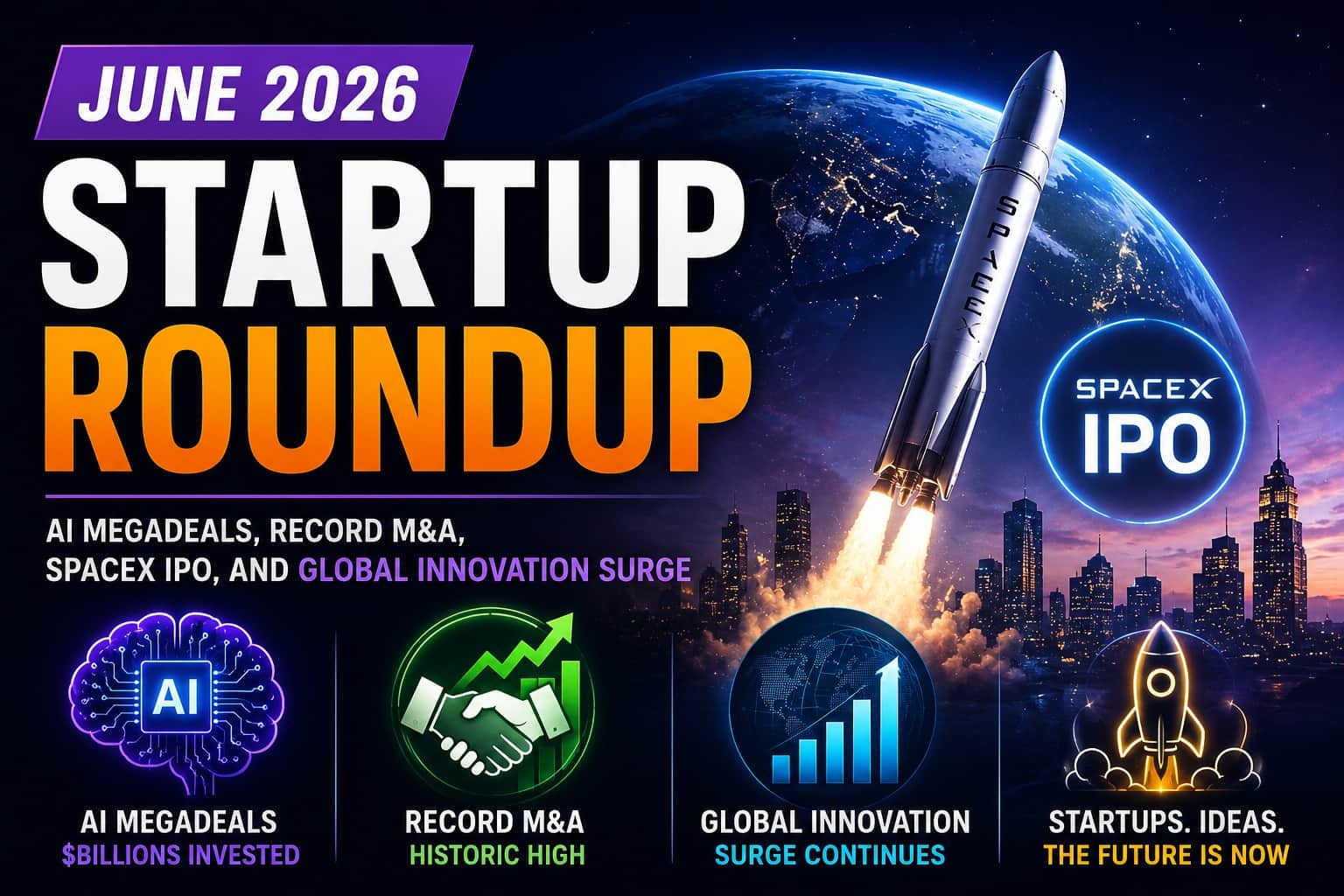
June 2026 has rewritten multiple records across venture capital, public markets, and corporate M&A in a single month. SpaceX completed the largest IPO in history, Anthropic and OpenAI both filed confidential S‑1s with the SEC, SpaceX acquired Cursor maker Anysphere for $60 billion in what became the largest VC‑backed startup acquisition ever recorded, Salesforce bought AI customer service platform Fin for $3.6 billion, Baseten raised $1.5 billion to cement its position as the dominant AI inference infrastructure company, Airwallex closed a $320 million round at an $11 billion valuation, Alan raised €480 million to build a global prevention insurance platform, and NEURA Robotics secured up to $1.4 billion backed by NVIDIA, Amazon, and Qualcomm. All of this unfolded in under four weeks. This monthly roundup covers every authenticated major development from late May through June 28, 2026, covering global startup funding rounds, IPO activity, acquisitions, and venture trends across AI, fintech, healthtech, robotics, defence tech, and emerging markets. Every figure in this article is sourced from primary filings, press releases, and verified technology media.
SpaceX Completes the Largest IPO in History, Raising $75 Billion at $1.77 Trillion Valuation
The defining event of June 2026 for global capital markets was SpaceX debuting on the Nasdaq on June 12 under the ticker SPCX, raising $75 billion by selling 555.6 million shares at $135 per share, achieving a valuation of approximately $1.77 trillion, and on its first trading day, the stock surged 19 percent to close at $160.95, pushing market capitalisation above $2 trillion and instantly positioning SpaceX among the world's six most valuable listed companies. The IPO is the largest in history, nearly three times the previous record held by Saudi Aramco's $25.6 billion raise in 2019, and it came with a total demand of over $250 billion with the offering oversubscribed approximately four times, prompting SpaceX to allocate an unusually large 30 percent of shares to retail investors. Goldman Sachs, Morgan Stanley, Bank of America, Citigroup, and JPMorgan Chase were the joint underwriters. SpaceX CEO Elon Musk retained roughly 42 percent of shares and 82 percent of voting power through a dual‑class structure, and the debut made Musk the first person in history to accumulate a net worth exceeding $1 trillion. The company's S‑1 cited a total addressable market of $28.5 trillion, with approximately 90 percent attributed to AI through its xAI subsidiary, which merged with SpaceX in February 2026. Starlink, the company's satellite internet business serving over 10 million subscribers, remains SpaceX's only currently profitable segment with quarterly revenue of $3.26 billion. The IPO is widely seen as the opening act for what analysts are calling the most consequential stretch of technology listings since the dot‑com era.
SpaceX Acquires Cursor Maker Anysphere for $60 Billion, Largest VC‑Backed Acquisition Ever
Just four days after its Nasdaq debut, SpaceX announced on June 16 that it had signed a definitive agreement to acquire Anysphere, the San Francisco company behind AI coding assistant Cursor, in an all‑stock transaction valued at $60 billion, making it the largest acquisition of a venture‑backed startup ever recorded. Under the agreement, Anysphere shareholders will receive SpaceX Class A shares priced at the volume‑weighted average over seven trading days prior to closing, with the deal expected to close in Q3 2026, subject to regulatory approval. Cursor was founded in 2022 by four MIT graduates including CEO Michael Truell and had reached roughly $2.6 billion in annualised enterprise revenue and approximately $4 billion in total annualised revenue, making it the fastest‑growing business software company in recorded history. The startup previously raised at a $29.3 billion valuation in November 2025 in a round co‑led by Accel and Coatue, meaning SpaceX is paying roughly double that amount in under a year. Cursor has approximately 50,000 enterprise customers and 4 million active developer users, and engineers at OpenAI, Stripe, and Spotify use it daily. The deal gives SpaceX's xAI subsidiary its first major presence in the AI developer tools market, where it has lagged behind Microsoft GitHub Copilot, Anthropic Claude Code, and Google Gemini Code. The transaction was set up by an option agreement signed April 21 under which SpaceX could either buy Anysphere for $60 billion or pay an approximately $10 billion break‑up fee. Investors including Accel, Thrive Capital, Andreessen Horowitz, DST Global, Coatue, NVIDIA, and Google will receive SpaceX Class A stock in exchange for their Anysphere shares. SpaceX's stock gained roughly 16 percent on the day the deal was announced, pushing the company briefly past Amazon and Microsoft by market capitalisation.
Anthropic Confidentially Files IPO Prospectus With SEC, OpenAI Follows One Week Later
On June 1, Anthropic, the company behind Claude, confirmed it had confidentially submitted a draft S‑1 registration statement to the SEC for a proposed initial public offering, edging ahead of rival OpenAI, which filed its own confidential prospectus exactly one week later on June 8. Anthropic's filing came less than a week after it closed a $65 billion Series H round at a $965 billion valuation, and the company's annualised revenue run rate had already surged to $47 billion by May 2026, up from $10 billion at the end of 2025, with approximately 80 percent of revenue coming from enterprise customers and Anthropic's share of enterprise AI market surpassing OpenAI's for the first time in April 2026. The company targets $70 billion in revenue and $17 billion in free cash flow by 2028, though it posted a $5.6 billion loss in 2024. Both Anthropic and OpenAI are working with Goldman Sachs and Morgan Stanley for their respective IPO processes, with Anthropic's debut potentially as early as October 2026 and OpenAI eyeing a September 2026 listing at a valuation above $1 trillion. Analysts describe the convergence of SpaceX, Anthropic, and OpenAI as the first of what could be three trillion‑dollar‑scale listings in 2026, a combination whose combined capital demand is large enough to create ripple effects across global institutional investment portfolios.
Baseten Raises $1.5 Billion Series F at $13 Billion Valuation to Dominate AI Inference
San Francisco‑based AI inference infrastructure startup Baseten announced a $1.5 billion Series F on June 22, led by Altimeter Capital, Conviction, and Spark Capital, with Sands Capital and Wellington Management as co‑leads and additional participation from IVP, Greylock, 01A, Blackbird, Durable Capital Partners, Verified Capital, Battery Ventures, and D.E. Shaw Ventures. The round was structured in two tranches at valuations of $13 billion and $11 billion respectively, representing a 160 percent increase in valuation in less than five months after the company raised a $300 million Series E at a $5 billion valuation in January 2026. Baseten processes more than one billion inference calls every day across 87 clusters spanning 18 cloud providers, and inference volume grew 40 times year over year while revenue grew approximately 20 times year over year. The platform serves leading application‑layer AI companies including Abridge, Clay, Cursor, Lovable, Mercor, and OpenEvidence, and the company has raised over $2 billion in total since its founding in 2019. Baseten's CEO and co‑founder Tuhin Srivastava noted that leading application‑layer companies are increasingly directing 30 to 50 percent of model spend toward custom and post‑trained models, which is exactly the workload Baseten's multi‑cloud infrastructure is architected to handle. The capital will fund compute, software, and talent investments to support its multi‑model inference and post‑training services at enterprise scale.
Salesforce Acquires Fin (Formerly Intercom) for $3.6 Billion to Strengthen Agentforce
On June 15, Salesforce signed a definitive agreement to acquire Fin, formerly known as Intercom, for approximately $3.6 billion, in what Salesforce CEO Marc Benioff described as a move to help every company become an agentic enterprise. Fin's core product is an AI agent powered by the company's proprietary Apex model, purpose‑built for customer support and capable of resolving complex customer queries end‑to‑end across live chat, email, WhatsApp, SMS, phone, and Slack. Fin was founded as Intercom 15 years ago and pivoted aggressively into AI customer agents in recent years. The transaction is expected to close in Q4 of Salesforce's fiscal year 2027, subject to regulatory clearances, and will complement Salesforce's flagship Agentforce platform by bringing a 30,000‑company customer base and a proven customer‑facing AI agent model into the Salesforce ecosystem. The acquisition is the largest agentic customer experience deal recorded to date and reflects the intense race among enterprise software companies to own the AI layer of customer operations before the market consolidates around a handful of platforms.
Airwallex Raises $320 Million Series H at $11 Billion Valuation, Launches Autonomous Finance Products
Global payments and financial platform Airwallex closed a $320 million Series H round on June 26, valuing the company at $11 billion, up from $8 billion just six months earlier after a $330 million Series G in December 2025. The round was led by returning investor Addition, with participation from Baillie Gifford, Hummingbird, QED Investors, T. Rowe Price, Hedosophia, Haun Ventures, Washington University in St. Louis, and Amex Ventures. Airwallex reported $1.3 billion in annualised revenue in March 2026, up 74 percent year over year, and $287 billion in annualised transaction volume, up more than 120 percent, with more than 90 percent of revenue now coming from customers using more than one Airwallex product. The company serves more than 676,000 businesses worldwide across 120 countries and holds more than 85 regulatory licences across North America, Europe, the Middle East, and Asia‑Pacific. Paired with the raise, Airwallex launched two new AI‑native products: T:0, an autonomous finance platform designed to handle a company's entire finance function from day one without human intervention, and Airi, an agentic consumer wallet. The strategic thesis is agentic commerce, the idea that AI agents will increasingly transact on behalf of businesses and that the financial rails underneath need to be built for software rather than people.
Alan Raises €480 Million Series G at €5.5 Billion Valuation for Prevention Insurance
French healthtech and digital insurance platform Alan announced a €480 million Series G on June 25, led by Prosus, the Amsterdam‑based technology investor, alongside existing shareholders Teachers' Venture Growth and Index Ventures and new investor Dara Holdings, valuing the Paris‑based company at €5.5 billion. Alan reached more than €800 million in annual recurring revenue in Q1 2026, a 53 percent year‑over‑year increase, is profitable in France, serves more than 1.1 million members across France, Spain, Belgium, and Canada, and counts more than 37,000 businesses as clients. The company employs over 850 people and is deliberately keeping headcount growth limited as a signal of operating leverage from its heavily AI‑driven model. Prosus describes the Alan investment as its largest in the healthcare space and sees the company as the foundation for a broader life‑assistant ecosystem. Alan plans to use the capital to expand into new markets, deepen its presence in existing ones, pursue acquisitions, and invest heavily in AI‑powered health services. The company's model frames health insurance not as a product you use when sick but as a prevention and continuous care platform, and Alan is positioning prevention insurance as a new global standard in healthcare for the digital era. The round requires regulatory sign‑off from France's Prudential Supervision and Resolution Authority before closing formally.
NEURA Robotics Raises Up to $1.4 Billion Series C, Backed by NVIDIA, Amazon, and Qualcomm
German cognitive robotics company NEURA Robotics announced a landmark Series C financing of up to $1.4 billion on June 10, bringing together NVIDIA, Amazon, Qualcomm Technologies, Tether, Bosch, Schaeffler, the European Investment Bank, imec.xpand, Lingotto Horizon, InterAlpen Partners, and others, in one of the largest robotics raises in European history and at a valuation of approximately $7 billion. NEURA builds cognitive robots designed to learn, collaborate, and operate across real‑world environments through a shared intelligence architecture it calls the Neuraverse, which combines robotics, AI, sensors, edge compute, and large‑scale learning infrastructure. The full funding is contingent on NEURA meeting specified operational milestones. The round follows a record‑setting year for global robotics investment: according to Dealroom, robotics companies have raised $55.8 billion so far in 2026, a figure nearly double the previous full‑year record set in 2025. NEURA founder and CEO David Reger said the company demonstrates that globally relevant AI infrastructure companies can emerge outside Silicon Valley wherever there is sufficient vision, engineering talent, and execution speed, challenging the assumption that physical AI leadership will consolidate exclusively in the United States or China.
PhysicsX Raises $300 Million, Hits $2.4 Billion Valuation for AI‑Powered Engineering Simulation
UK‑based deep tech startup PhysicsX raised $300 million in a round that pushed its valuation to $2.4 billion, extending its mission to accelerate engineering design cycles using physics‑informed AI models that can simulate complex physical systems orders of magnitude faster than traditional computational methods. PhysicsX's platform is used by aerospace, automotive, and energy companies that need to test thousands of design iterations in hours rather than months and is part of a broader wave of European deep tech companies attracting significant capital in 2026 as investors look for category‑defining scientific AI applications outside of pure language models.
Runpod Hits Unicorn Status With $100 Million Round at $1 Billion Valuation
GPU cloud and AI compute platform Runpod reached unicorn status after closing a $100 million round at a $1 billion valuation, reflecting the sustained demand for affordable, developer‑accessible AI compute infrastructure. Runpod provides on‑demand access to GPU clusters for AI training and inference workloads and has built a community‑oriented platform model that allows individual GPU owners to contribute capacity, giving it a distributed supply‑side advantage over purely centralised cloud providers.
Finn Germany Becomes New Mobility Unicorn With €140 Million Series D
German car subscription platform Finn achieved unicorn status after closing a €140 million Series D, with the company building one of Europe's largest fully digital car subscription businesses that allows consumers and businesses to access vehicles on flexible monthly terms without traditional ownership or leasing commitments. Finn's raise reflects continued investor interest in asset‑light mobility platforms that offer software‑driven flexibility on top of physical vehicle fleets, a model that has proven resilient in European markets where urban consumers increasingly prefer access over ownership.
Stark Europe Confirms €500 Million Raise Backed by Sequoia and Founders Fund
European drone technology company Stark confirmed a €500 million funding round backed by Sequoia and Founders Fund, in one of the largest defence technology raises in European startup history. Stark is building autonomous drone systems designed for both commercial and defence applications, and the scale of the round reflects the accelerating convergence of venture capital and defence procurement that has characterised European deeptech investment throughout 2026 as governments increase security spending and look to commercial technology suppliers to close capability gaps faster than traditional defence procurement timelines allow.
Robotics Sector Raises $55.8 Billion in 2026 Year to Date, Nearly Double Previous Record
Global robotics and physical AI startups have raised $55.8 billion in 2026 through June, according to Dealroom, nearly doubling the previous full‑year record and making robotics the fastest‑growing sector in venture capital by year‑over‑year growth rate. The surge reflects a shift in investor attention from software AI to embodied AI, the class of systems that can perceive, reason, and act in the physical world. The United States and China account for the majority of robotics capital, but European companies including NEURA Robotics, Humanoid, and Agile Robots are attracting increasingly large cheques. The robotics thesis in 2026 centres on physical AI platforms that can be deployed in manufacturing, logistics, construction, and healthcare environments without requiring custom programming for each new task.
AppsFlyer Raises Over $1 Billion at $2.7 Billion Valuation for AI‑Powered Marketing Measurement
Mobile measurement and marketing analytics platform AppsFlyer raised over $1 billion at a $2.7 billion valuation, investing the capital into AI‑powered attribution and measurement capabilities that can help advertisers understand which channels, creatives, and campaigns are actually driving business outcomes in an advertising ecosystem increasingly fragmented across mobile, connected TV, retail media, and AI‑generated surfaces. AppsFlyer serves thousands of mobile apps and brands globally and is one of the most widely used third‑party attribution platforms in the world.
SendCutSend Raises $110 Million at $1 Billion Valuation for On‑Demand Custom Parts Manufacturing
US online manufacturing marketplace SendCutSend raised $110 million at a $1 billion valuation, reaching unicorn status as one of the few non‑AI companies in this month's major funding news. SendCutSend operates an on‑demand custom parts manufacturing platform that lets engineers and product teams order laser‑cut, waterjet‑cut, and bent metal parts with same‑day turnaround from a domestic US production network. The raise confirms that industrial e‑commerce and digital manufacturing marketplaces can still command large venture valuations when they have the operational infrastructure and customer retention to match their software‑like growth rates.
Gradial Raises $65 Million for Agentic AI Enterprise Automation
AI startup Gradial raised $65 million in a round targeting enterprise automation workflows using agentic AI systems, adding to the crowded but still rapidly growing category of companies building AI agents that can operate inside complex business processes rather than simply assisting human workers. Gradial positions its platform at the intersection of enterprise workflow automation and AI reasoning, targeting operations teams that need to automate multi‑step tasks across multiple systems without requiring custom software development for each use case.
Nourish Raises $100 Million Series C for AI‑Powered Metabolic Health Platform
Metabolic health and nutrition platform Nourish closed a $100 million Series C to scale its AI‑native approach to personalised metabolic health, connecting members with registered dietitians and using AI to create ongoing personalised nutrition and lifestyle plans based on continuous health data. The raise reflects continuing investor conviction in preventative health platforms that can demonstrate measurable clinical outcomes and insurance reimbursability, two requirements that are separating fundable digital health businesses from the broader wave of consumer wellness apps.
xcures Raises $46 Million Series B for AI Medical Records Platform in Oncology
Oncology data startup xcures raised $46 million in a Series B round to scale its AI platform that extracts structured, usable clinical data from unstructured medical records, helping oncologists, researchers, and pharmaceutical companies understand patient outcomes and treatment effectiveness across real‑world populations. xcures is part of the growing oncology AI category where investors are writing large cheques for companies that can turn the mountains of historical clinical data locked in hospital records into actionable intelligence that can improve treatment selection and accelerate drug development timelines.
India Tech Funding Reaches $7.2 Billion in H1 2026 With Fewer but Larger Deals
India's startup ecosystem attracted approximately $7.2 billion in total technology funding in the first half of 2026, with the market exhibiting the global pattern of fewer deals but larger individual round sizes, according to data from multiple tracking sources. The concentration trend mirrors global venture dynamics where capital is flowing to companies with proven traction rather than spreading evenly across early‑stage bets. SuperLiving raised $7 million for an AI‑powered wellness platform targeting Indian consumers, continuing the country's strong showing in consumer health and wellness technology. India's 127 unicorns and 679,000‑plus startup companies represent one of the deepest technology ecosystems outside the United States and China, and H1 2026's $7.2 billion funding total positions it for another strong full year.
European Startup Funding Remains Active Across Healthtech, Climate, and Deeptech
Europe's startup market continued its strong momentum in June 2026 beyond the headline Alan and PhysicsX raises. Seedcamp announced a $320 million fund with a specific focus on US expansion support for European portfolio companies, one of the largest dedicated seed and early‑stage European funds ever raised. Berlin‑based Peec AI is targeting a $200 million valuation following strong growth in its enterprise AI analytics product. Multiple health, agriculture, and deeptech rounds across the UK, Germany, France, and the Netherlands reflect the continued diversification of European capital away from pure software SaaS into hard‑science AI applications. European venture funding reached $17.6 billion in Q1 2026, up nearly 30 percent year over year, with AI accounting for more than 50 percent of total European funding for the first time.
Qualcomm in Advanced Talks to Acquire AI Startup Modular for Approximately $4 Billion
Qualcomm was reported in advanced acquisition talks to buy AI software startup Modular for approximately $4 billion in a deal that would give the semiconductor giant direct ownership of a key layer in the AI deployment stack. Modular builds the MAX AI engine and the Mojo programming language, both designed to make AI model deployment faster and more hardware‑portable, reducing the friction of targeting different chip architectures including Qualcomm's own Snapdragon processors. The deal, if completed, would make Qualcomm one of the first chip companies to acquire a significant AI software platform, extending its strategy from selling silicon to owning the software stack that determines which hardware developers choose for AI workloads.
M&A Activity Heads Toward Record Year as AI Consolidation Accelerates
June 2026's deal activity pushed 2026 on track to become the biggest year for startup M&A in history, with the SpaceX‑Cursor deal alone setting a new record for any VC‑backed acquisition. The Salesforce‑Fin deal, the Qualcomm‑Modular talks, and dozens of smaller AI acquisitions across enterprise software, fintech, and healthcare reflect a broad strategic imperative among large technology companies: use AI‑era market capitalisation to acquire AI‑native product capabilities faster than internal development timelines can deliver them. The dynamic has compressed the traditional venture‑to‑acquisition timeline, with companies like Cursor reaching a $60 billion exit in under four years from founding, a pace that previous generations of software companies took decades to achieve.
IPO Wave of 2026: Three Trillion‑Dollar AI Listings in Sight
June 2026 marked the opening of a historic IPO window. SpaceX debuted on Nasdaq at $1.77 trillion and instantly became one of the world's largest companies. Anthropic filed confidentially on June 1 targeting a near-$1 trillion listing that could come as early as October 2026. OpenAI filed confidentially on June 8 and is targeting a September 2026 debut at over $1 trillion. Analysts at multiple investment banks describe the convergence of SpaceX, Anthropic, and OpenAI as a potential $3 trillion‑plus combined listing event that would test the capacity of global institutional capital to absorb three of the largest offerings in financial history within months of each other. Behind these headline deals, Databricks, Discord, and Oura are also advancing toward public markets, making the second half of 2026 one of the most closely watched IPO periods in recent memory.
Venture Capital Macro Trends: June 2026
Several structural trends are shaping global venture capital as of June 2026. First, the AI infrastructure layer is seeing the most aggressive capital concentration, with Baseten's $1.5 billion raise joining OpenRouter, Stord, and dozens of other infrastructure rounds from May in confirming that investors believe the control of AI serving, routing, and data pipelines is worth paying premium multiples to own early. Second, embodied AI and robotics have crossed into a new capital regime, with $55.8 billion raised globally in the sector through just six months, surpassing every prior full‑year record. Third, European healthtech is proving it can attract institutional‑scale capital outside the traditional US‑centric venture market, with Alan's €480 million and NEURA's $1.4 billion among the largest non‑AI European raises in years. Fourth, the IPO market has reopened at the very top of the market capitalisation scale first, with SpaceX demonstrating that investors are willing to absorb trillion‑dollar listings when the growth story is credible, which should create a positive sentiment environment for smaller but still significant offerings in the months ahead. Fifth, M&A at the frontier of AI is accelerating, with the SpaceX‑Cursor deal setting a new precedent for using freshly listed public equity as acquisition currency, a playbook that other newly public AI‑adjacent companies are likely to study carefully.
Stay informed
Startup news in your inbox
Get important funding rounds, founder stories, and startup updates.
No spam - only important startup updates.