OpenAI Is Building Its First AI Lab Outside America. It Chose Singapore. The $234 Million Investment Is the Smallest Part of the Story.
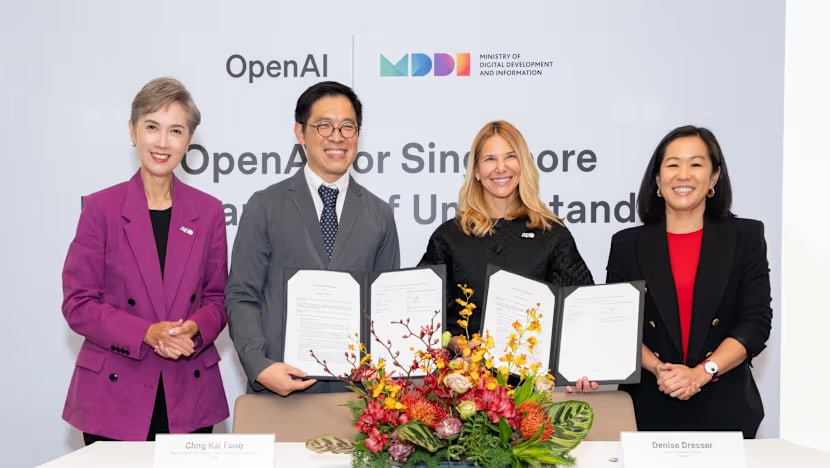
OpenAI has operated in Singapore since 2024, when it opened an office intended to support customers and partners across the Asia‑Pacific region. That office was a commercial outpost. What was announced on Wednesday at Singapore's ATxSummit is categorically different: OpenAI's first applied AI laboratory outside the United States.
The ChatGPT developer committed more than S$300 million, approximately $234 million, to strengthen Singapore's AI ecosystem under a Memorandum of Understanding signed with Singapore's Ministry of Digital Development and Information. The multi‑year partnership is the first national government agreement OpenAI has signed of this scope and sits within a framework the company is calling OpenAI for Singapore.
The agreement covers three areas: establishing an OpenAI Singapore Applied AI Lab, developing local AI talent programmes, and supporting startups, small businesses and public sector agencies. The Lab will create 200 engineers and technical specialists in the next few years to help Singaporean enterprises harness frontier AI into economic returns particularly in public services, finance, healthcare and digital infrastructure.
The ATxSummit timing is not incidental. Singapore's flagship technology conference, which has put an explicit focus on AI deployment this year, provided the public stage for what amounts to a coordinated national AI positioning announcement. Google also announced a Singapore deal on the same day, with a focus on training government researchers to use agentic AI tools for science, working with the Ministry of Education to train educators, and exploring collaborations in healthcare and life sciences. The two announcements together describe a city‑state that has successfully positioned itself as the preferred entry point for frontier AI companies expanding into Asia.
Why Singapore and Why Now
The question every analyst asks about OpenAI's choice of Singapore as the location for its first international applied AI lab is whether the commercial logic matches the political narrative, or whether this is primarily a diplomatic investment rather than a technical one.
The case for genuine commercial logic is specific. Singapore has one of the highest concentrations of Southeast Asian financial services infrastructure, with the regional headquarters of most major global banks and asset managers located in the city. It is the entry market for AI deployments across financial services companies that serve clients from Indonesia, Malaysia, the Philippines, Thailand, and Vietnam simultaneously. The regulatory environment, while rigorous, is more predictable than most Southeast Asian alternatives. The English‑speaking talent pool includes graduates from institutions with strong technical programs, and the city's immigration framework allows rapid talent acquisition.
The city‑state has been trying to carve out a niche in the global AI race, positioning itself as a neutral and talent‑rich platform for developing, testing and deploying AI solutions.
Singapore's own AI investment history provides the foundation that makes an OpenAI lab viable. The government invested over S$1 billion in public AI research through 2030, committed S$500 million in high‑performance computing infrastructure in 2024, and spent more than S$500 million on AI research and development through its AI Singapore national programme from 2019 through the mid‑2020s. A country that has spent billions building AI infrastructure and talent pipelines over a decade is a more useful location for a production‑oriented applied lab than a country starting from scratch regardless of market size.
The Competitive Dimension: OpenAI vs Accenture, Deloitte, and the Consulting Industry
The initiative builds on OpenAI Deployment Co., the company's services unit that embeds engineers within client organisations. This consulting‑style approach positions OpenAI against advisory firms like Accenture and Deloitte in the growing AI services market.
This sentence captures something about the Singapore announcement that the official press release does not emphasise. OpenAI is not simply licensing access to GPT‑5.5 to Singapore enterprises. It is embedding engineers inside client organisations to deliver AI outcomes directly. This is a consulting model, and the Singapore Applied AI Lab is the operational infrastructure that makes that model scalable in the Asia‑Pacific region.
The management consulting firms that have historically owned enterprise technology transformation engagements have been watching OpenAI's services ambitions with concern. A lab with 200 engineers in Singapore that can deploy directly into financial institutions, healthcare systems, and government agencies is a direct competitive entry into engagements that Accenture, Deloitte, McKinsey, and BCG have charged billions to execute. The difference is that OpenAI's engineers are building implementations of OpenAI's own models, which creates a vertical integration advantage that consulting firms cannot easily replicate.
Sam Altman's statement at the announcement described the partnership's direction in terms that reflect both commercial and geopolitical intent. OpenAI is striking partnerships with governments across the planet as part of a bid to stay ahead of rivals such as Anthropic and Google. The Singapore announcement, coinciding with Google's own Singapore AI partnership on the same day at the same summit, is the most visible manifestation of a race to establish national AI relationships that will shape which foundation models become the default infrastructure for government and enterprise AI in Asia over the next decade.
More at openai.com | Singapore MDDI at mddi.gov.sg
Stay informed
Startup news in your inbox
Get important funding rounds, founder stories, and startup updates.
No spam - only important startup updates.
Comments
Text only. No links or images.
No comments yet.