
Indian AI Coding Startup Emergent Becomes a Unicorn Just One Year After Launch

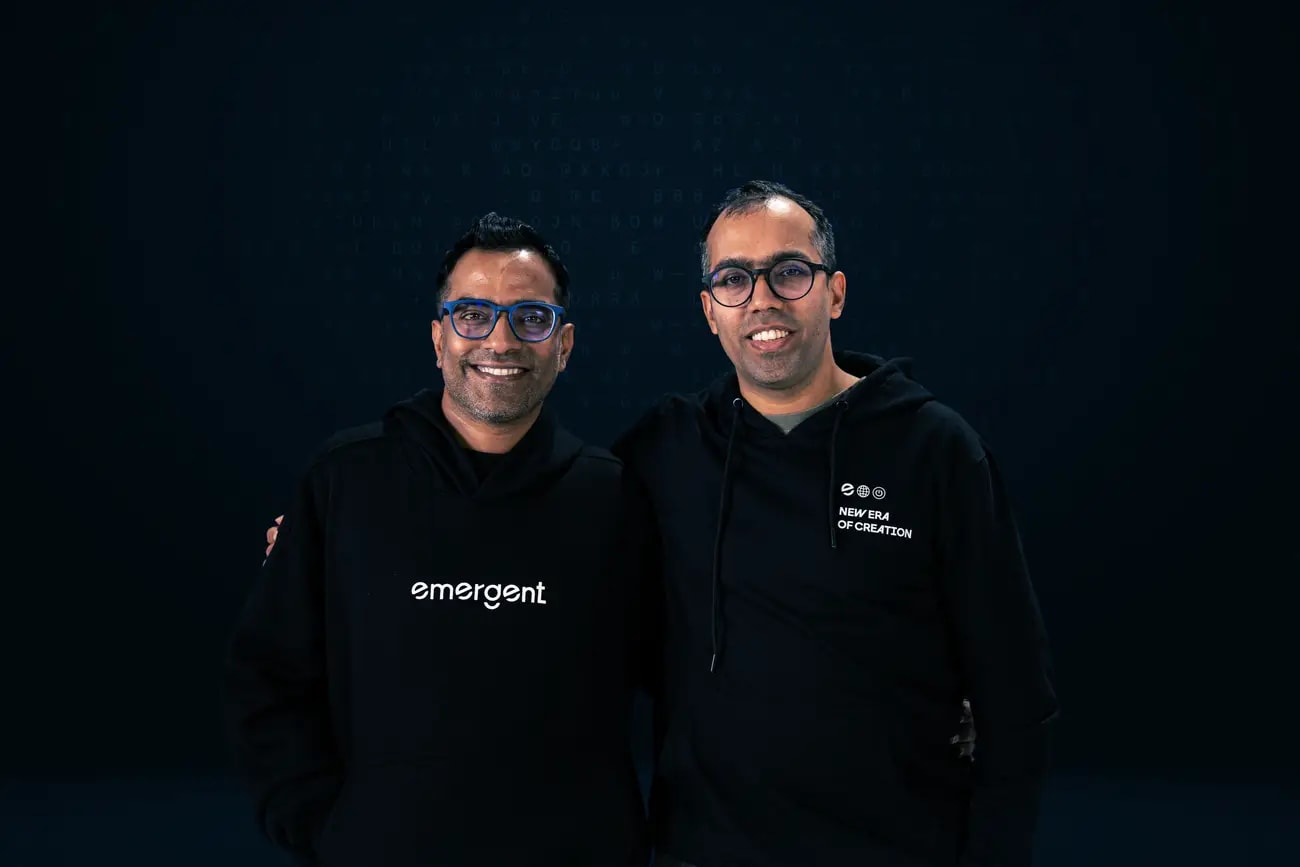
An AI coding startup founded by twin brothers just over a year ago has become one of the fastest companies in recent memory to reach unicorn status, closing a funding round that values it at 1.5 billion dollars.
Emergent, founded by Mukund and Madhav Jha in June of last year, has raised 130 million dollars in a Series C round led by private equity firm Creaegis, with MNI Ventures‑Claypond Capital and Sentinel Global serving as co‑lead investors. Existing backers Khosla Ventures, SoftBank Vision Fund 2, Lightspeed, and Y Combinator also returned for the round, which brings the company's total disclosed funding to roughly 230 million dollars.
The jump in valuation has been unusually steep even by the standards of the current AI funding environment. Emergent raised a 70 million dollar Series B in January at a 300 million dollar valuation, meaning its worth has increased roughly five times over in just six months. Before that, the company raised a 23 million dollar Series A led by Lightspeed, with participation from Prosus, Together, Y Combinator, and Google's AI Futures Fund.
Mukund Jha previously served as chief technology officer and co‑founder of Dunzo, the Indian quick‑commerce startup, while his brother Madhav holds a doctorate in theoretical computer science from Penn State University and helped start the Amazon SageMaker research team. Together, the pair built Emergent around a different bet than most of the crowded AI coding market. Rather than targeting professional developers or generating basic websites and prototypes, the platform is built to produce production‑ready software, including customer relationship management systems, inventory and manufacturing tools, and online marketplaces for small businesses and solo entrepreneurs.
That focus shows up clearly in the company's user base. Roughly 70 percent of Emergent's users have never written code before, according to the company, and its customers span trucking companies building shipment tracking software, factories, construction firms creating enterprise resource planning systems, and property managers developing internal tools. Jha described the pitch as effectively giving non‑technical founders an engineering team in a box, distinguishing the platform from developer‑focused coding tools like Anthropic's Claude Code, OpenAI's Codex, and Cursor.
Emergent reports an annual run‑rate revenue of 120 million dollars, up 70 percent over the past four months, with more than 200,000 paying customers and users having built over 12 million applications across 190 countries since launch. The company's newer Wingman feature extends the platform beyond pure app building into running day‑to‑day operations, using autonomous agents to handle tasks such as customer follow‑ups and scheduling.
Geographically, the company's revenue splits fairly evenly across regions, with North America accounting for roughly a third of the business, Europe another third, and the remainder coming from other markets. That European traction is significant enough that Jha said the company is now considering opening an office there, following its UK expansion plans. Emergent currently employs around 200 people, the majority based in Bengaluru, with a smaller team in San Francisco that the company plans to grow by 30 to 40 people by the end of the year.
Jha acknowledged that design remains an area for improvement, noting that many websites generated through AI tools tend to look visually similar to one another regardless of which platform built them. The company's roadmap includes efforts to improve the reliability of applications built on the platform and to support more complex AI applications, including ones that run on local and open‑source models rather than relying solely on commercial AI providers.
The raise lands amid intensifying competition in what has become known as the vibe coding category, where AI tools let people describe software in plain language rather than writing code directly. Stockholm‑based rival Lovable is reportedly targeting a valuation above 13 billion dollars after surpassing 500 million dollars in annual revenue, putting Emergent's 1.5 billion dollar valuation on the more modest end of the category despite its rapid rise. Prakash Parthasarathy of Creaegis, the round's lead investor, said the company's focus on production‑grade software rather than surface‑level prototypes positions small businesses and solo founders to take advantage of a shift in who gets to build software, calling it a historic moment for entrepreneurs who previously had no realistic path to custom technology. With global AI spending projected to reach 2.59 trillion dollars in 2026, and the broader vibe‑coding market alone expected to be worth close to 4.7 billion dollars this year, investors are betting Emergent's narrower focus on non‑technical small business builders gives it room to grow even as larger, better‑funded rivals chase similar ground.
Stay informed
Startup news in your inbox
Get important funding rounds, founder stories, and startup updates.
No spam - only important startup updates.
Comments
Text only. No links or images.
No comments yet.