Ex-Meta VP Behind a Controversial Surveillance Tool Launches Glow, a 1.2 Billion Dollar Cybersecurity AI Unicorn
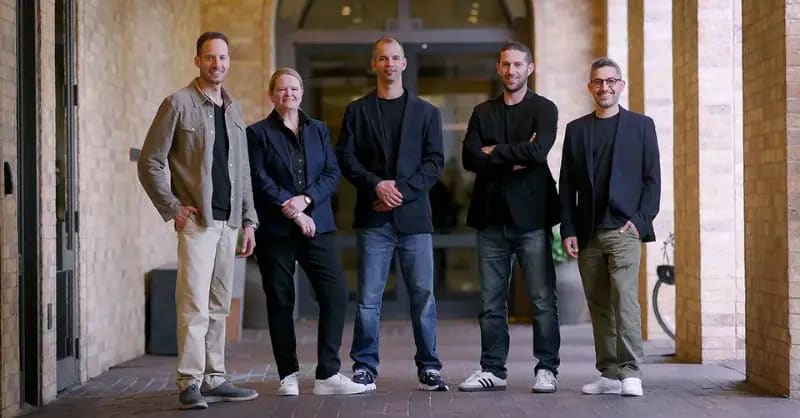
Roi Tiger (CEO),Omer Singer (VP of Strategy), Ophir Arie (VP of R&D)
Image credit: Glow
Cybersecurity startup Glow has emerged from stealth with 180 million dollars in an all equity Series A round at a 1.2 billion dollar valuation, betting that artificial intelligence is fundamentally changing how enterprises need to secure employee devices, from laptops to servers and other connected endpoints.
The round was led by Sequoia Capital, Cyberstarts, Greenoaks and Redpoint Ventures, with additional participation from Index Ventures, Swish Ventures, Lux Capital, Operator Collective and Holly Ventures. The investment places Glow among a growing group of cybersecurity startups, Wiz among them, that have crossed the billion dollar valuation mark before publicly disclosing any revenue figures, a sequencing that has become increasingly common within Israeli cybersecurity funding circles.
A Founding Team With Deep Roots in Enterprise Security
Glow was founded in 2025 and is based across Tel Aviv and Palo Alto, built by chief executive Roi Tiger, chief technology officer Omer Singer and vice president of research and development Ophir Arie. Singer previously led cybersecurity strategy at Snowflake, while Arie ran research and development at industrial security firm Claroty. Chief product officer Arnon Joseph spent eight years at Meta as a senior product director, and chief operating officer Emily Heath previously served as chief information security officer at United Airlines and DocuSign, while also sitting on the board of Wiz through its reported 32 billion dollar acquisition by Google.
Tiger's own background in the industry stretches back roughly fifteen years, when he co‑founded Onavo alongside Guy Rosen in Tel Aviv, building a mobile app designed to help users compress and monitor their mobile data usage. Meta acquired Onavo in 2013 for a reported figure between 120 million and 200 million dollars, and Tiger remained with the company for nine years, eventually rising to vice president of engineering.
The History That Follows Glow Into Its Launch
Court documents unsealed in 2024 revealed that Meta chief executive Mark Zuckerberg had directed staff in 2016 to find ways to gather analytics on competing platforms, including Snapchat, using Onavo's underlying technology. Apple removed Onavo from its app store in 2018 over data collection concerns, and Meta shut the app down entirely in 2019. Tiger has not publicly addressed his role in that chapter of the company's history, and Glow's launch materials do not reference it directly.
Glow's current pitch stands in notable contrast to that history. Rather than covertly monitoring device activity to gather intelligence, the company's platform is built to give enterprise security teams direct, transparent control over what software and AI tools are permitted to run on employee devices in the first place.
Shifting From Detection to Prevention
Glow's central argument is that traditional endpoint security tools were built primarily to detect and respond to threats after they occur, an approach the company argues is no longer sufficient as employees increasingly connect AI assistants, autonomous agents and third party AI applications to corporate systems, often faster than security teams can properly evaluate them.
According to Glow's own data, unauthorized AI use on corporate devices has climbed from roughly 15 percent to 45 percent over the past year alone. The company's AI agents are designed to map what software is currently running on a given device, assess the associated risk in real time, and block unapproved applications before they are ever installed, rather than flagging problems only after a compromise has already taken place.
Targeting an Increasingly AI‑Driven Threat Landscape
Glow frames its platform as a response to attackers who are increasingly using generative AI themselves to automate phishing campaigns, develop malware more efficiently and launch more sophisticated attacks at a pace traditional security tooling was not designed to match. That shift has prompted many enterprises to reconsider how they approach endpoint security more broadly, moving away from purely reactive detection models toward proactive prevention systems built around continuous, automated risk assessment.
The company has named no specific customers publicly, describing its early traction only in terms of broad sectors including healthcare, retail and financial services, a common pattern among early stage cybersecurity companies still building out named reference customers ahead of a fuller public launch.
What the Funding Will Support
Glow plans to use its new capital to expand its presence in the United States, grow a newly established research arm called Glow Labs, and continue building out the AI native capabilities of its endpoint security platform. The company already employs close to 100 people across its Tel Aviv and Palo Alto offices, a relatively large team for a company still in its first full year of operation, reflecting the seniority and experience level of its founding group.
Whether enterprises are ultimately willing to hand over decisions about what software runs on their systems to an AI agent remains an open question, one that will likely shape how quickly Glow can convert its early funding momentum and experienced leadership team into the kind of measurable customer traction that has so far been notably absent from its public launch.
Topics
Stay informed
Startup news in your inbox
Get important funding rounds, founder stories, and startup updates.
No spam - only important startup updates.
Comments
Text only. No links or images.
No comments yet.