Nscale Bets $3.5B on Figure's Humanoid Robots, Becoming Both Its Investor and Its Compute Supplier

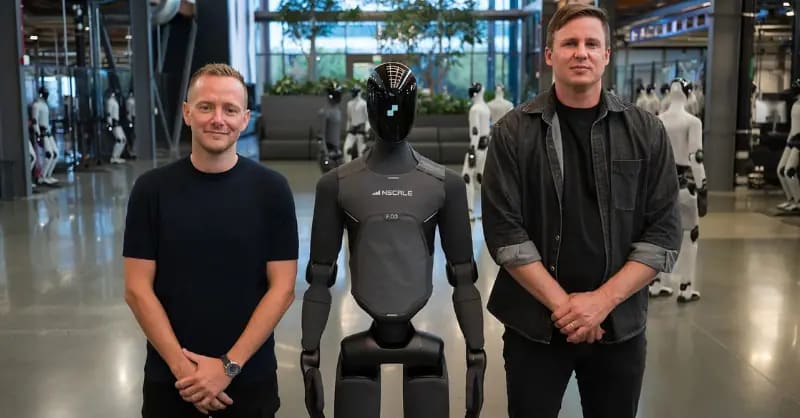
Josh Payne (Nscale) and Brett Adcock (Figure)
Nscale, the London based AI infrastructure company, has signed a multi‑year agreement to supply at least 3.5 billion dollars of AI cloud compute to Figure, the humanoid robotics company chasing a 39 billion dollar valuation, with room for the deal to grow past 6 billion dollars over time.
Training a humanoid robot to fold laundry, stack groceries, or work a factory floor for a full eight‑hour shift requires a surprising amount of computing power, in some cases exceeding what is needed to train a large language model, and that computational appetite is precisely what this deal is built to satisfy. Alongside the compute agreement, Nscale is also making an undisclosed strategic investment in Figure, becoming both a shareholder in the company and its preferred compute provider simultaneously. Up to 100,000 Nvidia GPUs are earmarked for the partnership, with the first systems targeted to come online at Nscale's Barstow, Texas site in the second half of 2027.
Figure founder and chief executive Brett Adcock framed the deal around the specific technical bottleneck it addresses. "Our AI model, Helix, becomes more capable the same way every learned system does: with more data and compute. Today we're excited to partner with Nscale to bring the compute required to make this vision a reality," Adcock said. Under the arrangement, Nscale will supply compute and orchestration infrastructure, Nvidia will supply the underlying chips, and Figure will build the AI models and physical robots on top of that combined foundation.
That structure follows a playbook Nvidia itself has used repeatedly with AI labs it invests in directly, and it is drawing similar scrutiny here. Some observers on Wall Street have flagged these kinds of circular arrangements, where an infrastructure provider takes an equity stake in the very customer buying its compute, as a technique that can make underlying demand for AI infrastructure look larger and more organic than it might actually be, since a portion of the "demand" is effectively subsidized by the infrastructure provider's own investment dollars flowing back to the customer.
Nscale is not short on capital to make this kind of bet. The company closed a 2 billion dollar Series C at a 14.6 billion dollar valuation in March, and just weeks before this Figure deal, closed roughly 3 billion dollars in debt financing specifically to build out GPU campuses across Texas and North Carolina. Nscale is also reportedly preparing for a potential US initial public offering, having told prospective investors it has secured approximately 51 billion dollars in contracted revenue backlog, a figure that gives context to why the company is willing to commit billions more toward a single robotics customer.
Nvidia chief executive Jensen Huang described the arrangement as a closed, self‑reinforcing loop of technology. "Nscale and Figure have activated the robotics flywheel: training Figure's models on Nvidia Vera Rubin through Nscale's AI cloud, validating them in Nvidia Isaac Sim, and deploying them on Nvidia GPUs in Figure's robots," Huang said. Nscale founder and chief executive Josh Payne offered a shorter framing of the same idea: "We're proud to be enabling the future of AI robotics together."
Figure's need for this scale of compute is tied directly to an unusually large and fast‑growing data pipeline. The company's recently launched Index initiative is now processing 30 minutes of human training video every second, contributed by paid human creators through a dedicated smartphone app, giving Figure an enormous and continuously growing stream of raw behavioral data to train its models on. More raw data alone does not solve the underlying problem, however; turning that data into a robot genuinely capable of working a real shift requires sustained, large‑scale training runs that Figure has said it lacked the infrastructure to run at the pace it wanted, until this deal.
Figure previously closed a Series C exceeding 1 billion dollars at a 39 billion dollar valuation in September 2025, led by Parkway Venture Capital with Nvidia, Intel Capital, Salesforce, and Qualcomm Ventures among the backers, following an earlier 675 million dollar Series B in 2024 that included Microsoft, Nvidia, Amazon's Industrial Innovation Fund, and Jeff Bezos through Bezos Expeditions.
Figure is far from alone in commanding this scale of capital within humanoid robotics. Skild AI raised 1.4 billion dollars in January at a valuation above 14 billion dollars, led by SoftBank with Nvidia and Bezos also investing. Apptronik closed a 520 million dollar Series A extension in February, pushing its total round size past 935 million dollars. Physical Intelligence was reported in March to be in talks for roughly 1 billion dollars at a valuation above 11 billion dollars, though that round had not been confirmed as closed months later. Taken together, humanoid robotics startups have raised 8.6 billion dollars so far in 2026, already 1.8 times the total raised across the entirety of 2025, underscoring how rapidly investor capital has poured into the category over a very short window.
The open question hanging over all of this capital, for Figure and its well‑funded competitors alike, is whether any of these companies can convert warehouse pilots and choreographed factory demonstrations into robots genuinely capable of paying their own compute bills through real commercial deployment, before investors begin asking more pointed questions about who is actually buying the finished output rather than simply funding the training infrastructure behind it.
Topics
Stay informed
Startup news in your inbox
Get important funding rounds, founder stories, and startup updates.
No spam - only important startup updates.
Comments
Text only. No links or images.
No comments yet.