Nuance Labs Raises $50M To Build Emotionally Intelligent AI Conversations
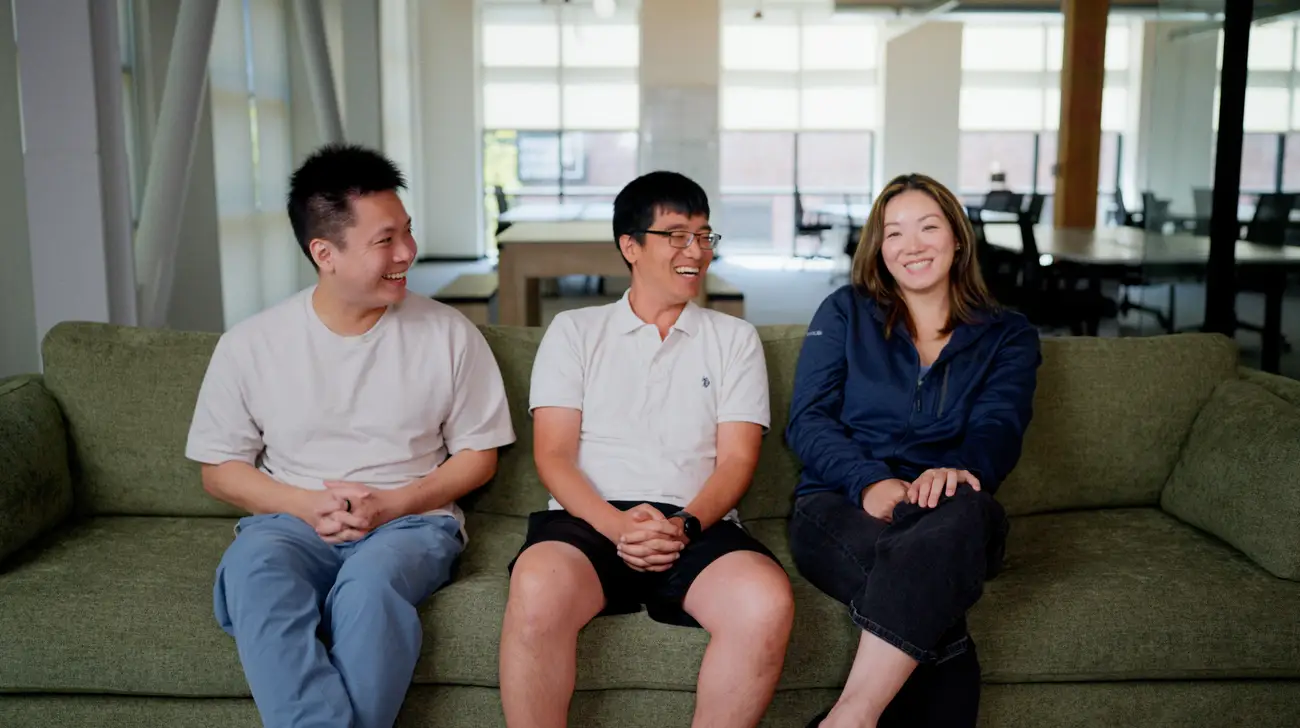
Nuance cofounders Fangchang Ma (CEO), Edward Zhang, and Karren Yang,
Image credit: Nuance
Nuance Labs, a Seattle based AI research company, has raised 50 million dollars in a Series A funding round to build a single model capable of reading and responding to human emotion in real time, an approach the company argues current AI avatars and voice assistants cannot manage because they are built from separately stitched together parts.
The round was led by returning investor Lightspeed Venture Partners, with participation from existing backers Accel and South Park Commons, alongside new investors NVIDIA's NVentures and Define Ventures. It follows a 10 million dollar seed round led by Accel that closed last year, shortly after the company was founded.
Nuance Labs was started by Fangchang Ma, Edward Zhang and Karren Yang, three researchers who spent years at Apple working on how machines perceive and reconstruct people. According to the company, that earlier work repeatedly ran into the same limitation, that faithfully reconstructing a person for telepresence was already difficult, and following the interplay of verbal and non‑verbal cues in a live, back and forth conversation was harder still. That gap between what existing systems could do and what a genuinely natural conversation requires became the starting point for the company.
The technical argument behind Nuance Labs centres on how current AI avatars and conversational agents are built. A typical system transcribes speech to text, passes that text to a language model that decides what to say next, converts the response back to speech, and separately animates a face to roughly match. Each handoff in that chain introduces delay, and much of what makes a conversation feel human, including tone, gaze, timing and small facial reactions, tends to get lost somewhere between those separate components. The result, the company argues, is the familiar uncanny valley effect, where an avatar sits frozen while a person talks, talks over them, or simply cannot keep pace with a live exchange.
Nuance Labs is building a single full duplex model intended to replace that chain of separate systems entirely. The model processes audio and video simultaneously and continuously, rather than waiting for one input to finish before generating a response, and it is designed to pick up on cues beyond spoken words themselves, including facial expression, gaze direction, gesture and conversational timing. The aim is a system that can hold the kind of natural give and take found in a conversation with another person, responding with both vocal and facial expression rather than a single output channel.
Lightspeed has framed its interest in the company around a broader shift it sees taking shape across AI more generally. As large language models make raw reasoning ability increasingly commoditised, the firm has argued that emotional intelligence is emerging as the next real point of differentiation between AI systems, and that just as language models learned to understand meaning by predicting the next word, a model can learn to understand emotion by learning to predict human emotional behaviour directly from audiovisual data. Nnamdi Iregbulem, a partner at Lightspeed, has described the founding team's combination of technical depth and execution as central to the firm's decision to lead the round, calling the resulting single model a potential foundational layer for AI products more broadly.
The new funding will go toward three main priorities, accelerating development of the core model, expanding the research team across modeling, data, evaluation, inference and real time serving, and supporting the company's first public research preview, expected later this year, where people will be able to try a face to face conversation with the model directly. Sign‑ups for that preview are currently open through the company's own waitlist.
Nuance Labs enters a field where voice based AI assistants have already reached wide adoption, while equivalent face to face or avatar based systems have lagged behind. The company's argument is that voice AI succeeded despite its flaws because it was still more useful than the alternatives that came before it, and that face to face AI has not yet crossed that same threshold of usefulness, largely because of the latency and disjointedness that comes from assembling several separate systems into one pipeline. Whether a single unified model can close that gap in a way that feels genuinely natural, rather than simply a faster or smoother version of the same stitched together approach, is likely to become clearer once the public research preview goes live and a wider group of people can judge the experience directly rather than relying on early demonstrations.
Topics
Stay informed
Startup news in your inbox
Get important funding rounds, founder stories, and startup updates.
No spam - only important startup updates.