Samsung Leads Mistral's Record €3B Round, Making Chip and Cloud Partners Into Shareholders Too
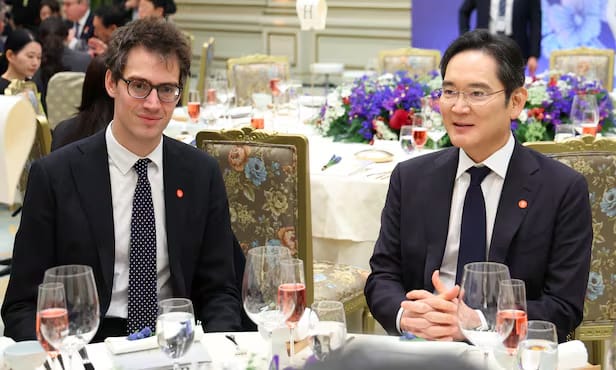
Lee Jae-yong, Chairman of Samsung Electronics, and Arthur Mensch, CEO of Mistral
Image credit: Mistral
Mistral, the Paris based AI lab, has closed a 3 billion euro Series D funding round led by Samsung Electronics, pushing its valuation past 21 billion euros, roughly 24 billion dollars, in what the company describes as the largest equity raise ever achieved by a European technology company.
The Scaleup Europe Fund, managed by EQT, and existing investor PSG Equity also participated in the round, with the deal marking the Scaleup fund's first investment since EQT took over as its manager. New investors Advent, funds managed by BlackRock, and the Grand Duchy of Luxembourg joined the round, alongside a long list of returning backers: a16z, ASML, Belfius, BNP Paribas CIB, Bpifrance, Carmignac, DST Global, Eurazeo, General Catalyst, Headline, Hillspire, Index Ventures, Korelya Capital, Lightspeed, Nvidia, Phoenix Court's Solar fund, and Salesforce Ventures.
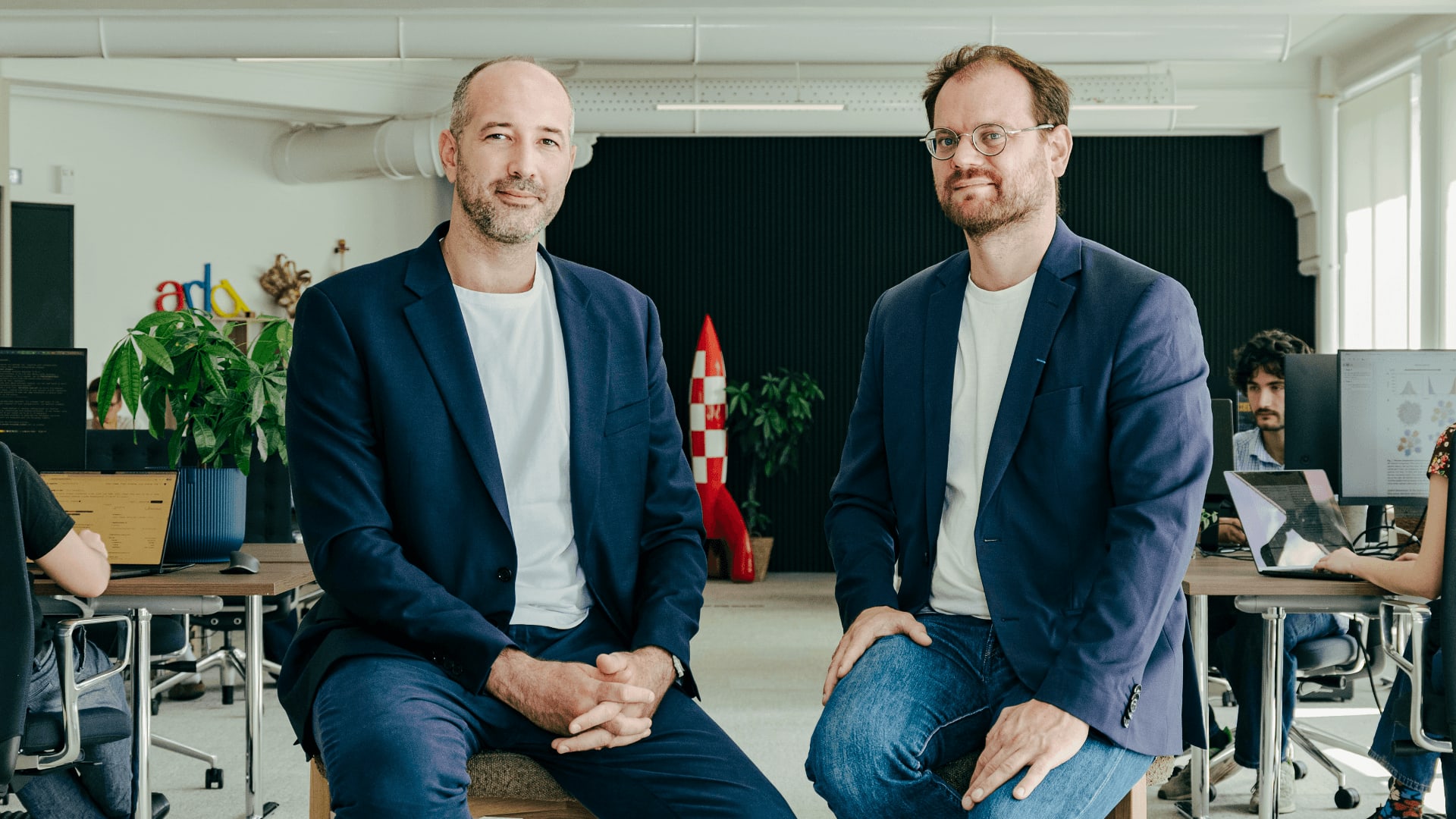
Mistral was founded in April 2023 by Arthur Mensch, Guillaume Lample, and Timothée Lacroix, who first met as students at École Polytechnique near Paris before working at Google DeepMind and Meta's AI research division, respectively. They left those roles to build a company explicitly positioned as a European alternative to vendors based only in the United States, betting that businesses and governments would want a credible option beyond OpenAI and Anthropic. Mensch serves as chief executive, Lample as chief scientist, and Lacroix as chief technology officer.
Mensch framed the company's core pitch around a specific structural advantage built into its approach. "Organisations want to industrialise AI inside systems that are already complex: their own data, their own tools, their own compliance constraints," he said. "It's why we've built Mistral on open‑weight frontier models and infrastructure that we control end to end, so our customers can too." That emphasis on open‑weight models, in contrast to the closed systems OpenAI and Anthropic keep proprietary, has become central to Mistral's positioning with regulated industries specifically. A bank running Mistral's models inside its own data center keeps customer records entirely outside US‑owned cloud infrastructure, a distinction that matters considerably for financial institutions and governments navigating strict data residency requirements.
Mistral says its strategy has already secured more than 125 enterprise customers across 20 countries, including Airbus, ASML, and HSBC. The company now employs more than 1,000 people, and plans to direct the new funding toward advanced research, expanded training capacity, and accelerated international growth, on top of the 4 billion euros already committed to building European data centers.
The round carries a notable structural feature: several of Mistral's key hardware and infrastructure partners are now also its shareholders. ASML, Samsung, and Nvidia each supply Mistral with critical hardware, chips, or cloud infrastructure, and each now holds an equity stake in the company as well, a dynamic that mirrors the increasingly common pattern across the AI industry of infrastructure providers investing directly in the very companies buying their products and services.
EQT partner Kirk Lepke, whose fund previously backed European scale‑ups Wolt and Mews, described Mistral's ambition in broad terms. "Most companies at the frontier choose a layer," Lepke said. "Arthur and his team are building across all of them, models, infrastructure and applications, from Europe, and at remarkable speed. We believe that combination of ambition and execution puts Mistral in a strong position to shape the next era of AI."
The scale of this round nearly doubles Mistral's valuation from its previous Series C, led by ASML roughly a year earlier, and brings the company's total disclosed equity funding since 2023 to approximately 6 billion euros, on top of an 830 million dollar debt facility secured in March 2026 specifically to purchase Nvidia GPUs. Even at 21 billion euros, however, Mistral's valuation remains considerably smaller than its two primary American rivals: OpenAI closed a 7 billion dollar tender offer at an 852 billion dollar valuation, while Anthropic raised at a 965 billion dollar valuation, overtaking OpenAI for the first time. That gap underscores just how much larger the US frontier AI labs have grown relative to their most prominent European counterpart, even as Mistral's own valuation has climbed steeply in absolute terms.
The raise arrives as Europe continues pushing to demonstrate that its AI industry can compete financially and technologically with the American labs dominating global headlines, rather than serving merely as a regional alternative. The global generative AI market was valued at roughly 390 billion dollars in 2025 and is projected to approach 3.5 trillion dollars by 2033, and Mistral's stated ambition is not necessarily to build the single largest model, but to become the primary European‑owned model that enterprises in regulated industries can run entirely under their own control. Samsung, EQT, and PSG Equity are betting that this kind of sovereignty carries genuine commercial value distinct from raw model performance. The open question, as Mistral itself would likely acknowledge, is whether Airbus, HSBC, and its other enterprise customers ultimately agree, or whether they instead migrate toward whichever American lab offers the most capable model regardless of where it is built or hosted.
Topics
Stay informed
Startup news in your inbox
Get important funding rounds, founder stories, and startup updates.
No spam - only important startup updates.
Comments
Text only. No links or images.
No comments yet.