
Scapia Raises $63M Led by General Catalyst, More Than Doubles Valuation to $500M+ as India's Travel Fintech Moment Arrives
Editorial Team
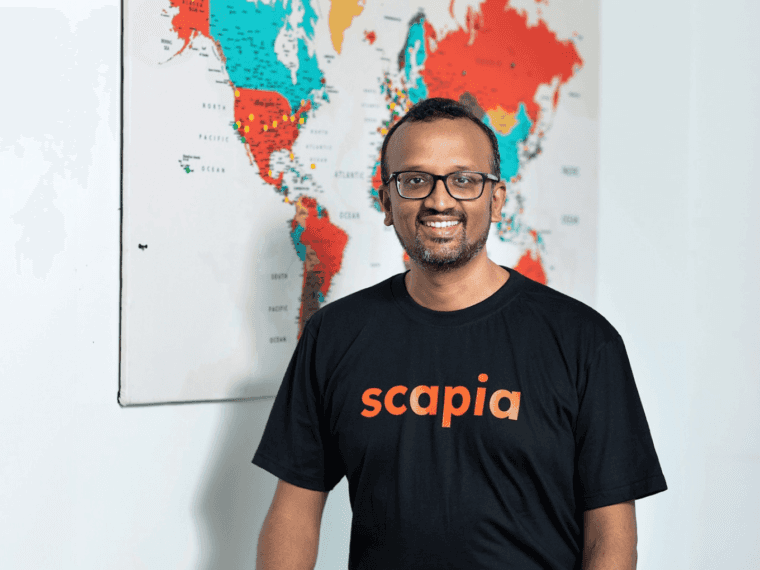
Scapia, the Bengaluru‑based startup that has built a travel‑first financial ecosystem for young Indians, has raised $63 million in a new funding round led by General Catalyst, with continued participation from existing investors Peak XV Partners and Z47. The deal, announced on May 21, assigns Scapia a post‑money valuation of more than $500 million, more than doubling the company's approximate $200 million valuation from just over a year ago when it closed its Series B in April 2025.
Total equity funding since Scapia's founding in January 2022 now stands at approximately $126 to $135 million across multiple rounds. The round was announced against a backdrop of declining fintech deal volumes in India, where Q1 2026 saw the number of deals fall by more than half compared to the prior year even as aggregate funding remained roughly flat. That Scapia closed this round at a significantly higher valuation in that environment is itself a meaningful data point about investor confidence in the company's specific trajectory.
What Scapia Builds and Who Uses It
Founded by Anil Goteti, a former Flipkart executive, Scapia sits at the intersection of two of the fastest‑growing consumer behaviors in India: digital payments and outbound travel. The company offers co‑branded credit cards in partnership with Federal Bank and BOBCARD, combining the financial infrastructure of established banks with a consumer product designed entirely around how young, digitally native Indians think about spending.
The platform has expanded significantly since the credit card product first launched. Scapia's current ecosystem includes:
- Co‑branded travel credit cards with Federal Bank and BOBCARD offering rewards built for frequent flyers
- Scapia Pay, a rewards‑first UPI experience launched in the past six months
- Add‑on credit cards and credit card bill payments across all banks through the Bharat Bill Payment System
- The Scapia Store, a commerce layer built inside the app
- Scapia Experiences, a curated travel and lifestyle product
- Flight and stay booking infrastructure integrated directly with the financial products
That breadth reflects a deliberate super‑app philosophy. The credit card product is what Goteti has described as the financial product at the core of a comprehensive travel ecosystem, not a standalone card. Every other product in the Scapia stack is designed to deepen engagement with users who already have a Scapia card and give non‑cardholders a reason to download the app and eventually convert.
The Growth Metrics Driving the Raise
The commercial evidence behind Scapia's valuation step‑up is specific and verifiable. Flight bookings on the platform have grown 5 to 6 times year‑on‑year. Stay bookings have grown 8 times over the same period. Tier‑II and tier‑III cities in India, places like Jaipur, Kochi, Indore, and Surat, are contributing a rising share of overall bookings, which matters because it signals that Scapia's appeal is not limited to metro consumers who already have multiple fintech options.
Revenue from operations reached Rs 40.4 crore in FY2025, up 67 percent from Rs 24.2 crore in FY2024. Net losses narrowed marginally to Rs 83.1 crore from Rs 88 crore, reflecting a business that is still investing for growth but doing so against a backdrop of improving unit economics. Employee count reached 145 by August 2025, up 65 percent year‑on‑year.
The valuation multiple implied by the $500 million post‑money figure at current revenue is high, as it is for most consumer fintech platforms at this stage. What General Catalyst is pricing is the trajectory and the market structure, not the current revenue base.
Why General Catalyst Led This Round
General Catalyst's decision to lead this round is significant for reasons beyond the capital. The firm is one of the most prominent US venture investors, with a portfolio that includes Airbnb, Stripe, Snap, and Canva. Its participation in an Indian travel fintech round of this size signals genuine conviction about the specific market Scapia is targeting, not just a portfolio diversification gesture toward emerging markets.
The timing is also notable. India's UPI‑based payments infrastructure is one of the most sophisticated real‑time payment systems in the world, handling billions of transactions per month. Credit card penetration relative to India's total population remains low compared to developed markets, which means the growth runway for a well‑designed travel credit product aimed at the generation of Indians now entering their peak earning and spending years is genuinely large. General Catalyst's thesis, as articulated by the firm around the investment, is that Scapia is building for a generation of Indians that treats travel as a way of life rather than an occasional luxury.
Peak XV Partners and Z47, both of which led or participated in the prior Series B, continuing into this round is another signal. Existing investor follow‑on participation in a new round from a new lead indicates the existing investors see the same trajectory that General Catalyst saw in due diligence.
Competition and Market Context
Scapia competes with Niyo, another Indian startup blending banking and travel, and with Ixigo on the travel booking side. Global fintech players including Revolut have publicly identified India as a priority market for expansion. The competitive environment is not empty, but Scapia's credit card at the center of a travel ecosystem, rather than a travel platform bolted onto a banking product, gives it a structurally different entry point into customer acquisition and retention.
India's alternative payments startup segment has attracted over $418 million in funding since 2020, with 2025 marking a peak in deal activity. The broader Indian media and entertainment market and travel demand are both growing, and the intersection of young consumers with disposable income, a preference for digital financial products, and a rising aspiration to travel internationally is exactly the demographic Scapia has built its product around.
Goteti has framed the company's direction clearly. Scapia plans to use the $63 million to scale to millions of customers across India, sharpen the product suite, build brand presence, and accelerate the transition to what he describes as an AI‑first organization. Engineering, product, data science, and design hires are explicitly called out as priorities for the capital deployment, with AI talent specifically highlighted as the central focus.
Stay informed
Startup news in your inbox
Get important funding rounds, founder stories, and startup updates.
No spam - only important startup updates.