Startup News Roundup: July Week 4, 2026, Materials AI, Battery Tech, Fintech and Cybersecurity Lead the Week
Editorial Team
startup update july week 4 2026
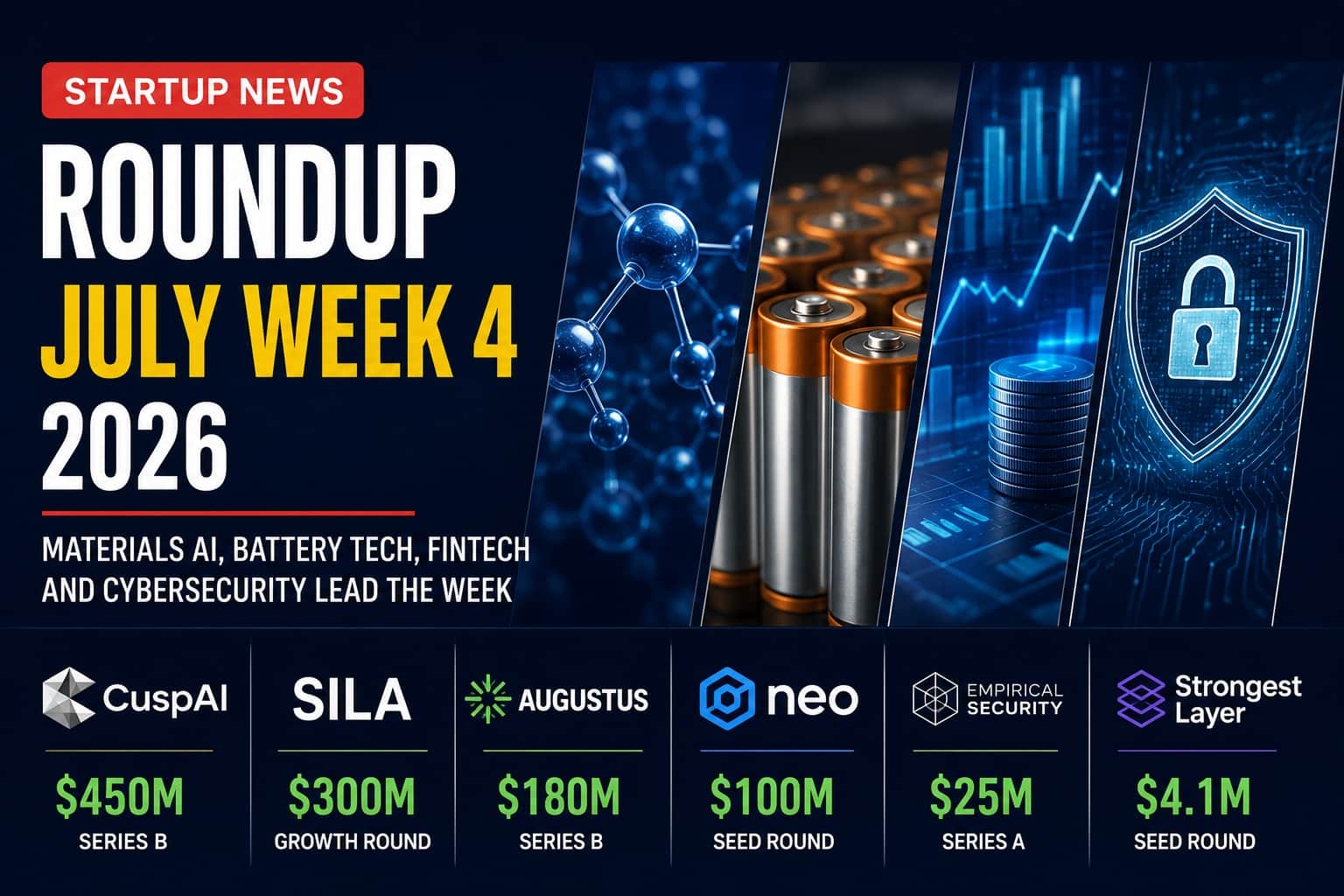
The fourth week of July brought a wide spread of venture activity, from a nine‑figure bet on AI‑driven materials science to fresh capital for battery manufacturing, fintech infrastructure and three distinct approaches to cybersecurity. Here is a roundup of six standout funding rounds from the week, spanning deep tech, energy, finance and security.
CuspAI Raises 450 Million Dollars to Speed Up Materials Discovery With AI
Cambridge, UK‑based CuspAI raised 450 million dollars in a Series B round, backed by Kleiner Perkins, NEA, Bezos Expeditions, the UK government, AMD Ventures, Lux Capital, Glade Brook Capital Partners, Invest‑NL and other investors, bringing its total funding to more than 650 million dollars. The company is applying AI models to materials discovery, a field that has traditionally relied on years of laborious laboratory experimentation to identify new compounds with useful physical or chemical properties. By simulating molecular interactions computationally before physical testing begins, CuspAI is positioning itself to compress discovery timelines across industries including energy storage, semiconductors and advanced manufacturing. The scale of the round, and the presence of a national government among its backers, signals how seriously materials science is now being treated as a frontier AI application rather than a niche academic pursuit.
Sila Raises 300 Million Dollars to Expand Battery Material Production
Battery materials company Sila closed a 300 million dollar growth round backed by Atreides Management, Sutter Hill Ventures, 8VC, Bessemer Venture Partners, Matrix Partners and funds advised by T. Rowe Price Associates, among other existing and new investors. The financing brings Sila's total capital raised to approximately 1.6 billion dollars and will support the expansion of its silicon‑carbon anode production facility in Moses Lake, Washington. Silicon‑carbon anodes are seen as a key upgrade over traditional graphite anodes in lithium‑ion batteries, offering higher energy density for electric vehicles and consumer electronics. The round reflects continued investor appetite for the physical, capital‑intensive infrastructure underpinning the broader electrification and battery supply chain, even as headline AI funding dominates most weekly venture coverage.
Augustus Raises 180 Million Dollars at a 1 Billion Dollar Valuation for Fintech Infrastructure
Augustus announced a 180 million dollar Series B round at a 1 billion dollar valuation, led by Tiger Global with participation from Hummingbird, QED Investors and a group of fintech and infrastructure focused founders. While the company has kept some product details close, the round places Augustus among a growing list of fintech infrastructure startups reaching unicorn status on the strength of enterprise demand for modernized financial rails and workflow automation. Tiger Global's participation, alongside a roster of operator‑investors from within the fintech ecosystem, suggests the round carries weight beyond its headline figure, with backers who bring direct operating experience in the exact infrastructure category Augustus is building within.
Neo Emerges From Stealth With 100 Million Dollars to Secure Enterprise AI Software
Cybersecurity startup Neo launched out of stealth with 100 million dollars in funding to help enterprises control and secure AI software operating with increasing autonomy inside their systems. The round underscores how much investor confidence continues to rest on founder track record in cybersecurity, particularly as the shift toward agentic, semi‑autonomous enterprise software creates security questions that traditional access control and monitoring tools were not built to answer. Neo's positioning centers on giving security teams visibility and control over what AI systems are permitted to do once they are granted access to sensitive enterprise environments, a governance layer that is quickly becoming its own cybersecurity subcategory as AI adoption inside large organizations accelerates.
Empirical Security Raises 25 Million Dollars to Predict Threats in the Agentic AI Era
Chicago‑based Empirical Security raised 25 million dollars in a Series A round led by Brightmind Partners, with additional participation from Costanoa Ventures, Hyde Park Angels and other investors, bringing its total funding to 37 million dollars. Founded in 2024, the company is building tools focused on predicting and identifying threats specifically in environments shaped by agentic AI, rather than relying purely on traditional signature‑based detection methods. Empirical's pitch is that as enterprises deploy more autonomous AI systems, the resulting attack surface grows both faster and messier than what conventional vulnerability management tools were designed to track, creating demand for platforms built specifically to monitor and predict threats tied to that shift.
StrongestLayer Raises 4.1 Million Dollars to Catch Email Attacks That Evade Traditional Filters
StrongestLayer announced 4.1 million dollars in new funding, led by Inovia Capital with participation from Sorenson Capital, LaunchPod, Alumni Ventures and former Mandiant chief product officer Chris Key, bringing its total seed funding to 9.3 million dollars. The company argues that a growing share of damaging email attacks, particularly scams and business email compromise attempts, now evade traditional pattern‑matching security systems since they contain no obviously malicious payload or link. Rather than scanning for known malicious signatures, StrongestLayer's approach is built around analyzing intent and context within a message, a smaller but increasingly common bet among email security startups responding to attackers who have grown more sophisticated at avoiding conventional detection.
What the Week's Funding Activity Shows
Taken together, this week's rounds illustrate how broad the current venture appetite has become even outside pure foundation model plays. Materials science, battery manufacturing, fintech infrastructure and multiple distinct approaches to cybersecurity all attracted meaningful capital in the same week, with round sizes ranging from just over 4 million dollars to nearly half a billion. The common thread across most of these deals is a focus on solving a specific, well‑defined operational problem, whether that is compressing years of laboratory testing into computational simulation, expanding physical battery production capacity, modernizing financial infrastructure, or closing security gaps created by the rapid rise of autonomous AI systems inside the enterprise. For founders watching the broader funding environment, the week reinforces a consistent pattern across 2026: capital continues to reward precision over breadth, regardless of whether the underlying business sits in software, hardware or physical infrastructure.
Topics
Stay informed
Startup news in your inbox
Get important funding rounds, founder stories, and startup updates.
No spam - only important startup updates.