TurboVec Compresses AI Vector Memory from 31GB to 4GB Using Google Research's TurboQuant Algorithm, Outperforming FAISS
Editorial Team
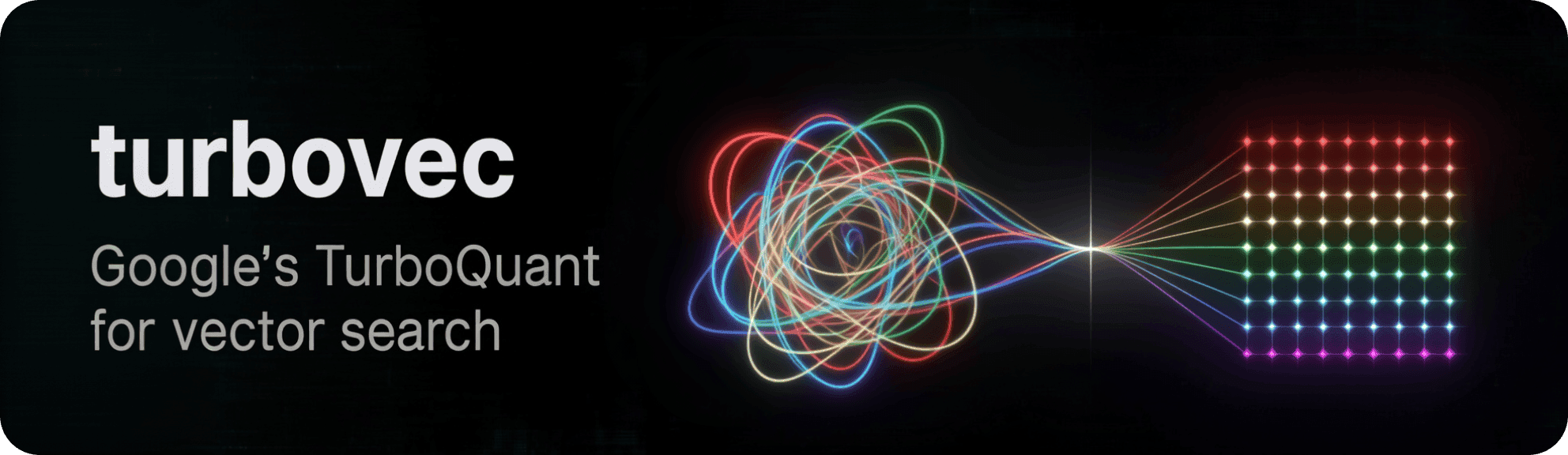
A new open‑source vector indexing library called TurboVec is drawing significant attention across the AI infrastructure community after benchmarks showed it could compress a 10‑million‑document vector corpus from 31 gigabytes of RAM to approximately 4 gigabytes, while matching or outperforming Meta's widely used FAISS library on search speed. Built on TurboQuant, a quantization algorithm developed by Google Research and presented at ICLR 2026, TurboVec addresses one of the less‑discussed but increasingly costly constraints in scaling AI systems: the memory demands of vector search.
Since its release, the repository has accumulated over 3,500 GitHub stars and more than 300 forks, an unusually fast adoption curve for a low‑level infrastructure library.
The Problem TurboVec Solves
Vector search underpins most modern retrieval‑augmented generation (RAG) pipelines. When a developer builds a system where an AI model retrieves relevant documents before generating a response, those documents are stored as numerical embeddings, high‑dimensional vectors that capture the semantic meaning of each piece of text. Searching across millions of these embeddings at query time is computationally intensive and, at scale, memory‑intensive.
Storing 10 million document embeddings in the standard float32 format requires 31 gigabytes of RAM. For development teams running local inference, on‑premise deployments, or air‑gapped environments where data cannot leave a controlled network, that number represents a hard infrastructure constraint. For companies running large RAG systems in the cloud, it is a direct cost driver.
TurboVec addresses this by compressing those embeddings using the TurboQuant algorithm. The same 10‑million‑document corpus fits in approximately 4 gigabytes, an approximately 8x reduction at 4‑bit quantization. In 2‑bit mode, compression ratios approaching 16x are achievable. A single 1,536‑dimensional embedding, the size used by OpenAI's standard embedding models, shrinks from 6,144 bytes to approximately 384 bytes.
What Makes TurboQuant Different
Most vector quantization methods that achieve comparable compression ratios require a training step. Before you can compress your embeddings, you need to train a codebook, a set of representative vectors that the algorithm uses as reference points for compression. This process takes time, requires representative training data, and must be redone when the underlying data distribution changes significantly.
TurboQuant eliminates this requirement entirely. The algorithm is data‑oblivious, meaning it compresses vectors without any prior knowledge of the data and without any training step. This is not just a convenience feature. It means TurboVec can ingest new data online, without retraining, and the compression process works immediately on any dataset regardless of domain or content type.
The mathematical basis for this is rigorous. The quantization approach operates within a factor of 2.7 of Shannon's theoretical distortion‑rate lower bound, meaning the compression it achieves is close to what information theory says is the maximum possible without losing search quality. That bound provides a formal guarantee that the recall tradeoffs are predictable and near‑optimal rather than empirical approximations.
Performance Against FAISS
FAISS, developed by Meta's research team, has been the de facto standard for large‑scale vector similarity search for several years. It is integrated into most major vector database implementations and widely used in production RAG systems. Any meaningful performance comparison against FAISS is therefore significant for AI infrastructure teams.
TurboVec's benchmarks show the following:
- On ARM‑based processors, including Apple M‑series chips widely used by AI developers, TurboVec outperforms FAISS IndexPQFastScan by 12% to 20% across multiple configurations
- On x86 processors with AVX‑512 support, TurboVec matches or slightly exceeds FAISS performance in most 4‑bit configurations
- At 2‑bit quantization in multi‑threaded workloads, results are within 1% of FAISS on x86
The library achieves this through hand‑optimised SIMD kernels written for both ARM NEON and x86 AVX‑512 instruction sets, allowing it to exploit hardware‑level parallelism efficiently. The Rust implementation with Python bindings means developers working in Python‑based AI stacks can integrate TurboVec without leaving their existing toolchain.
Search‑Time Filtering Without the Usual Tradeoffs
One practical feature that distinguishes TurboVec from standard approaches is its handling of filtered search. Most vector databases perform filtering after retrieval, meaning the system over‑fetches candidate vectors and discards irrelevant ones based on metadata conditions. This introduces a tradeoff between recall quality and filtering accuracy.
TurboVec integrates filtering directly into the SIMD search kernels. Blocks containing no eligible vectors are skipped entirely before scoring begins. This reduces unnecessary computation and eliminates the over‑fetching tradeoff, a meaningful improvement for applications where search results need to be restricted to specific subsets of a corpus, such as a user's personal documents or a tenant's data in a multi‑tenant system.
Privacy and Deployment Flexibility
TurboVec runs entirely on local infrastructure. No managed service, no cloud dependency, no data leaving the deployment environment. This is a non‑trivial consideration for the growing number of organisations building AI systems under data residency requirements, legal hold obligations, or simply strong internal data governance policies.
The library's architecture makes it well suited for edge inference, air‑gapped environments, on‑premise deployments, and any scenario where vector search capability is needed without the operational complexity of a managed vector database service.
Context: Why This Matters Now
The timing of TurboVec's emergence is not coincidental. The AI industry is in the middle of an infrastructure spending supercycle. Combined capital expenditure guidance from the four largest cloud and AI companies for 2026 exceeds $650 billion. A significant portion of that spending is directed at the memory and compute infrastructure needed to run AI systems at scale. When Google Research's TurboQuant paper was first circulated, it triggered a notable sell‑off in memory chip stocks, with major DRAM manufacturers seeing share price declines as investors assessed the implications of dramatically reduced memory requirements for large‑scale AI deployments.
TurboVec is not the end of demand for high‑capacity AI infrastructure. FAISS on GPU remains superior for very large corpora, and TurboVec's own documentation acknowledges that for corpora under 100,000 vectors, the difference is negligible. But in the 1‑million to 10‑million vector range, which describes a large and growing portion of real‑world RAG deployments, TurboVec's combination of training‑free compression, near‑optimal recall, and competitive search speed makes it a genuinely compelling option.
For AI teams constrained by memory budgets, operating in environments where data cannot leave the premises, or simply looking to reduce the infrastructure cost of running vector search at scale, TurboVec represents a meaningful step forward that is grounded in published, peer‑reviewed research rather than benchmark optimism.
Stay informed
Startup news in your inbox
Get important funding rounds, founder stories, and startup updates.
No spam - only important startup updates.