Exein Secures $270M At $1.7B To Protect AI-Powered Machines
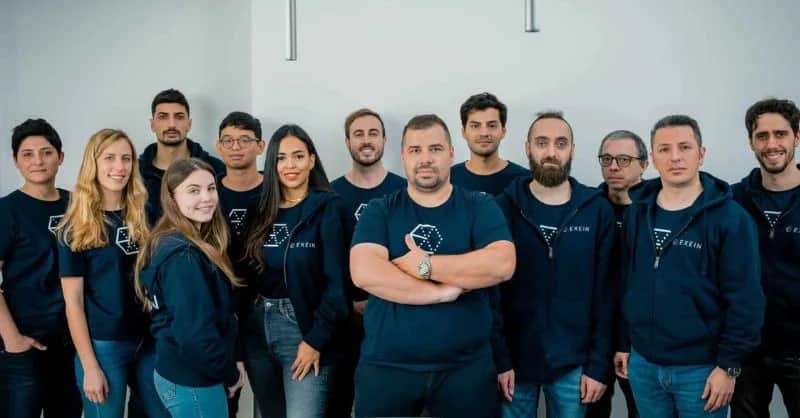
Exein founder CEO Gianni Cuozzo and team
Image credit: Exein
Exein, a Rome based cybersecurity company, has raised 270 million dollars in a Series C funding round at a 1.7 billion dollar valuation, a jump the company says makes it Europe's most valuable cybersecurity startup and pushes it into unicorn status.
The round was led by Headline, with new investors Goldman Sachs, Sofina, KfW Capital, Deutsche Telekom's investment arm T.Capital and the European Investment Bank Group joining existing backers. It follows a run of rapid fundraising for the company, including a 70 million euro Series C tranche in mid‑2025 and a further 100 million euro raise led by Blue Cloud Ventures with support from J.P. Morgan in December 2025, which brought the company's total capital raised in 2025 alone to 170 million euros.
Exein was founded in 2018 by chief executive Gianni Cuozzo and has spent most of its history focused on a specific technical bet, embedding cybersecurity code directly onto connected devices at the firmware level rather than trying to protect them purely from the network layer. That approach, delivered through the company's Photon platform, works at the kernel level, aiming to block malicious code before it can execute rather than cleaning up after an attack has already succeeded. Exein says that architecture now protects more than two billion connected devices across industrial automation, automotive, energy, healthcare, semiconductors, aerospace and robotics, with customers including Nvidia, AWS and MediaTek.
The new funding is tied to a shift in how Exein frames its own mission, moving from securing conventional connected devices toward what the company calls Physical AI, the growing category of robots, vehicles, drones and industrial machines that run AI models directly rather than simply reporting data back to a cloud service. Cuozzo has framed that shift as the natural continuation of the company's original bet rather than a departure from it, arguing that AI is moving out of the cloud and into the physical world, and that this transition is precisely what Exein was built for. He has pointed to frontier AI models pushing the window for patching vulnerabilities toward zero, arguing that attacks increasingly happen at machine speed, which means defensive systems have to operate at that same speed rather than relying on a human response in the loop.
That machine speed argument sits behind the two main things Exein plans to build with the new capital, a foundation model trained on machine telemetry data and autonomous security agents capable of responding to attacks without waiting for a human operator to intervene. The distinction Exein draws between conventional and physical cybersecurity is fairly direct, when a laptop gets compromised, the immediate consequence is typically data exposure, but when a robotic arm, a drone or a vehicle gets compromised, the consequence can be physical harm, a difference the company argues justifies treating machine security as its own distinct category rather than an extension of conventional endpoint security.
The scale of investor interest in this round reflects a broader growth trajectory the company has been reporting. Exein says its valuation has increased roughly thirtyfold over the past two years, and that annual recurring revenue in the first half of 2026 ran four times higher than the same period the previous year. Cuozzo has told reporters that the fresh capital is needed largely to let the company compete globally for a limited pool of cybersecurity and computing talent, a constraint that has become one of the more consistent bottlenecks across the sector regardless of how much capital a company has raised.
Exein's rise also fits a wider pattern of European venture capital increasingly backing security infrastructure built specifically around AI systems, rather than treating AI as one application among many that existing cybersecurity products need to cover. As AI models move into robots, vehicles and critical infrastructure, investors backing this round have argued that securing that physical layer will become one of the defining cybersecurity problems of the coming decade, a framing that treats Exein's embedded systems expertise and multi‑year head start collecting machine level data as a structural advantage over newer entrants trying to build similar capabilities from scratch.
That head start now comes with a correspondingly larger burden of proof. Exein holds more capital than any other European cybersecurity startup at this stage, which shifts the immediate question away from fundraising momentum and toward execution, specifically whether the planned foundation model and autonomous agents actually ship at the pace the company is promising, whether enterprise contracts in North America and Asia grow to match the valuation, and whether Photon's kernel level approach continues to hold up as attackers start targeting the AI model layer itself rather than the firmware beneath it. At a 1.7 billion dollar valuation, investors have already priced in the broader thesis that physical AI security will be a large and durable category. What happens next depends less on convincing more investors of that thesis and more on Exein proving it can defend the machines it says it is protecting.
Topics
Sources
Stay informed
Startup news in your inbox
Get important funding rounds, founder stories, and startup updates.
No spam - only important startup updates.