Startup News Roundup May 13, 2026 | Amp $1.3B AI Grid, Isomorphic $2.1B, Vapi Amazon Ring, White Circle, LemFi, A-Star
Editorial Team
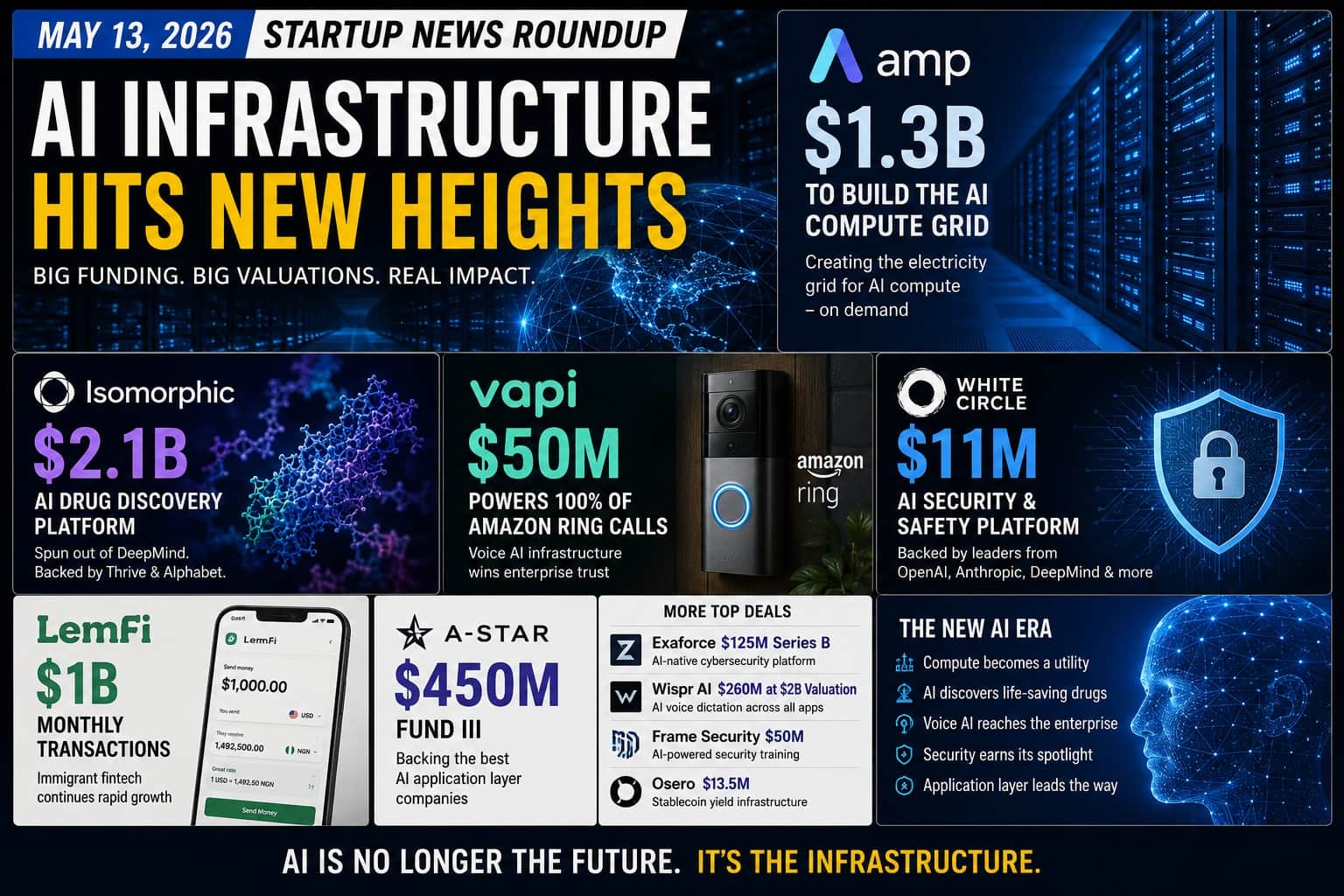
This is not a normal Tuesday for startup funding. The deals announced today represent something specific: the moment AI infrastructure stopped being described as the next big thing and started being treated by institutional capital as a utility. An electricity grid for compute. A drug discovery engine backed with the same conviction as a semiconductor foundry. A voice AI that runs every call for one of the world's most recognized consumer hardware brands. Today's funding stories are not about potential. They are about the present tense of AI deployment.
Here is everything that happened.
The Lead Story: Amp Raised $1.3 Billion to Build the Electricity Grid for AI Compute
The most consequential announcement of the morning came from Menlo Park. Amp, the AI compute infrastructure startup founded by former Andreessen Horowitz general partner Anjney Midha, raised more than $1.3 billion from investors including a16z, Y Combinator, and various cloud computing providers.
The analogy Midha uses is precise: AMP wants to be what Midha calls "an independent system operator of the grid" for AI compute. The idea is modeled on PJM Interconnect, the utility that pools electricity capacity across the Northeast. AMP doesn't own data centers or GPUs directly. Instead, it pools capacity across clouds and meters it to frontier research teams on demand, "kind of like a dorm meal plan," according to Midha.
The core commercial problem Amp addresses is specific and documented. Amp aims to create a global pool of specialized computer chips that can be used by start‑ups, universities and other organizations that otherwise would not have access to the vast amounts of computing required to train the most powerful A.I. models. "Some companies just can't get the computing power they need," Midha said. "The world's wealthiest and most powerful companies are hoarding the infrastructure for themselves."
The coalition model is the structural innovation. Investors contribute funds that Amp can use to buy computing power from the data center operators. A.I. start‑ups then join the coalition so they can use the computing power to build A.I. models. In return, these start‑ups contribute additional funds or perhaps other resources. Some start‑ups may share digital data needed to train A.I. models. Or they may share the models themselves, giving away the core software code to others in the coalition.
The commercial logic of this structure is compelling. AMP pegs idle FLOPs inside independent AI labs at 30 to 40 percent. A significant portion of the world's existing AI compute capacity sits idle because procurement timing, contract structures, and demand variability mean that no single organization can fully utilize the capacity it has contracted. Amp is building the market mechanism to reallocate that idle capacity to the teams that need it, at the moment they need it, without requiring them to sign multi‑year data center contracts they cannot afford.
Midha's background makes him the right person to build this. As the architect of a16z's Oxygen GPU program, which allocated more than $1.25 billion of compute access to portfolio companies, he built the practical knowledge of how AI labs procure and use compute that most fund managers never acquire. The transition from allocating compute inside a16z to building an independent compute market is not a conceptual leap. It is the same problem at a different organizational scale.
Isomorphic Labs: $2.1 Billion for the Lab That Already Changed Drug Discovery Once
Isomorphic Labs, the AI‑powered drug discovery company spun out of Alphabet's Google DeepMind, closed a massive Series B worth over $2.1 billion, led by Thrive Capital with Alphabet participating.
Isomorphic was created from the team behind AlphaFold, DeepMind's protein structure prediction system that solved one of biology's most persistent computational challenges and earned the Nobel Prize in Chemistry for its contributions to structural biology. The transition from protein structure prediction to drug molecule design is the commercial application of that breakthrough: if you can predict how proteins fold, you can design molecules that interact with them in therapeutically useful ways.
The $2.1 billion extends prior funding of $600 million and targets accelerating Isomorphic's drug design engine and global operations. Clinical trial timelines have slipped to late 2026, which the company acknowledges reflects the genuine difficulty of translating computational biology discoveries into clinically validated treatments. But the investor conviction that $2.1 billion represents reflects a specific judgment: that the underlying computational approach is sound, the pipeline is real, and the commercial stakes of being right about AI‑driven drug discovery are large enough to justify the risk.
The biotech‑AI convergence continues attracting mega‑rounds because the addressable problem, the $2 trillion annual global pharmaceutical R&D market with its notoriously high failure rates, is large enough to justify frontier‑model‑scale capital investment.
Vapi: The Voice AI That Won 100% of Amazon Ring's Inbound Calls
Vapi, the voice AI infrastructure platform, raised $50 million in a Series B led by Peak XV Partners with M12, Kleiner Perkins, and Bessemer, reaching a post‑money valuation of approximately $500 million. Total funding now stands at $72 million.
The commercial achievement that catalyzed this round is specific and impressive: Vapi powers 100 percent of Amazon Ring's inbound calls after beating more than 40 rival platforms in a competitive evaluation. Amazon Ring is the home security and smart doorbell platform with tens of millions of active users globally. Customer service for a consumer IoT platform at that scale involves millions of daily interactions, and Ring selected Vapi over every alternative available.
Other named enterprise customers include Intuit, New York Life, and over 1 million developers on Vapi's self‑serve platform. ARR is in healthy eight figures. The combination of enterprise names, consumer brand deployment at scale, and developer platform breadth describes a company that has solved the three distinct go‑to‑market challenges that most voice AI infrastructure companies fail at simultaneously.
White Circle: When the People Who Build the Models Back the Guardrails
Paris‑based White Circle raised $11 million in seed funding from leaders at OpenAI, Anthropic, DeepMind, Mistral, Hugging Face, Datadog, and Sentry. CEO Denis Shilov went viral in 2024 for writing a universal jailbreak prompt that bypassed safety filters on every major AI model. The experience, and the institutional attention it attracted, led directly to White Circle's founding.
White Circle is betting that AI safety will not be solved entirely at the model‑training stage. As businesses embed models into more products, Shilov said the relevant question is no longer just whether OpenAI, Anthropic, Google, or Mistral can make their models safer in the abstract; it is whether a healthcare company, bank, legal app, or coding platform can control what an AI system is allowed to do in its own environment.
The commercial traction, more than one billion API requests processed and enterprise customers including Lovable and two of the world's largest digital banks, validates that the market for production AI governance is real and paying. White Circle's proprietary models monitor AI inputs and outputs in real time. Based on each company's custom policies, they detect harmful content, catch hallucinations, prevent prompt injection attacks, flag model drift and identify abusive or malicious users.
The KillBench research, which ran more than one million experiments across 15 AI models and found systematic biases that amplify under structured output integration, is the most commercially significant academic output associated with any seed‑stage company's funding announcement in recent memory. It makes White Circle's product case empirically rather than theoretically.
LemFi: $1 Billion in Monthly Transactions and Still Raising
LemFi, a fintech app built for immigrants and global citizens, is reportedly raising a €30M Series B extension as it crosses $1B in monthly transactions and saw 30% month‑on‑month growth in activity.
The extension follows a $53 million Series B led by Highland Europe and puts LemFi in the company of the most commercially proven immigrant fintech platforms in the market. These results back its plan to grow beyond remittances and stay ahead of competitors, including Taptap Send, WorldRemit, and Remitly. The startup has also been growing through acquisitions, including the purchase of currency exchange Bureau Buttercrane, which gave it regulatory approval from Ireland's central bank, and British credit fintech Pillar. The latter involves a Financial Conduct Authority credit licence and the ability to assess immigrants without local financial history, addressing a key problem in credit access.
A‑Star's $450 Million: The Anti‑Megafund Argument Has a Track Record
A‑Star raised $450 million for its third fund, targeting AI application layer companies built on top of foundation models. The portfolio already includes Ramp (now approaching $40 billion valuation), Decagon ($4.5 billion), and Mercor ($492 million raised). Miles Dieffenbach runs the investment office at Carnegie Mellon's endowment. He said his team prefers "smaller funds that are more focused and concentrated." His take on A‑Star at a bigger size: "We would be very worried if this fund was a $1 billion fund size."
Additional Notable Deals Today
Exaforce $125 million Series B: The AI‑native cybersecurity startup raised $125 million at a $725 million valuation backed by HarbourVest, Peak XV, Mayfield, Khosla Ventures, and Seligman Ventures. Its Exabots automate SOC tasks, reduce false positives by up to 90 percent, and enable natural language threat investigation. Customers include Replit and Guardant Health.
Wispr AI in talks for ~$260 million at $2 billion valuation: The AI dictation startup Wispr Flow, which allows voice control across all apps on desktop and mobile operating systems, is negotiating a raise led by Menlo Ventures at a $2 billion valuation, roughly doubling its previous mark. Bloomberg reported the discussions.
Frame Security $50 million: New York‑based Frame Security raised $50 million for AI‑powered training platforms that help organizations defend against deepfakes and phishing. The AI‑as‑attacker threat vector is among the fastest‑growing in enterprise security.
Osero $13.5 million: Osero raised $13.5 million led by Sky Ecosystem, the fund associated with ex‑MakerDAO, for a stablecoin yield infrastructure product that enables permissionless yield on dollar‑denominated stablecoins.
The Week's Five Themes
Reading today's announcements as a group produces five patterns worth tracking.
Compute democratization is getting institutional backing. Amp's $1.3 billion for a non‑ownership compute pool model is the largest single validation yet of the argument that the AI compute gap between hyperscalers and everyone else is a solvable market problem rather than a permanent structural feature of the industry. If Amp works, the advantage that Big Tech's GPU stockpiles provide shrinks materially.
Drug discovery AI is entering a capital‑intensive phase. Isomorphic's $2.1 billion is not a pre‑revenue research bet. It is post‑AlphaFold clinical execution capital. The question it answers is whether the same computational advantage that predicted protein structure can be reliably translated into drug molecules that pass clinical trials. At $2.1 billion from Thrive Capital and Alphabet, the investor conviction is that the answer is yes.
Voice AI has found its enterprise killer app. Amazon Ring is the data point that makes the voice AI category credible to every enterprise buyer who was not sure whether voice AI was a feature or a platform. When a company serving tens of millions of consumers routes 100 percent of its inbound calls through a three‑year‑old startup after evaluating 40 alternatives, the platform verdict is in.
AI security is a category, not a niche. White Circle's investor list, which reads like a who's who of foundation model leadership, is the clearest available institutional signal that production AI governance is a real and growing market. Every company deploying AI agents in 2026 faces the same exposure profile that KillBench documented. The companies that build monitoring and enforcement infrastructure for that exposure will be as commercially necessary as network security is to internet deployment.
The application layer remains the best venture bet. A‑Star's concentrated $450 million in AI application companies backed by Carnegie Mellon's endorsement of its fund size discipline is the quiet counterargument to every AI megafund. The largest returns from the AI era are not necessarily coming from the companies building the models. They are coming from the companies building on top of them.
Stay informed
Startup news in your inbox
Get important funding rounds, founder stories, and startup updates.
No spam - only important startup updates.