Syte Banks €9M To Shrink Weeks Of Property Assessment Into Minutes

Matthias Zühlke (CEO) and David Nellessen
Image credit: Syte
syte, a Münster based real estate technology company, has raised 9 million euros in Series A funding to automate more of the earliest and often slowest phase of property development, the weeks of manual assessment that typically happen before a single brick gets laid.
The round was led by amberra, the venture studio of the Cooperative Financial Group Volksbanken Raiffeisenbanken, with NRW.BANK joining as a new investor. Existing backers, including companies affiliated with the Schwarz Group, High‑Tech Gründerfonds, vent.io and Vantage Value, also participated. The raise brings syte's total funding to approximately 17 million euros, following a 2.6 million euro seed round in 2022 and a further 5 million euro round in 2024.
syte was founded in 2021 by chief executive Matthias Zühlke and has built its platform around a specific, persistent inefficiency in how land and existing properties get evaluated. Assessing whether a plot of land or a building can support a given development typically requires manually checking zoning rules, construction law, and the underlying economics of a project, a process that can take weeks even before a developer decides whether a project is worth pursuing at all. Zühlke has argued that how land and property have historically been assessed costs the real estate and financial industry significant time and money, and that whoever manages to digitise those processes will have real influence over what actually gets built across Germany and the wider European market going forward.
syte's platform addresses that bottleneck by mapping more than 62 million land parcels across Germany and layering proprietary analytics on top of that data to automate the earliest stages of a development project, covering building potential, zoning and construction law compliance, and financial feasibility analysis. The company positions that early‑stage automation as targeting a different constraint than the one most real estate technology tools focus on, since construction and financing costs can only be influenced to a limited degree once a project is already underway, whereas faster, more reliable early assessment can help developers identify viable projects sooner and avoid the planning mistakes that come from moving forward on land that was never going to work.
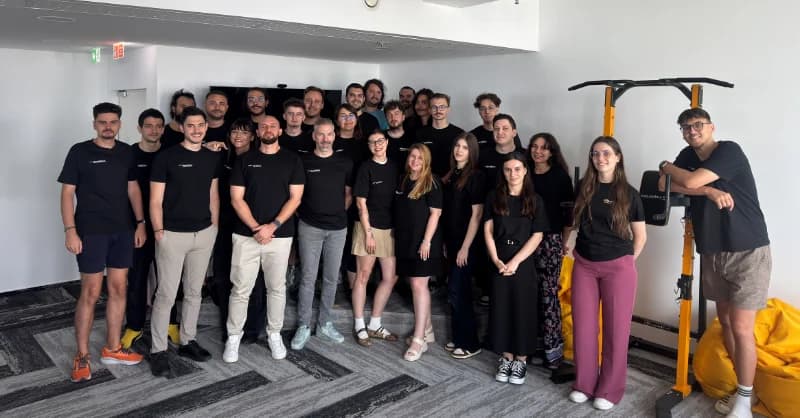
The platform is already used by more than 200 customers spanning developers, banks and brokers, and the company says its annual recurring revenue has doubled year on year, alongside a headcount that has grown past 40 people. syte was named PropTech of the Year in 2025, and its work has drawn particular interest from within the cooperative banking sector that its lead investor represents. Björn Schmuck, chief executive of amberra, has described the real estate business as holding major strategic importance for the cooperative financial group, arguing that syte makes the underlying potential of land and buildings visible early, with the help of AI, and lets banks advise clients faster and on a more data‑driven basis. Schmuck pointed specifically to several cooperative banks already using the platform in real estate sales and client advisory work as concrete evidence of that value, a detail that also hints at how amberra intends to help distribute syte's platform further, through the cooperative group's existing network of hundreds of banks.
The new capital will go toward two main goals, according to Zühlke, continuing to automate the planning phases the platform already covers, and expanding syte beyond its home market in Germany into other European countries. In the longer term, the company has said its ambition is to digitally map the entire process that precedes the physical construction of a property, extending its current focus on early‑stage assessment into a more complete picture of everything that happens between identifying a piece of land and breaking ground on it.
That ambition arrives at a moment when Germany's building sector has been dealing with a persistent housing shortage compounded by slow administrative procedures, a combination that has made the early planning phase syte targets an increasingly visible point of friction across the industry. Whether syte's bank‑backed distribution strategy translates into meaningfully faster adoption across the wider European real estate sector, rather than remaining concentrated among the cooperative banks already integrated into amberra's network, is likely to become clearer as the company works through its planned expansion beyond the German market over the coming year. The platform itself is also explicit about the limits of what automation can replace at this stage, supporting early analysis and preliminary assessment while leaving formal decisions to the authorities, lenders and professional advisers who remain responsible for signing off on any project that syte's platform helps identify.
Topics
Stay informed
Startup news in your inbox
Get important funding rounds, founder stories, and startup updates.
No spam - only important startup updates.