
Veridion Banks $20M To Turn Business Data Into A Living, Real-Time Graph
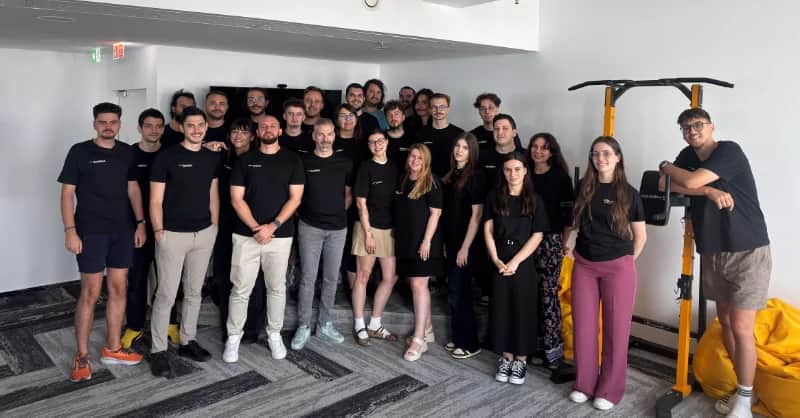
Veridion team
Image credit: Veridion
Veridion, a business intelligence company originally founded in Bucharest, has raised 20 million dollars in Series A funding to expand a continuously updated digital graph of the world's businesses, arguing that the quarterly and annual data refresh cycles most market intelligence tools still rely on have become too slow for how quickly commercial conditions now change.
The round was led by Hoxton Ventures, with existing investors Underline Ventures, OTB Ventures, Gapminder, Day One Capital and LAUNCHub all returning. It follows two earlier seed rounds, a 1.5 million dollar raise in 2020 and a 6 million dollar round in February 2023, bringing Veridion's total funding to more than 27.5 million dollars since founding.
Veridion, formerly known as Soleadify, was founded in 2019 by chief executive Florin Tufan. The company has built what it describes as a living digital replica of the global business landscape, a continuously refreshed graph currently covering 642 million companies across 249 countries, with each company resolved into a structured record of 461 attributes spanning legal registrations, operating locations and corporate hierarchy. That graph has grown considerably in scale over a short period, expanding from roughly 80 million companies three years ago to its current size, a pace of growth the company attributes to its underlying AI approach of continuously parsing company websites, public registries, regulatory filings, product catalogues, social profiles and news sources rather than relying on periodic manual data collection.
The core argument behind Veridion's pitch is that traditional business intelligence, typically refreshed quarterly or annually, has stopped functioning as genuine intelligence in a commercial environment where conditions can shift meaningfully within days or hours. Stefan Gergely, Veridion's head of growth, has pointed to recent disruption around the Strait of Hormuz as an example of how a single geopolitical event can simultaneously affect international trade, insurance exposure, supply chains and the outlook for thousands of businesses at once, circumstances that data refreshed on a quarterly cycle would capture only well after the fact. Gergely has framed information updated that infrequently as history rather than intelligence, arguing that commercial risk now changes by the hour in a way static datasets are structurally unable to reflect.
Rather than positioning itself as a replacement for existing market intelligence platforms, Veridion has built its product to complement them, supplying the continuously updated operational layer that sits underneath decision‑making in areas including credit and risk analysis, insurance underwriting, third‑party risk management, environmental and social governance assessment, procurement and supply chain operations. The company says its approach can deliver market intelligence up to 52 times faster than traditional sources while covering more than 30 times as many businesses, a claim rooted in the breadth and update frequency of its underlying graph rather than any single data category.
One of Veridion's most notable partnerships is with Experian, which uses the company's data to extend its own visibility into private companies that traditionally sit outside the reach of conventional credit bureaus. Jon Roughley, Experian's director of data strategy and innovation, has described Veridion's contribution as bringing new signals about how companies actually operate into Experian's models, capturing forms of risk that traditional credit data was simply never designed to see. That kind of partnership illustrates how Veridion's business model works in practice, supplying a data layer that established financial and risk infrastructure providers can build directly into their own products rather than competing with those providers for the same enterprise customers.
Hussein Kanji, founder of Hoxton Ventures, has framed the investment around a bigger ambition than a single product category, describing Veridion as having the potential to become one of the most important data companies in the world, a comment that reflects the firm's view of live, continuously verified business data as increasingly foundational infrastructure across financial services and risk management, sectors that have historically waited far too long between accurate pictures of the businesses they depend on.
The company currently serves more than 100 organisations and employs more than 60 people across Europe and North America, which has already become its largest market. The new funding will go toward continued product development, team growth and further international expansion, according to Tufan, with the explicit goal of helping organisations understand commercial risk earlier, before disruption escalates into a genuine crisis rather than after the fact.
Veridion's rapid growth, both in the scale of its underlying business graph and the pace of its fundraising, sits inside a broader shift in how financial and risk institutions think about data freshness as a competitive advantage rather than a nice‑to‑have feature. As geopolitical volatility, climate related disruption and rapid market shifts become more frequent rather than exceptional, the gap between organisations working from real‑time operational data and those still relying on periodically refreshed datasets is likely to widen. Whether Veridion can maintain the accuracy and coverage of its graph as it continues to expand at this pace, without the data quality issues that have undermined similar large scale data aggregation efforts in the past, will likely determine whether Kanji's assessment of the company's long‑term importance holds up as it moves into a larger and more competitive stage of growth.
Topics
Stay informed
Startup news in your inbox
Get important funding rounds, founder stories, and startup updates.
No spam - only important startup updates.