South Korean AI Memory Chip Startup XCENA Raises $135 Million Series B at $570 Million Valuation
Editorial Team
XCENA, a South Korean semiconductor startup building memory‑centric computing solutions for AI infrastructure, has closed a $135 million Series B round, pushing its valuation to $570 million and bringing total capital raised to $185 million. The announcement, made on May 29, 2026, underscores growing investor appetite for AI infrastructure plays that go beyond GPU dominance and target the memory layer of the compute stack.
The round was co‑led by Korean institutional investors Atinum Investment and IMM Investment, with participation from a broad coalition of new and returning backers including SBI Investment, Mirae Asset Capital, STIC Ventures, Wonik Investment Partners, SV Investment, LB Investment, Corstone Asia, Kiwoom Investment, DSC Investment, Shinhan Venture Investment, Korea Development Bank, KDB Capital, Premier Partners, Kolon Investment, Company K Partners, K2 Investment Partners, Partners Investment, and Kyobo Securities.
Rethinking AI's Real Bottleneck
At the heart of XCENA's proposition is a counter‑narrative to the GPU‑centric view of AI infrastructure. Every time a large language model generates a response, data leaves memory, travels through CPU preprocessing, gets processed by a GPU, and then returns along the same path. That cycle repeats for every word generated. The data movement overhead is not trivial. It adds latency, consumes significant energy, and scales with every new inference request.
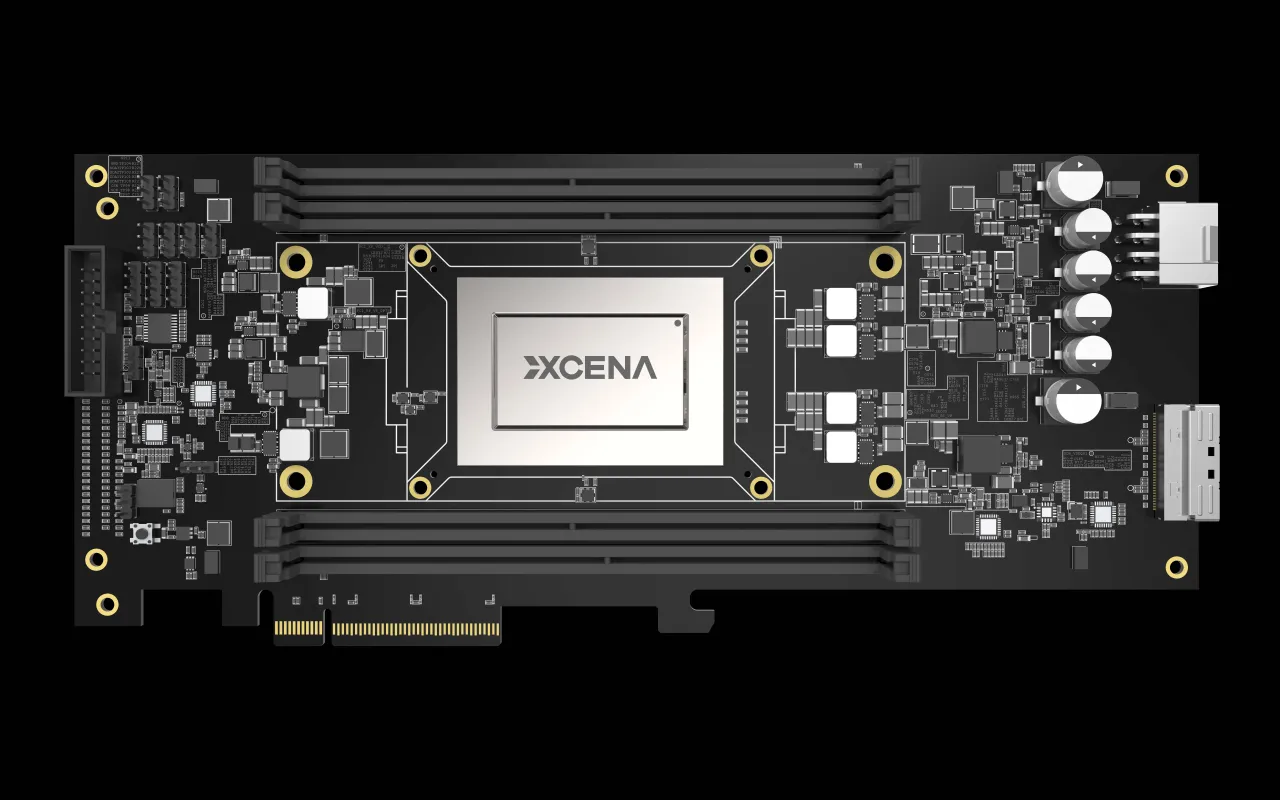
XCENA was founded in 2022 to address this structural inefficiency. The company's flagship product, the MX1, is a computational memory controller that merges high‑capacity pooled DDR5 memory with near‑data processing cores. Built on the open Compute Express Link (CXL) standard, MX1 enables computation to happen where data resides, eliminating unnecessary routing through expensive GPU infrastructure.
"CPUs and GPUs have both gotten smarter over the decades. Memory never did," said Jin Kim, CEO and co‑founder of XCENA, in a statement accompanying the fundraise. "AI workloads are exposing the fundamental limitations of traditional computing architectures as larger models, expanding context windows, and increasingly data‑intensive inference workloads drive unprecedented memory demands."
Founders with Deep Semiconductor Roots
XCENA was co‑founded by Jin Kim, Dohun Kim, and Harry Juhyun Kim, all veterans of Samsung Electronics and SK Hynix, the two Korean memory giants whose chips power the vast majority of Nvidia GPUs in circulation. Jin Kim notably held executive positions at both companies before founding XCENA, and was reputedly the youngest executive in SK Hynix history before leaving to build the startup.
That institutional pedigree matters in a sector where execution credibility is closely watched. The decision to manufacture MX1 on Samsung's foundry lines adds further supply chain credibility that many fabless chip startups struggle to establish with investors and enterprise customers.
Timeline and Competitive Positioning
MX1 mass production chips are scheduled to roll off Samsung's production lines by the end of 2026, with the company targeting commercial revenues beginning in 2027. The product is currently being explored with select partners for real‑world performance validation across high‑demand compute workloads.
XCENA operates in a competitive space that includes Astera Labs and Marvell, both Nasdaq‑listed companies developing next‑generation memory connectivity solutions. XCENA's differentiation lies in its architecture, specifically its use of thousands of small, efficient RISC‑V cores optimised for data processing near memory, compared to the handful of general‑purpose cores that characterise competing approaches.
The funding will be deployed across three priorities: accelerating global expansion with a growing presence in Northern California to engage hyperscalers and technology partners, scaling customer deployments around MX1, and advancing the next generation of the computational memory roadmap.
As AI workloads grow more demanding and data centres grapple with rising power costs and memory bottlenecks, XCENA's bet on memory‑centric computing is moving from an engineering thesis toward a market‑ready product. With $185 million raised and Samsung as a manufacturing partner, the company enters the second half of 2026 with the resources and credibility to test that thesis at scale.
Stay informed
Startup news in your inbox
Get important funding rounds, founder stories, and startup updates.
No spam - only important startup updates.