Musk's Boring Company Hits $20B Valuation, and Some Investors Are Being Asked to Do More Than Write a Check
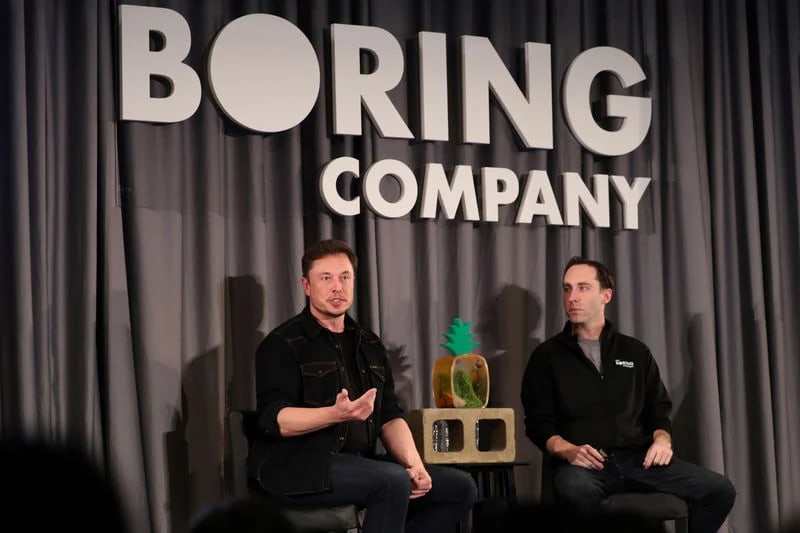
Elon Musk
Image credit: Reuters
The Boring Company, Elon Musk's tunneling and underground transportation startup, has closed a new funding round at a valuation of roughly 20 billion dollars, according to The Wall Street Journal, nearly quadrupling the 5.7 billion dollar valuation it carried after its 2022 Series C round.
The Journal had first reported in July that the company was in talks to raise about 4 billion dollars at that 20 billion dollar valuation. Its latest reporting confirms the financing has now closed around that figure, though the final size of the round and the complete list of participating investors remain undisclosed. That means the 20 billion dollar number describes what the company is now worth rather than a confirmed total amount raised.
What makes this round unusual is not just its size but its terms. According to the Journal, some investors who participated were told they would need to do more than simply provide capital: they would be expected to help recruit staff for open roles at the company, or make introductions to local government officials in cities where The Boring Company hopes to build, and that investors who could not deliver on those commitments risked having some of their shares bought back. That is an unusual clause for a private financing round, but it reflects something fundamental about the business The Boring Company is actually in: success depends as much on navigating city halls, permitting offices, and local politics as it does on the underlying tunneling technology itself. Before a single boring machine can start digging, the company needs land access, planning permission, and formal agreements with public authorities, meaning an investor capable of opening the right door with a city official can be worth as much to the company as an investor writing an additional check.
The Boring Company spun out of SpaceX in 2018, after Musk began exploring tunnels as a way to relieve urban traffic congestion. Its most established project is the Vegas Loop, which moves passengers between stations around the Las Vegas Convention Center and the Strip using Tesla vehicles traveling through underground tunnels and connecting surface routes, having begun transporting passengers in 2021. That project has given the company a controlled environment in which to prove its underlying concept works, though it has not been without controversy: tunnel workers have suffered serious injuries during construction, and Nevada regulators said last year that the company had violated environmental regulations nearly 800 times.
Nashville and Dubai represent a more significant test of whether The Boring Company's model can be replicated outside its home base. The company is building an underground Loop in Nashville at its own expense, and in Dubai it has begun a multi‑phase tunnel project with the Roads and Transport Authority, starting with a four‑mile pilot phase estimated to cost around 154 million dollars, with plans for an eventual expansion to 14 miles. Unlike Las Vegas, both of those projects require the company to prove it can repeat its model in an entirely new regulatory and political environment, and turn engineering plans into working infrastructure operating under terms set largely by public authorities rather than the company itself. The Journal has also reported that The Boring Company has pitched additional projects in Baltimore, Chicago, and Los Angeles, suggesting the company is actively working to expand its US pipeline well beyond its two current flagship international projects.
The timing of this valuation jump lines up closely with a broader wave of investor enthusiasm around Musk's other ventures. SpaceX completed a record 85.7 billion dollar initial public offering in June, followed days later by a 20 billion dollar investment‑grade bond sale. That momentum appears to be spilling over into investor appetite for Musk's smaller, less mature companies as well, giving him considerable leverage in private markets: his ability to raise substantial capital across multiple ventures simultaneously means investors seeking any exposure to the broader Musk ecosystem may be more willing to accept unusual terms, like the recruiting and government‑relations obligations attached to this round, than they would from a founder without that same track record.
Unlike SpaceX, however, The Boring Company has no public share price to establish a daily market value and no Tesla‑style quarterly disclosures giving outside investors regular visibility into its financial performance, and its growth depends on physical tunnel construction that can take years to secure permits for, finance, and actually build. The new valuation gives the company considerably more capital to work with, but it also raises the bar for what it needs to demonstrate next: that Las Vegas can serve as a genuinely repeatable blueprint rather than a one‑off proof of concept, and that Nashville and Dubai can move beyond signed agreements and pilot phases into tunnels people are actually riding on a daily basis. Whether investors in this round are betting on today's operating Vegas Loop or on Musk's considerably larger vision for underground transit more broadly will likely only become clear once those two international projects are further along, and once the full list of who actually put money into this round becomes public.
Topics
Stay informed
Startup news in your inbox
Get important funding rounds, founder stories, and startup updates.
No spam - only important startup updates.
Comments
Text only. No links or images.
No comments yet.