Solo Developer's Pay-to-Rank Leaderboard Site Reportedly Nets $21,000 in 24 Hours
Jonathan Wilke
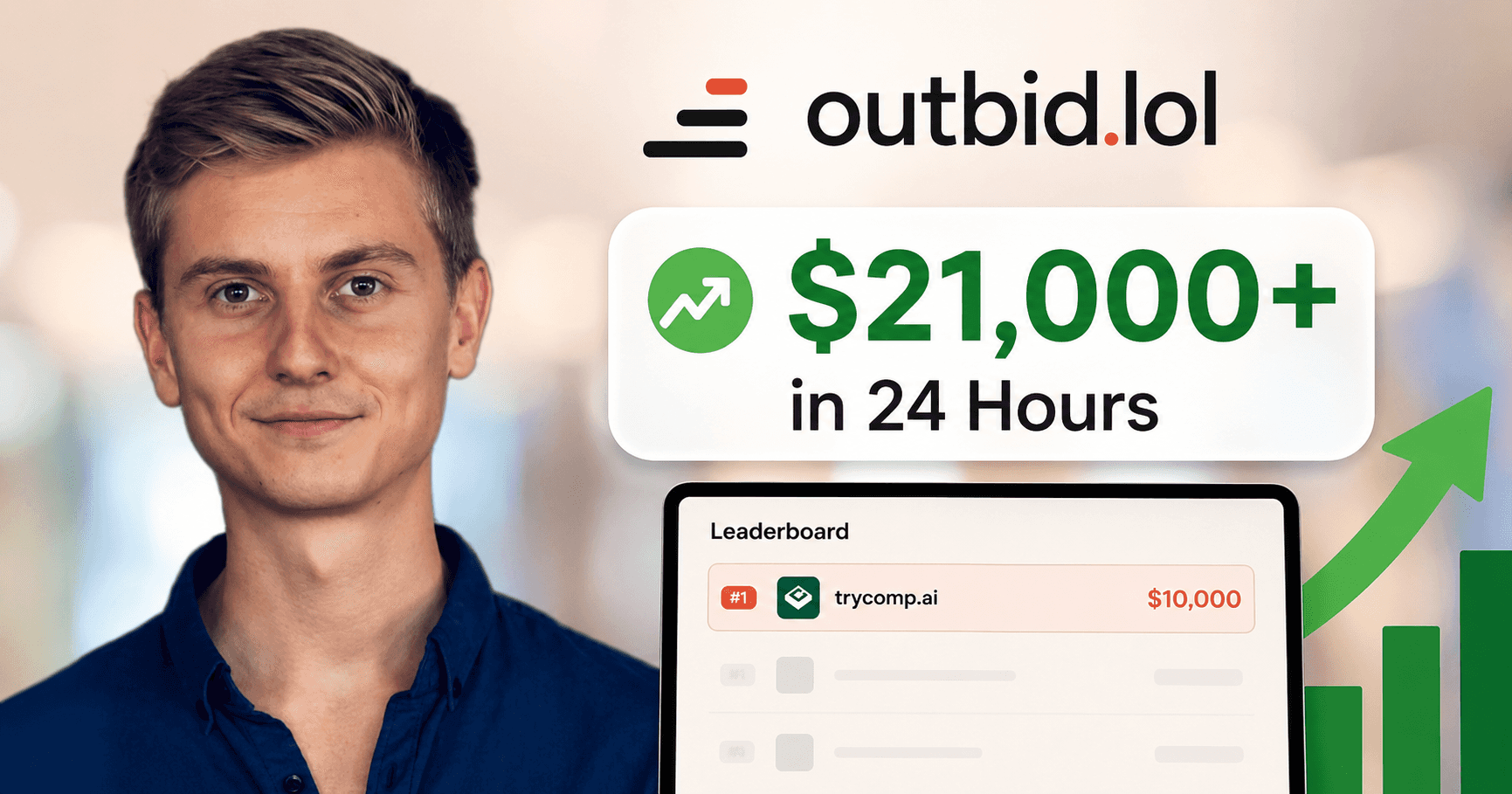
A simple website that lets anyone pay to rank higher on a public leaderboard has reportedly generated more than 21,000 dollars within its first 24 hours online, according to posts from its creator, developer Jonathan Wilke.
The site, outbid.lol, works on a straightforward mechanic. Users submit a whole‑dollar bid, starting as low as 2 dollars, to claim a ranking position on the leaderboard by linking a product URL or an X handle. Whoever bids the most holds the top spot until someone else outbids them. Wilke says bids climbed quickly after launch, including one bid of 10,000 dollars for the top position, with at least one user reporting strong click‑through traffic after spending 420 dollars to secure a place on the board.
According to Wilke's own account, posted directly on X, the site launched at 11:08 PM and had drawn more than 200,000 visitors, gained him over 1,500 new followers, and briefly broken his analytics provider within a single day. He says he was also approached with an acquisition offer of 100,000 dollars for the site, which he turned down, and that at least three copycat versions of the concept had already launched by the time he posted his summary roughly six hours later. Separate web searches turned up at least two similarly named sites, bidboard.lol and outbids.lol, both using near identical mechanics, lending some support to Wilke's claim about rapid copycatting even though neither has been independently confirmed as a direct clone built in response.
It is worth being direct about sourcing here. Every figure in this story, including the exact revenue amount, visitor count, and the reported acquisition offer, comes solely from Wilke's own posts on X rather than from independent verification by a news outlet, payment processor, or analytics platform. No traditional tech press coverage of the launch had emerged at the time of writing, and screenshots or public logs confirming the revenue total have not been independently reviewed. Numbers reported this way should be treated as a founder's self‑reported account rather than confirmed fact, consistent with how any single‑source social media claim ought to be handled.
Setting aside the unverified specifics, the broader shape of the story fits a familiar pattern in the indie hacker and micro SaaS community, where extremely simple, low‑cost‑to‑build tools occasionally catch a wave of attention on social platforms and generate outsized short‑term traffic and revenue relative to their build complexity. Pay‑to‑rank and pay‑to‑play leaderboard mechanics in particular have surfaced periodically as a novelty format, offering builders quick visibility for products or personal brands in exchange for a direct cash bid rather than relying on algorithmic distribution.
Reactions among other builders who engaged with Wilke's posts were mixed. Several praised the simplicity and cleverness of monetizing attention directly through a bidding mechanic rather than advertising or subscriptions, while others cautioned that the format's novelty is also its biggest risk, since a bidding based leaderboard depends entirely on sustained curiosity and social sharing rather than any lasting underlying utility, making a rapid drop‑off in traffic and bids just as plausible as continued growth once the initial wave of attention fades.
Sources
Stay informed
Startup news in your inbox
Get important funding rounds, founder stories, and startup updates.
No spam - only important startup updates.