
Prevalent AI Takes Its First Outside Capital in Nine Years With $22M Growth Round
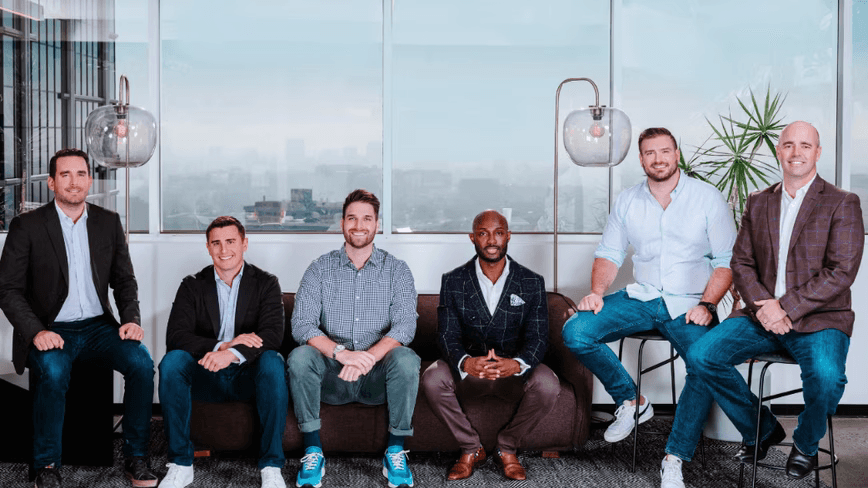
Prevalent AI Paul Stokes (CEO) and Arun Raj and team
Image credit: Prevalent AI
Prevalent AI, a London based enterprise AI company, has secured 22 million dollars in growth funding from Los Angeles based Integrity Growth Partners, marking the first primary outside capital the company has raised since its founding nine years ago.
The company was started in 2017 by Paul Stokes and Arun Raj, alongside a founding team with deep cybersecurity and intelligence backgrounds that included Sir Iain Lobban, the former director of Britain's signals intelligence agency GCHQ, and Andrew France, a former GCHQ deputy director for cyber defense operations who also co‑founded cybersecurity company Darktrace. Stokes has said he deliberately declined external investment for nine years, choosing instead to grow the company on its own revenue until he judged the market to be genuinely ready for what Prevalent AI had built. The only prior capital event in the company's history came in 2021, when Istari, a cybersecurity platform backed by Singapore's Temasek, purchased a minority stake through a secondary transaction that did not involve any new capital entering the business itself.
That level of capital discipline stands out sharply against a broader AI funding market where startups frequently raise large sums well before reaching meaningful revenue. Prevalent AI says it has been profitable since landing its first customer and has more than doubled its annual recurring revenue over the past twelve months without primary outside funding, a track record that appears to have shaped how Integrity Growth Partners approached the deal. IGP managing partner and co‑founder Ryan Anderson pointed directly to that discipline as part of what drew the firm to the investment. "Paul, Arun, and the team have built something rare: genuinely differentiated, AI‑native technology that the most sophisticated enterprises in the world rely on, all while maintaining remarkable capital discipline," Anderson said.
At the core of Prevalent AI's platform is what the company describes as a data fabric that reaches into hundreds of separate enterprise systems, pulling information out and rebuilding it as a continuously updating knowledge graph. Security and operations teams can query that graph directly to understand which assets, controls, and identities exist across their organization and, critically, which of those are currently going unmonitored, a question that has become significantly harder to answer as enterprise technology stacks have grown more fragmented and complex. The company refers to the resulting graph as sovereign, meaning customers retain control over where their underlying data is physically stored and processed rather than ceding that decision to Prevalent AI's own infrastructure.
That positioning has proven especially relevant as autonomous AI agents move deeper into enterprise operations. Reliable action from an AI agent depends heavily on the quality and completeness of the organizational context it has access to, and Prevalent AI's pitch is that most enterprises still lack that foundation, leaving even well built AI agents operating on incomplete or fragmented information. Anderson noted that agentic AI raises the stakes considerably on both data quality and depth, a dynamic Prevalent AI's team of roughly 200 people has spent nine years building infrastructure to address, initially with a narrow focus on cybersecurity applications.
The company's technology has already demonstrated measurable impact within that original cybersecurity use case, with Prevalent AI stating its engine has cut executive reporting times in security operations by as much as 95 percent for some customers. That result has become a central proof point as the company now works to extend the same underlying data fabric and knowledge graph technology into new domains, including financial crime analysis, regulatory compliance, and broader operational risk management, areas that share cybersecurity's core challenge of needing to synthesize signals scattered across many disconnected internal systems.
The market opportunity behind that expansion is substantial. Enterprises globally are expected to spend roughly 240 billion dollars on information security this year alone, according to Gartner, though much of that spending has historically gone toward acquiring more raw data rather than generating more usable insight from data organizations already hold. Gartner has separately cautioned that a meaningful share of agentic AI projects are likely to struggle or fail specifically due to gaps in underlying data quality, a warning that lines up closely with the problem Prevalent AI has built its business around solving.
With the new capital, Prevalent AI plans to expand its presence in the United States, build out its global go to market structure, and grow its executive leadership team, moves that mark a significant shift for a company that has operated for nearly a decade without a dedicated sales organization or formal external growth strategy. Whether the capital discipline that defined Prevalent AI's first nine years persists as it opens a US office, builds its first sales team, and competes more directly for enterprise budgets remains an open question, but the scale of investor interest in the round suggests strong conviction that the underlying problem, giving AI systems dependable context about the organizations they operate within, is only going to grow larger as agentic AI adoption accelerates across the enterprise.
Topics
Stay informed
Startup news in your inbox
Get important funding rounds, founder stories, and startup updates.
No spam - only important startup updates.