Runable Raises $21M Series A to Bet AI Agents Can Grow Businesses, Not Just Build Them
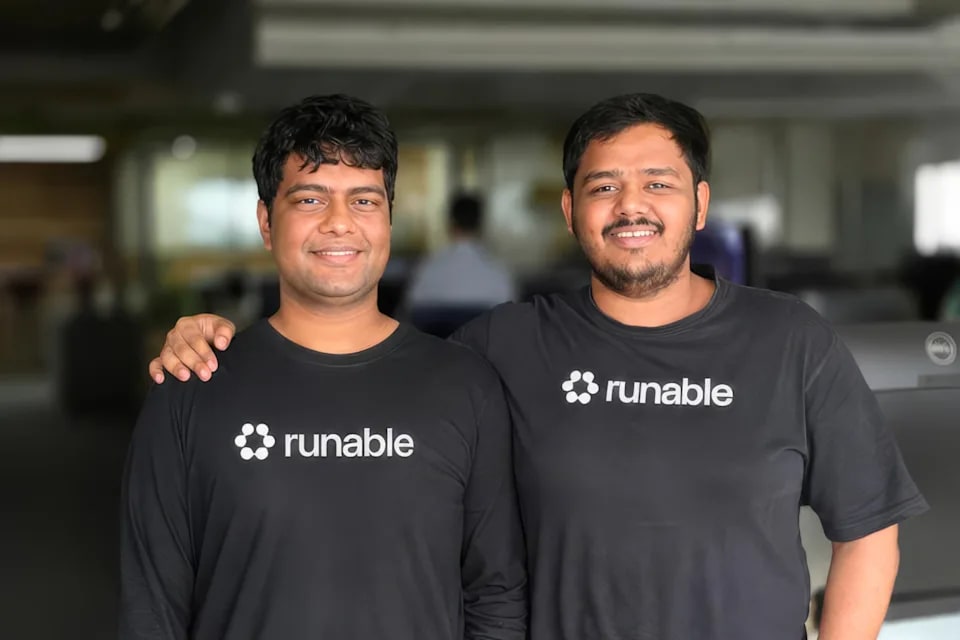
Runable founder Umesh Kumar (CEO) and Saksham Sarda
Image credit: Runable
Runable, a Bengaluru based agentic AI startup, has raised 21 million dollars in a Series A funding round to expand beyond helping small businesses build software and into helping them find customers and grow. The round was co‑led by Susquehanna Venture Capital and Nexus Venture Partners, with existing investors Together Fund and Array VC also participating.
The all‑equity, primary funding round values Runable at 65 million dollars post‑money, according to co‑founder and chief executive Umesh Kumar. The company was founded in 2025 by Kumar and Saksham Sarda, initially as an AI infrastructure startup building browser technology to scrape data at scale, a considerably narrower and more technical starting point than where the company has ended up. The pivot came from watching how customers actually used the product: Kumar and Sarda noticed users increasingly asking their browser‑based agent to create things like slide decks and websites rather than simply extract data, a pattern that pushed the founders toward building a general‑purpose AI agent instead.
That shift proved commercially decisive. Runable went from zero to a 2 million dollar annualized revenue run rate within three weeks of launching payments in March, according to Kumar, a pace of early monetization that is unusual even within a fast‑moving AI agent market. Today, Runable's agent lets users build websites, apps, presentations, and other content using natural language prompts, while also handling more operationally focused tasks including finding customers, running advertising campaigns, managing social media, and improving how a business appears within AI chatbots.
Kumar has been direct about the thinking behind the pivot toward outcomes rather than pure content creation. "Building software stopped being the hard part," he said. "Nobody starts a business because they want a landing page. They start it because they want customers and revenue." That framing positions Runable deliberately against a wave of AI coding and content tools, including Cursor, Lovable, and Replit, along with general‑purpose agent platforms like Manus and Genspark, all of which Runable competes with to varying degrees but which the company argues stop short of addressing what actually determines whether a small business survives and grows.
Nexus Venture Partners partner Jishnu Bhattacharjee echoed that distinction directly. "Most AI tools stop at output, while businesses need outcomes: customers, revenue and cash in the bank," he said. "That's what Runable's general‑purpose autonomous AI agent does: not just automate software creation but build, run and grow a business." Together Fund co‑founder and general partner Shubham Gupta made a similar case for where durable value in AI is likely to accumulate. "Durable value in AI would be created by helping users run their businesses, rather than just creating software," Gupta said. "95 per cent of that revolves around customers, revenues and operations, which is exactly what Runable powers."
Runable's user base reflects that small‑business focus concretely. The company's roughly 1.5 to 1.7 million registered users are mostly small‑business owners, frequently operating in two‑person teams running agencies, consultancies, cleaning companies, and similar operations, spread across the United States, the United Kingdom, Japan, and Brazil, with Japan reportedly on track to become one of the company's largest markets. Usage volume has scaled quickly alongside that user growth: Runable says its platform consumed more than 1 trillion tokens over the past 90 days, with paying customers accounting for roughly 60 to 70 percent of that total usage, a relatively high conversion signal for a consumer‑facing AI product at this stage.
Remarkably, Runable has built and scaled to this point with a team of just 15 people, a headcount that underscores how much of the company's own operations already run on the same kind of AI‑driven automation its product sells to customers. With the new capital, Runable plans to invest in growth channels and measurement infrastructure, expand its free Runable Academy educational offering, and hire across engineering, machine learning, product, growth, and support functions.
Runable enters an increasingly crowded agentic AI landscape that includes both frontier AI labs such as Anthropic and OpenAI and a wave of specialized coding and business‑building platforms, all racing to capture the same broad shift toward AI systems that can act autonomously rather than simply respond to prompts. The company's specific bet is that the software‑creation layer of that market is rapidly commoditizing, and that the more durable and defensible opportunity lies one step further downstream, in helping the small businesses using these tools actually convert their AI‑generated websites, apps, and content into paying customers and sustained revenue. Whether Runable's agent can reliably deliver on customer acquisition and growth outcomes at the same pace it has delivered on software creation will be the clearer test of that bet as the company moves from its rapid early traction toward broader, more competitive markets.
Topics
Stay informed
Startup news in your inbox
Get important funding rounds, founder stories, and startup updates.
No spam - only important startup updates.
Comments
Text only. No links or images.
No comments yet.