
Stellar Alpina Lands €160K to Build Europe's Detonation Rocket Engine
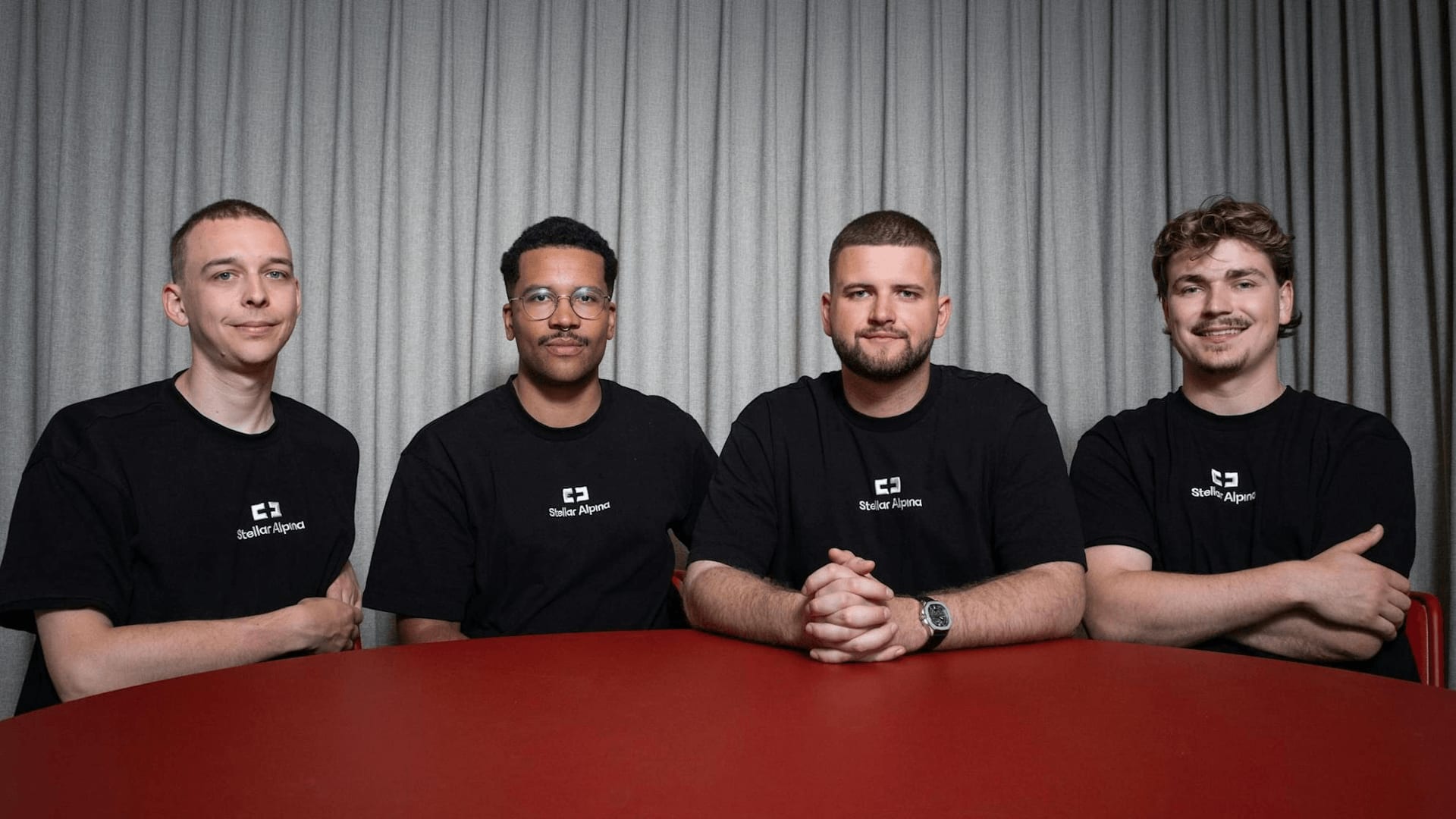
Stellar Alpina founder Rick Röthlisberger, Simi Wespi, Victor Elliesen, and Patrick Egli.
Image credit: Stellar Alpina
Stellar Alpina, a Zurich based space technology startup, has received 160,000 euros, equivalent to 150,000 Swiss francs, from Venture Kick to advance development of a new generation of compact rocket engines designed to move spacecraft after they reach orbit.
The company develops rotating detonation rocket engines, known as RDREs, which generate thrust using continuously rotating, supersonic combustion waves rather than the steady, controlled burn used by conventional chemical rocket engines. That approach can meaningfully reduce the size and complexity of a propulsion system while improving its overall performance, opening up new possibilities for orbital mobility and future in‑space infrastructure that would be difficult or prohibitively bulky to achieve with traditional engine designs.
Stellar Alpina was founded by Rick Röthlisberger, Simi Y. Wespi, Victor Elliesen, and Patrick Egli, all alumni of ARIS, the Academic Spaceflight Initiative Switzerland, where the founding team first worked on interdisciplinary rocketry projects and, in 2024, built the world's first known student‑built rotating detonation rocket engine. According to the company, co‑founder Simi Wespi spent years advocating for RDRE technology within Switzerland's space community despite facing repeated rejections, eventually assembling a dedicated team within ARIS to prove the underlying concept could work, work that ultimately became the technical foundation the company was built on.
That early academic groundwork translated into remarkably fast commercial execution once Stellar Alpina formally incorporated. The company built and commissioned its own test infrastructure and completed what it describes as Europe's first known commercial RDRE hotfire campaign just 82 days after incorporation, running Engine 0 through eight detonative hotfires and achieving up to five stable detonation waves during testing, a pace of hardware development that is unusual even by the standards of fast‑moving deep tech startups.
Stellar Alpina's technology is aimed at a specific gap emerging within the space economy as the cost of reaching orbit continues to fall. Co‑founder Victor Elliesen has framed that shift directly: "The space economy is moving beyond the question of access to orbit. The next challenge is movement after launch: transferring, repositioning, and operating assets across higher‑energy orbits, cislunar space, and more complex mission architectures. We believe detonation‑based propulsion can provide the step change this requires by making rocket engines smaller, more efficient, and more capable. Stellar Alpina is building the foundation for mobility in the space between worlds."
In practical terms, the company's propulsion technology is aimed at supporting orbital transfers, satellite repositioning, spacecraft inspection missions, and, over the longer term, deep‑space infrastructure and missions beyond Earth's immediate orbit. As satellite operators increasingly need to reposition assets across different orbital regimes, whether to extend a satellite's operational life, respond to changing mission requirements, or support more complex multi‑orbit architectures, compact and efficient in‑space propulsion becomes an increasingly important, and currently underserved, part of the broader space infrastructure stack.
This latest Venture Kick award follows a considerably larger funding milestone the company reached earlier in the year. In May 2026, Stellar Alpina closed a 3.8 million euro, or 3.5 million Swiss franc, pre‑seed round led by Founderful, with participation from LP&E and a group of strategic investors from the broader European deep tech ecosystem, bringing the company's total disclosed funding to roughly 3.9 million euros once this Venture Kick contribution is included. That pre‑seed round was itself notable for closing so soon after the company's founding, underscoring the level of investor confidence generated by Stellar Alpina's rapid early hotfire testing results.
With the new Venture Kick funding, Stellar Alpina plans to expand its testing infrastructure, conduct additional hotfire campaigns beyond its initial Engine 0 tests, and accelerate development toward its first flight‑ready engine, the critical next milestone separating a successfully demonstrated propulsion concept from hardware that can actually be integrated into a real spacecraft and flown in orbit. Venture Kick itself operates as a staged, competitive funding program supporting Swiss university and research spin‑offs, with awards typically increasing in size as a startup demonstrates further progress, meaning this 150,000 Swiss franc award likely reflects continued validation of Stellar Alpina's technical progress alongside the earlier pre‑seed capital raised from private investors.
Stellar Alpina's rapid trajectory, from a student rocketry project within ARIS to Europe's first known commercial RDRE hotfire campaign within 82 days of incorporation, and on to a multi‑million euro pre‑seed round within months of that milestone, positions the company as one of the more closely watched early‑stage entrants in the growing field of in‑space mobility and orbital transfer technology. Whether rotating detonation propulsion can move from promising hotfire test results to a genuinely flight‑qualified engine, and whether Stellar Alpina can secure the customer relationships needed to prove out real commercial demand for compact orbital mobility hardware, will likely determine how much of the space economy's next challenge, movement after launch, the company is ultimately able to capture.
Topics
Stay informed
Startup news in your inbox
Get important funding rounds, founder stories, and startup updates.
No spam - only important startup updates.
Comments
Text only. No links or images.
No comments yet.