US Government Forces Anthropic to Shut Down Claude Fable 5 and Mythos 5 Worldwide Just Three Days After Launch
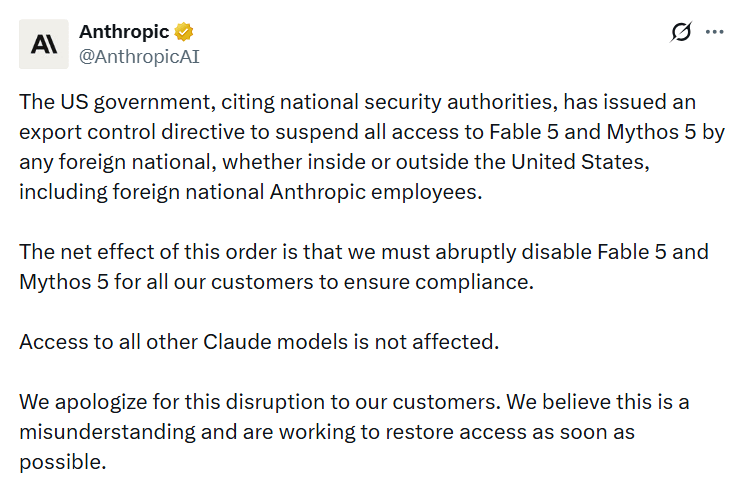
Anthropic launched what it called its most capable publicly available AI models in history on June 9, 2026. By the evening of June 12, they were gone. At 5:21 PM Eastern time on Friday, the company received a letter from US Commerce Secretary Howard Lutnick informing CEO Dario Amodei that Claude Fable 5 and Claude Mythos 5 would be subject to export controls, effective immediately, citing national security authorities. Within hours, both models were disabled for every customer worldwide. Developers watching their API calls return a 404 error got no warning. There was no maintenance window. There was no scheduled downtime. There was a government letter, and then there was silence.
It is, by most accounts, the first time the United States government has used export control authority to force the removal of a specific, publicly deployed frontier AI model from production. The implications reach far beyond Anthropic.
What the Order Said and What It Required
Commerce Secretary Lutnick's letter, drafted with the help of officials from the Commerce Department's Bureau of Industry and Security, directed Anthropic to suspend all access to Fable 5 and Mythos 5 for any foreign national, whether inside or outside the United States, including foreign national Anthropic employees.
That scope created an immediate and unresolvable compliance problem. Anthropic cannot reliably verify citizenship in real time, and so it had no practical mechanism to restrict access to foreign nationals while keeping the models available to US citizens. The result was a global suspension for every customer, not just non‑US users.
Anthropic published a public statement, complied with the directive, and confirmed that all other Claude models remained fully operational. Claude Opus 4.8, Sonnet 4.6, and the rest of the product line continued without any disruption. The shutdown was targeted and surgical in its legal framing, but blunt and total in its practical effect.
Why the Government Acted: The Jailbreak Claim
An administration official told reporters the Commerce Department decided to act after another company claimed it was able to jailbreak Mythos 5, which alarmed the administration about possible national security risks. The administration had previously tried to persuade Anthropic to pause the release of the models entirely but was unsuccessful. The export control letter followed that failure as a more forceful instrument.
Anthropic's own account of the government's concern centres on a specific technique: asking the model to read a particular codebase and identify software flaws. The company says this represents a narrow, non‑universal jailbreak and that the government has so far provided only verbal evidence, not a technical demonstration verified by Anthropic's own red team.
That framing matters enormously to Anthropic's defence of its position. The company spent thousands of hours before launch red‑teaming Fable 5's safeguards alongside the US government, the UK AI Safety Institute, third‑party safety organisations, and internal teams. No universal jailbreak, defined as a technique that broadly unblocks a wide range of dangerous capabilities, was found. Fable 5 launched with a classifier system routing sensitive queries in cybersecurity, biology, chemistry, and model distillation to Claude Opus 4.8, a fallback that fired in fewer than five percent of sessions.
Anthropic's review of the demonstration found that the technique surfaced only a small number of previously known, minor vulnerabilities. The company noted in its public statement that the capability in question is also present in other models, including GPT‑5.5, which remains available worldwide without equivalent restriction.
Anthropic said it believes the shutdown is a misunderstanding and stated publicly that the action does not adhere to the principles of a transparent, fair, and technically grounded process, principles the company has endorsed as foundational to constructive government engagement with AI development. It confirmed it is working to restore access as quickly as possible but gave no timeline.
The History Behind the Confrontation
Mozilla, one of the organisations with access to Mythos Preview through Project Glasswing, said it resolved hundreds of vulnerabilities as a direct result of working with the model. That context makes the government's concern about offensive applications of the same capability more complex to evaluate. The same code analysis power that helps security researchers find and patch vulnerabilities could, in theory, help attackers identify them. That dual‑use problem is not new to security software. It is the fundamental tension at the heart of the entire defensive cybersecurity industry.
Reports indicate the Trump administration had previously attempted to prevent Anthropic from releasing the models entirely, and was unsuccessful. The export control directive represents the administration's second and more coercive attempt to constrain access. The sequence carries a significance that Anthropic acknowledged obliquely in its public statement. A government that tried and failed to prevent a launch, then used regulatory authority to achieve the outcome it sought through a different mechanism, is establishing a precedent about the relationship between AI companies and government control over what gets deployed.
What This Means in Practice for Developers and Enterprises
For the thousands of developers and enterprises who integrated Fable 5 in the three days it was publicly available, the shutdown was immediate and disruptive. API calls to claude‑fable‑5 return errors. Workflows built on the model's one‑million‑token context window, its extended thinking capability, and its documented improvements in software engineering, code review, and long‑horizon task completion are non‑operational.
The June 22 billing transition date, after which Fable 5 access would have moved from the free introductory window to standard credit‑based pricing, is now irrelevant while the model is suspended. Anthropic has provided no return date. Claude Opus 4.8 is the recommended fallback for developers rebuilding affected workflows.
For enterprises evaluating Anthropic's Mythos‑class capabilities, the shutdown also creates a procurement risk consideration that did not exist before June 12. A frontier AI model can now be removed from service by government order within days of its public release, with no advance notice and no appeal process visible to customers. That is a new category of operational risk that enterprise procurement, risk management, and legal teams will need to factor into AI vendor assessments.
The Larger Precedent
The fact that a cutting‑edge AI model is being treated as subject to export controls signals that advanced AI models, while being software, are beginning to be viewed by governments as critical technologies related to military affairs, cyber operations, and national security. Previous export control actions have targeted semiconductors, chip manufacturing equipment, and quantum computing hardware. This is the first time the mechanism has been applied to a deployed inference model.
That precedent has two possible trajectories. In one, it represents a calibrated and temporary response to a specific, identified risk that is resolved through technical dialogue between Anthropic and the Commerce Department, and Fable 5 returns to service with additional safeguards or clearer documentation of its limitations. In the other, it establishes a template through which governments can assert control over which AI capabilities are available to their populations and to non‑citizens operating within their borders, a shift that would reshape how frontier AI companies approach public deployment globally.
This incident is a first: a US government export control directive targeted at a specific commercial AI model's general availability. Not at a chip. Not at a dataset. At deployed inference. It will not be the last.
Key facts as of June 13, 2026:
- Directive received: 5:21 PM Eastern, June 12, 2026
- Signed by: US Commerce Secretary Howard Lutnick, Bureau of Industry and Security
- Models affected: Claude Fable 5 and Claude Mythos 5 only
- Scope: all foreign nationals inside or outside the US, including Anthropic employees
- Days since launch: three
- Models unaffected: Claude Opus 4.8, Sonnet 4.6, Haiku, and all other Claude models
- Anthropic's position: complying under protest, calling it a likely misunderstanding, working to restore access
- Return timeline: none provided
For Anthropic's official statement and the latest status on access restoration, visit https://anthropic.com/news/fable‑mythos‑access.
The story is not over. It has barely started. Whether Anthropic can restore access, on what terms, and how quickly, will define the next chapter of the relationship between the AI industry and the US government. What June 12, 2026 established, regardless of how that chapter ends, is that a frontier AI model is no longer simply a product. It is a regulated technology, subject to the same sovereign authority the US has long asserted over semiconductors, weapons systems, and encryption. The implications for every AI company building at the frontier will take years to fully understand.
Stay informed
Startup news in your inbox
Get important funding rounds, founder stories, and startup updates.
No spam - only important startup updates.
Comments
Text only. No links or images.
No comments yet.