Startup Funding Roundup May 21 2026: Mercury Hits $5.2B Valuation, ICEYE Secures €300M, Key AI & Fintech Deals Today

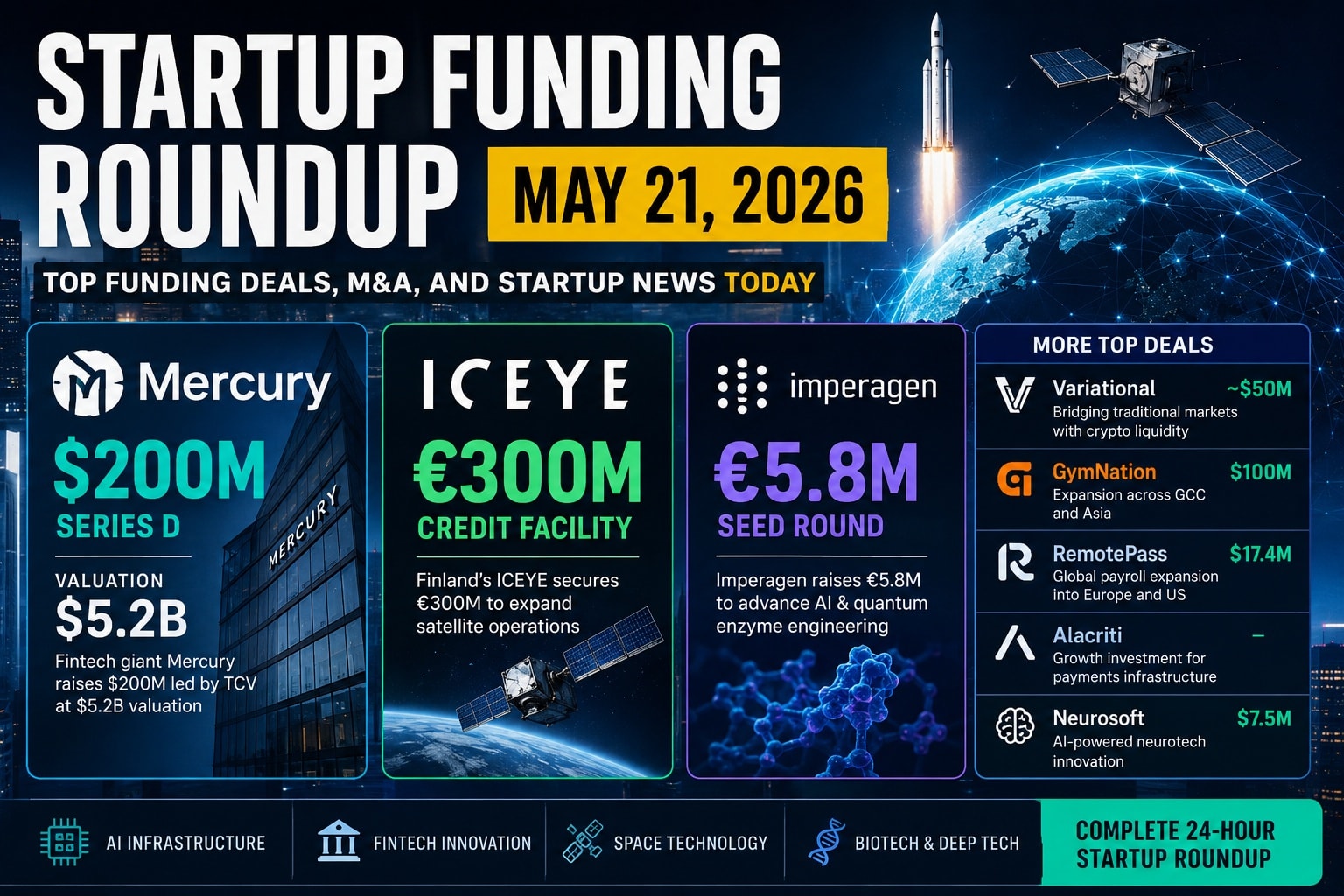
Global startup funding activity remained strong over the last 24 hours as investors continued pouring capital into AI infrastructure, fintech platforms, space technology, and deep‑tech innovation. Today’s startup funding roundup highlights a market increasingly driven by enterprise AI adoption, sovereign technology investments, and infrastructure‑focused startups capable of scaling globally.
The biggest headline comes from fintech platform Mercury, which secured a massive $200 million Series D round at a $5.2 billion valuation. Meanwhile, Finnish satellite company ICEYE locked in a €300 million credit facility to accelerate its Earth observation expansion, reflecting growing investor confidence in defense and space technology startups.
Across Europe, the United States, and the Middle East, funding momentum remains concentrated around AI‑powered enterprise tools, payment infrastructure, biotech innovation, and next‑generation computing technologies.
Mercury Raises $200M Series D at $5.2B Valuation Amid AI Startup Boom
Fintech startup Mercury announced a $200 million Series D funding round, pushing the company’s valuation to approximately $5.2 billion and cementing its position as one of the most valuable private fintech startups in the startup banking ecosystem.
The round was led by TCV with participation from major venture firms including Andreessen Horowitz (a16z), Sequoia Capital, Coatue, and CRV. The latest investment reportedly brings Mercury’s total funding close to $700 million.
Mercury has emerged as one of the primary banking platforms serving startups, particularly AI‑native companies launching at unprecedented speed in 2026. As generative AI tools reduce the barriers to building software products, thousands of founders are entering the startup ecosystem, creating growing demand for digital banking infrastructure, treasury services, payments, and financial automation.
The company’s growth also reflects a broader venture capital trend favoring infrastructure‑oriented fintech startups over riskier consumer lending businesses. Investors are increasingly prioritizing predictable recurring revenue, enterprise adoption, and scalable financial systems instead of high‑burn growth models.
Mercury’s latest valuation highlights how fintech infrastructure remains one of the strongest‑performing categories in venture capital despite broader economic uncertainty.
ICEYE Secures €300M as Space and Defense Tech Funding Accelerates
Finland‑based satellite startup ICEYE secured a €300 million credit facility to support the expansion of its synthetic aperture radar (SAR) satellite network.
The company specializes in Earth observation systems capable of delivering real‑time monitoring regardless of weather conditions or time of day. ICEYE’s technology is increasingly being used for defense intelligence, disaster response, climate monitoring, and sovereign space infrastructure.
The financing comes at a time when governments and institutional investors are aggressively backing space and defense technology companies amid rising geopolitical tensions and growing demand for independent satellite capabilities.
Defense‑focused startups, geospatial intelligence platforms, and aerospace infrastructure companies have become some of the fastest‑growing sectors within the global startup ecosystem in 2026. Investors view these businesses as strategically important long‑term infrastructure assets rather than speculative venture bets.
The funding also reinforces Europe’s growing role in the global space technology market as regional startups compete more aggressively with American aerospace companies.
Imperagen Raises €5.8M to Combine AI, Quantum Computing, and Biotech
Manchester‑based startup Imperagen raised €5.8 million in seed funding to expand its AI and quantum‑powered enzyme engineering platform.
The biotech startup uses artificial intelligence and advanced computational modeling to accelerate enzyme discovery and industrial biotechnology applications. By combining AI systems with quantum simulation techniques, the company aims to improve pharmaceutical development, sustainable manufacturing, and synthetic biology workflows.
The funding round reflects growing investor interest in AI‑driven biotech platforms capable of reducing research timelines and improving scientific precision.
AI‑powered biotechnology continues to attract significant venture capital attention as investors increasingly back startups applying machine learning to healthcare, biology, pharmaceuticals, and materials science.
The convergence of AI, biotech, and quantum computing is now emerging as one of the most closely watched areas in deep‑tech investing.
Variational Expands Crypto Infrastructure Push With New Funding
Crypto infrastructure startup Variational reportedly secured around $50 million in fresh funding as institutional interest in digital asset infrastructure continues recovering.
The company focuses on bridging traditional financial markets with crypto liquidity systems, helping institutions access more efficient trading infrastructure across digital and traditional assets.
While speculative crypto startups continue facing volatility, infrastructure‑focused blockchain companies remain attractive to investors due to their long‑term utility and institutional adoption potential.
Stablecoin payments, tokenized financial assets, cross‑border settlement systems, and institutional crypto trading tools remain among the strongest‑funded blockchain categories in 2026.
RemotePass, GymNation, and Alacriti Highlight Broader Startup Activity
Outside the AI and defense sectors, several notable growth‑stage startups also announced major updates over the past 24 hours.
RemotePass, the UAE‑based payroll and remote workforce platform, raised $17.4 million to expand operations across Europe and the United States. The company operates in the rapidly growing Employer of Record (EOR) and global payroll infrastructure sector, which continues benefiting from long‑term remote hiring trends.
Fitness and wellness company GymNation secured $100 million to accelerate expansion across GCC markets and Asia. The funding reflects ongoing investor appetite for consumer businesses with strong subscription economics and scalable regional operations.
Meanwhile, payments infrastructure company Alacriti received a strategic growth investment to expand its digital money movement platform for banks and financial institutions. Real‑time payments and banking modernization continue to remain high‑priority areas across the fintech ecosystem.
AI Infrastructure and Deep Tech Continue Dominating Venture Capital
Today’s startup funding news further confirms that artificial intelligence infrastructure remains the dominant investment theme across global venture capital markets.
Investors continue prioritizing startups focused on:
- Enterprise AI systems
- AI compute infrastructure
- Autonomous software platforms
- Data center technologies
- Defense AI
- Robotics
- Semiconductors
- Biotech automation
At the same time, venture firms are becoming increasingly selective with capital deployment. Investors are now emphasizing sustainable revenue growth, enterprise traction, operational efficiency, and defensible technology advantages.
The shift marks a major evolution from the aggressive growth‑focused funding cycles seen earlier in the decade.
Deep‑tech categories including quantum computing, synthetic biology, semiconductor infrastructure, and aerospace systems are also experiencing renewed momentum as governments and corporations invest heavily in strategic technologies.
Lam Capital Venture Competition Highlights Semiconductor Momentum
Another notable ecosystem event taking place today is the Lam Capital Venture Competition in Fremont, California, where startups focused on semiconductors, AI enablement, robotics, and advanced manufacturing are competing for investment opportunities.
The competition reflects growing investor attention toward hardware infrastructure startups as AI demand continues straining global compute capacity.
Semiconductor startups have regained significant importance in venture capital conversations due to increasing demand for GPUs, edge computing systems, AI accelerators, and domestic chip manufacturing capabilities.
As AI adoption expands globally, infrastructure startups supporting compute, energy efficiency, and hardware scalability are expected to remain among the strongest‑funded sectors through the remainder of 2026.
Startup Funding Trends Defining May 2026
Several major trends continue shaping the startup ecosystem this month.
Artificial intelligence remains the largest driver of venture activity globally, particularly across enterprise automation and infrastructure software. Space and defense technology funding is accelerating rapidly as governments prioritize sovereign capabilities and national security technologies.
Fintech infrastructure startups continue outperforming consumer‑facing financial platforms, while deep‑tech categories such as biotech, semiconductors, and quantum computing are seeing renewed investor confidence.
Despite strong capital flows into strategic sectors, venture firms are becoming increasingly disciplined, focusing heavily on revenue quality, sustainable growth, and operational fundamentals.
The result is a startup market where infrastructure and long‑term utility matter more than speculative growth narratives.
Today’s startup funding roundup demonstrates that global venture capital markets remain highly active despite tighter investment conditions across several sectors.
From Mercury’s multibillion‑dollar fintech valuation to ICEYE’s major space‑tech financing and Imperagen’s AI‑biotech expansion, the strongest‑funded startups are increasingly those building foundational infrastructure for the next phase of the global technology economy.
As AI adoption accelerates and governments invest more aggressively in strategic technologies, infrastructure‑focused startups across fintech, defense, compute, biotech, and automation are likely to remain at the center of venture capital activity throughout 2026.
Stay informed
Startup news in your inbox
Get important funding rounds, founder stories, and startup updates.
No spam - only important startup updates.
Comments
Text only. No links or images.
No comments yet.