20-Year-Old Founder Raises $2.5M for Alteon, an Aircraft That Never Has to Land
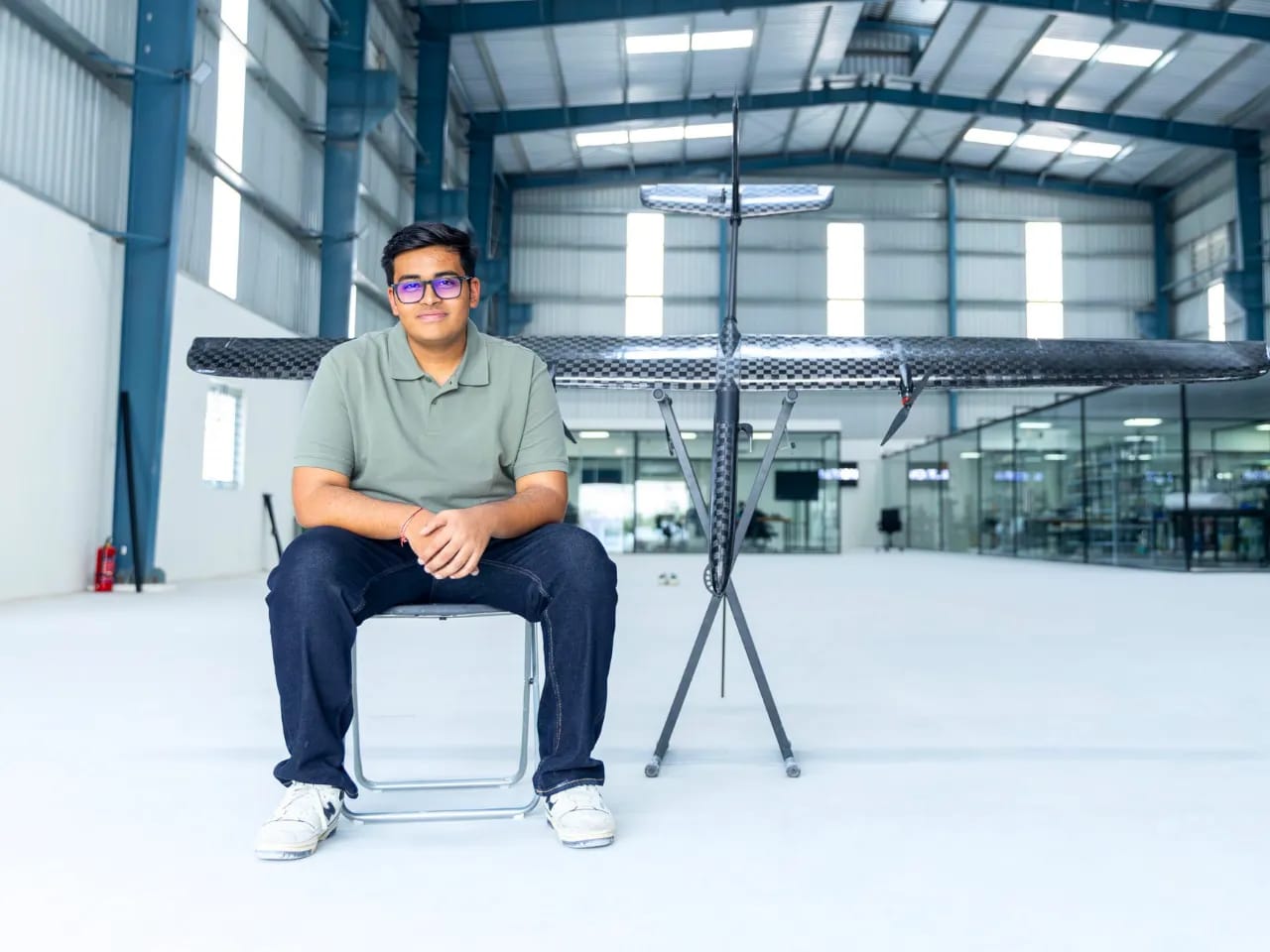
Alteon founder Samay Sanghvi
Image credit: Alteon
Alteon, a Bengaluru based deep‑tech aerospace startup, has raised 2.5 million dollars in pre‑seed funding to advance its work on autonomous aircraft designed to remain airborne for months, and eventually more than a year, without ever needing to land.
The round was led by solo investor Lachy Groom, with participation from Together Fund. According to founder Samay Sanghvi, Groom decided he wanted to invest within the first 30 minutes of their initial meeting, a pace that reflects the kind of conviction‑driven, fast‑moving deal Groom has become known for as an individual backer of ambitious deep‑tech founders.
Alteon was founded in 2023 by Sanghvi, who began building aircraft straight out of high school, crashing radio‑controlled models before progressing to functional prototypes. He is now 20 years old and runs a 20‑person team operating out of a 10,000‑square‑foot facility in Hoskote, roughly 25 kilometres east of Bengaluru. Together Fund co‑founder Shubham Gupta, whose firm backed Alteon when Sanghvi was just 19, framed the investment around the founder's specific combination of traits. "We're proud to back Samay, all of 19 when we invested, whose rare mix of engineering depth and commercial instinct convinced us he's the one to build this," Gupta said.
The core problem Alteon is trying to solve is one that has constrained aviation since its earliest days: every aircraft ever built has eventually had to land, whether for refuelling, maintenance, or crew recovery. Alteon's answer draws directly from nature, specifically from albatrosses, seabirds capable of flying enormous distances with minimal energy expenditure by exploiting a technique called dynamic soaring. The manoeuvre works by repeatedly moving between layers of air travelling at different speeds, close to the ocean's surface, extracting kinetic energy from that wind gradient with each cycle rather than relying on engine power or stored fuel.
Sanghvi has described the underlying engineering philosophy behind the company's approach directly. "Ultra high endurance is downstream of ultra high efficiency, precision and reliability," he said. "Day in, day out we put our aircraft in the air and learn from every build, every flight and every failure to get closer to building aircraft that can stay airborne for more than a year." That iterative approach has translated into a striking pace of testing: Alteon says it builds four to five aircraft per week and completed more than 200 test flights in the past 30 days alone.
The funding follows what the company describes as a key technical milestone: an offshore flight test in which Alteon's aircraft autonomously flew multiple consecutive O‑shaped loops less than a metre above the ocean's surface, reaching speeds above 62 miles per hour during a test conducted over the Bay of Bengal. The test specifically derisked the low‑altitude, near‑surface manoeuvring that Alteon's entire dynamic‑soaring approach depends on, demonstrating that the aircraft's autonomous flight systems could reliably operate that close to a moving, unpredictable ocean surface without human intervention.
Independent experts have offered a measured but genuinely encouraging assessment of that milestone. Dr. Gabriel Bousquet, a Silicon Valley based aerospace and robotics engineer who researched dynamic soaring during his PhD at MIT, called Alteon's low‑altitude flight over water a "promising first result." He was careful to note, however, that the harder and still unproven challenge lies ahead: demonstrating that the aircraft can reliably extract enough energy from real‑world wind conditions to sustain flight over extended periods, while simultaneously contending with turbulence, waves, sea spray, rain, and constantly changing light conditions, all while continuously sensing and reacting to a moving ocean surface in real time.
Sanghvi has identified the company's next major milestone as what he calls "energy‑neutral dynamic soaring," a state in which the aircraft can fly continuously with its propulsion system switched off entirely, drawing sufficient energy from the wind alone to remain aloft indefinitely. Alteon's initial aircraft design calls for a fixed‑wing vehicle with a wingspan of roughly three metres, intended to fly close to the ocean surface, climb into a faster airflow, and repeat that cycle continuously, eventually using propellers as turbines to convert a portion of the harvested wind energy into electricity for onboard batteries and systems. As of this funding round, Alteon has not yet demonstrated that its aircraft can sustain flight solely on energy obtained through dynamic soaring, a distinction the company has been transparent about even as it pursues an ambitious eventual target of 417 days of continuous flight.
The company's initial commercial application is maritime surveillance. A fleet of aircraft capable of remaining airborne for months, rather than requiring the periodic patrols flown by conventional aircraft or the intermittent coverage provided by satellites, could offer governments continuous, real‑time visibility across vast stretches of ocean. Together Fund has pointed to potential uses including detecting and deterring illegal fishing and drug trafficking, and potentially assisting national security responses to threats at sea. Alteon's own broader positioning describes its ambition as building swarms of low‑cost, long‑endurance drones capable of monitoring massive ocean territories continuously, replacing the expensive ships, satellites, and periodic aircraft patrols that traditional naval surveillance has depended on.
With the new capital, Alteon plans to advance its autonomous dynamic‑soaring technology, scale its research and development efforts, and continue offshore testing as it works toward eventually deploying fleets of long‑endurance aircraft over open ocean. Whether the company can close the gap between its current, genuinely impressive low‑altitude flight demonstrations and the far harder goal of sustained, engine‑free flight for months at a time remains an open scientific and engineering question, one that outside experts like Bousquet suggest will require Alteon to prove out considerably more before its aircraft can operate reliably and continuously in the unpredictable conditions of the open ocean.
Topics
Stay informed
Startup news in your inbox
Get important funding rounds, founder stories, and startup updates.
No spam - only important startup updates.
Comments
Text only. No links or images.
No comments yet.