Foldcast Secures €160K to Cut Concrete Use With Recyclable Paper Moulds
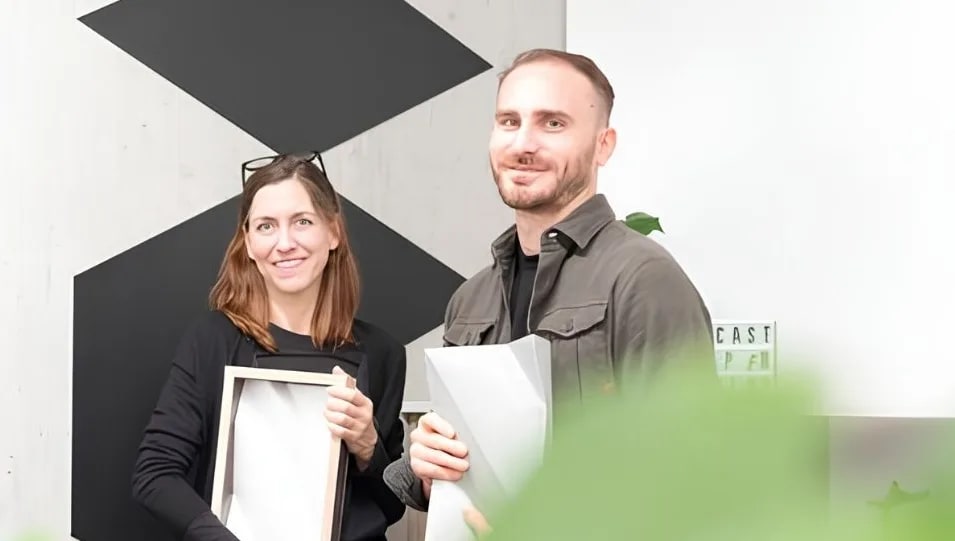
Foldcase Fabio Amicarelli (CEO) and Ena Lloret-Fritschi
Image credit: Foldcast
Foldcast, a Swiss construction technology startup, has secured 160,000 euros, equivalent to 150,000 Swiss francs, from Venture Kick to advance its recyclable paper mould technology for material‑efficient concrete construction and support its transition from validation to commercial deployment.
The company was founded by chief executive Fabio Amicarelli and chief scientific officer Ena Lloret‑Fritschi, and originated as a spin‑off from the Academy of Architecture at Università della Svizzera Italiana, or USI, in Mendrisio, developed within the university's Fabrication and Material Aware Architecture research group. Foldcast Sagl has operated as a standalone startup based in Lugano since December 2024, following years of academic research into how digitally fabricated formwork could change the economics of concrete construction.
The problem Foldcast is built to address sits at the intersection of two persistent tensions in the construction industry. Concrete accounts for roughly 8 percent of global CO2 emissions, yet conventional construction methods routinely use significantly more material than is structurally necessary. That overuse persists largely because of a formwork problem: traditional timber and metal moulds, the temporary structures that give poured concrete its shape while it cures, are costly, time‑consuming, and inflexible, making it economically impractical to produce the kind of optimized, material‑efficient shapes that engineers already know how to design on paper but rarely see built in practice.
Foldcast's answer replaces that timber and metal formwork with digitally fabricated, recyclable paper moulds shaped to the precise structural geometry a given concrete element actually needs. Using advanced design software paired with digital cutting machines, the company can shape paper formwork so that concrete is placed only where it is structurally required, rather than poured into a simple, over‑engineered rectangular or slab shape purely because that geometry is the cheapest and easiest to build a mould for. Once the concrete has cured, the paper formwork is removed and can be reused or fully recycled, replacing roughly 90 percent of the material traditionally used in conventional wood and metal formwork systems.
The performance claims behind that approach are substantial. Foldcast says its paper moulds are five times cheaper and ten times faster to produce than conventional alternatives, while enabling up to 50 percent savings in concrete material use and a 40 percent reduction in embodied CO2 emissions for a given structural element. Those gains come specifically from being able to affordably produce the kind of optimized, non‑standard shapes that reduce how much concrete a structure needs without compromising its structural performance, shapes that would simply be too expensive and slow to produce using traditional formwork at any meaningful scale.
Foldcast's technology has already moved beyond laboratory testing into real industrial and building‑scale validation. The company completed its first full‑scale production test with Müller‑Steinag Gruppe, a major Swiss precast concrete manufacturer, a milestone Amicarelli has described as the turning point that proved Foldcast was more than a research concept and could genuinely scale within the construction industry. A separate demonstrator project produced a 7‑by‑7‑metre concrete slab serving as a functional external storage facility built at ETH Zurich's Hönggerberg campus, marking the technology's first real‑building application. Building on that early traction, Foldcast is now developing Derma, a prefabricated façade system, as it prepares its core technology for broader industrial use.
The latest funding continues a staged progression of support Foldcast has received through Venture Kick, a Swiss philanthropic initiative that funds university spin‑offs through a competitive three‑stage process. The company previously received CHF 10,000 and later CHF 40,000 through earlier Venture Kick stages, with the CHF 40,000 award specifically supporting business development activities, strategic partnerships, and pilot project development ahead of the company's first formal financing round. Foldcast also received CHF 150,000 through InnoBooster, an initiative of the Gebert Rüf Stiftung supporting Swiss university founders who have advanced through Venture Kick's second stage, alongside two other Swiss deep tech startups in that cohort: Kyra, building AI software to forecast electricity grid congestion, and Subatron, developing polymer‑based transducers for wireless underwater communication.
Foldcast is targeting an initial customer base of sustainability‑driven real estate developers and institutional asset owners across Switzerland and Europe, positioning the company within what it describes as a 134 billion dollar addressable segment of the broader 1.8 trillion dollar global concrete industry. That framing reflects a deliberate focus on customers already motivated by carbon reduction and material efficiency goals, a segment likely to adopt a genuinely new formwork technology faster than cost‑driven contractors operating on thinner margins and tighter timelines, even though Foldcast's own economics argue its paper moulds should eventually be cheaper across the board, not merely more sustainable.
With this latest funding, Foldcast plans to continue its transition from validated prototype and pilot‑stage technology toward full market entry, building on its existing industrial partnerships and demonstrator projects. The construction industry has historically been one of the slower sectors to adopt genuinely new fabrication methods, weighed down by conservative engineering standards, established supplier relationships, and the high cost of getting a structural failure wrong. Whether Foldcast's combination of lower cost, faster production, and reduced material use proves compelling enough to overcome that inertia at scale will become clearer as the company moves from demonstrator projects and pilot partnerships toward broader commercial deployment across its target European markets.
Topics
Stay informed
Startup news in your inbox
Get important funding rounds, founder stories, and startup updates.
No spam - only important startup updates.
Comments
Text only. No links or images.
No comments yet.