
Muon Space Raises $250M Series C at $1.5B Valuation to Scale Satellite Production
Muon Space
Image credit: Muon Space
Muon Space, the Mountain View based satellite manufacturer, has closed a 250 million dollar Series C financing round at a 1.5 billion dollar valuation, pushing the company's total equity funding past 386 million dollars.
The round, which the company described as heavily oversubscribed, was led by Eclipse Capital, with new participation from Galvanize, Google, Salesforce Ventures, Wellington Management, I Squared Capital, and Toyota's Woven Capital. Existing investors Radical Ventures, Congruent Ventures, Costanoa Ventures, Activate Capital, ACME Capital, ArcTern Ventures, and Overlap Holdings all returned to participate again, a sign of continued conviction from the company's earlier backers alongside the new capital arriving from Silicon Valley's biggest technology platforms.
Muon Space was founded in 2021 by chief executive Jonny Dyer, a former SpaceX engineer, alongside co‑founders Dan McCleese, Paul Day, Reuben Rohrschneider, and Pascal Stang. The company describes itself as the Mission Foundry for high‑performance satellite constellations, offering an integrated platform that spans mission design, spacecraft manufacturing, launch coordination, and ongoing operations, an end‑to‑end model intended to compress what has traditionally been a bespoke, multi‑year process for building and deploying a satellite constellation into something closer to a repeatable, scalable product.
That model has already been tested in orbit. Muon reports a 100 percent mission success rate across 11 satellites currently operating in space, with seven of those satellites launched within just the first half of 2026 alone, marking what the company describes as the most productive stretch in its history. Beyond its own operating satellites, Muon holds an active production backlog of more than 50 satellites for defense, civil, and commercial customers, building on earlier multi‑satellite prototyping work with the Pentagon's Defense Innovation Unit. Space Systems Command separately awarded Muon a 44.6 million dollar Small Business Innovation Research Phase III contract in October to build a three‑satellite prototype demonstrating space‑based environmental monitoring for the Department of War, with the Joint Requirements Oversight Council identifying cloud characterization and theater weather imagery as the mission's top priorities.
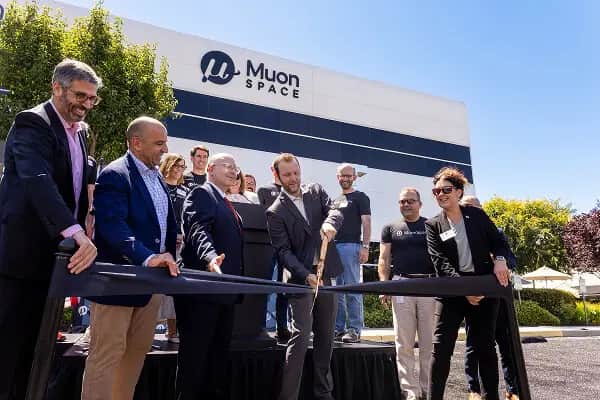
The new capital is earmarked primarily for expanding Muon's satellite manufacturing plant in San Jose, California, with the goal of scaling production capacity to manufacture up to 500 small satellites annually by 2027, a dramatic jump from the 11 satellites the company has deployed to date. Infrastructure expansion at the San Jose facility will proceed through late 2026, with automated assembly lines and expanded cleanroom capacity coming online in phases, timed to meet multi‑satellite delivery schedules for both commercial Earth observation networks and military space programs running through 2028.
Alongside its manufacturing buildout, Muon is investing in differentiated mission capabilities including advanced payloads, on‑orbit AI compute, and real‑time, ultra‑high bandwidth satellite connectivity developed in partnership with SpaceX's Starlink network. The company is also working to reduce its reliance on shared rideshare launch programs, instead securing dedicated medium‑lift launch capacity intended to insulate its production and deployment schedules from the delays and pricing volatility that have periodically affected rideshare missions, a step aimed at supporting more predictable, rapid constellation deployment for both corporate and government customers.
Eclipse founder and chief executive Lior Susan framed the firm's investment around Muon's ability to industrialize what has historically been a highly custom, slow‑moving process. "Muon is redefining how space infrastructure is built," Susan said. "By integrating mission design, manufacturing, launch and operations into a single platform, the team has turned what was once a bespoke, years‑long process into a repeatable model built to scale. With multiple successful constellations already in orbit and demand accelerating across commercial, government, and international sovereign customers, Muon is positioned to become the foundational platform for the next generation of space‑based capabilities."
The financing arrives at a moment of renewed investor enthusiasm for commercial space infrastructure more broadly, with interest in the sector picking up following SpaceX's initial public offering in June 2026, which drew fresh attention to the underlying economics of building and operating space‑based infrastructure at scale. A 1.5 billion dollar private valuation puts Muon firmly into unicorn territory, but as Tech Startups has noted, the company's next phase will likely be measured less by valuation than by execution, since scaling from 11 satellites currently in orbit to a factory capable of producing 500 a year represents an enormous operational leap regardless of how much capital sits behind it. Whether Muon can convert its 50‑satellite backlog and expanding government relationships into sustained production at that scale will be the clearest test yet of whether its integrated Mission Foundry model can genuinely replace the bespoke, multi‑year satellite programs that have defined the industry until now.
Topics
Stay informed
Startup news in your inbox
Get important funding rounds, founder stories, and startup updates.
No spam - only important startup updates.