
Benford Raises €5M, Skips The Software Sale And Becomes The Auditor
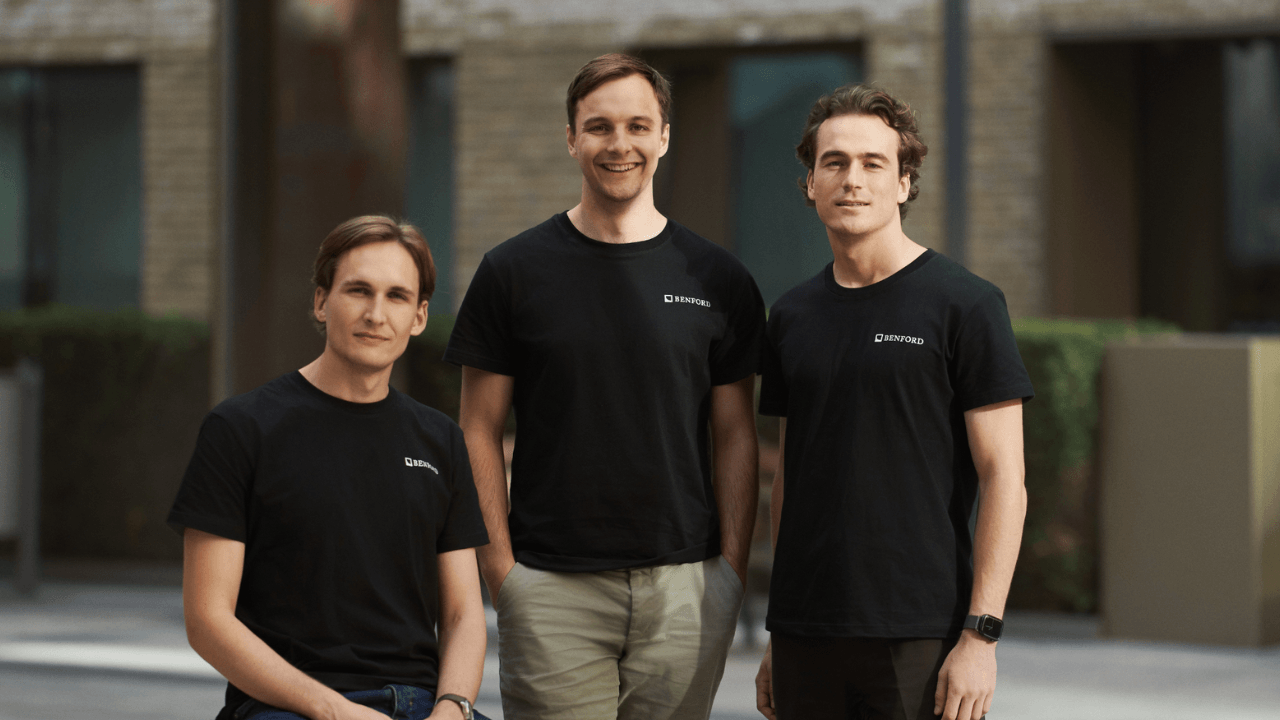
Benford founder Mads Bogen Øye, Thibault Mallion, and Andreas Rystad
Image credit: Benford
Benford, a Norwegian licensed audit firm, has raised 5 million euros in pre‑seed funding to prove that the fastest way to modernise financial audit is not to sell better software to existing auditors, but to become the auditor itself.
The round was led by firstminute capital and Global Founders Capital, with additional backing from Sondo. A notable group of angel investors from across European finance software also joined, including Peter ter Maaten of HSO, Arthur Waller and Quentin de Metz of Pennylane, Alexandre Prot of Qonto, and members of the Spandow family, who founded Nordic accounting group Amesto, a roster that gives Benford direct access to people who have personally built and scaled the kind of financial infrastructure software its own clients already rely on.
Benford was founded by Mads Bogen Øye, Thibault Mallion and Andreas Rystad, whose combined backgrounds span Palantir, Goldman Sachs and investment firm One Peak. That mix of data infrastructure and financial services experience shapes the company's core thesis directly, that audit has been left behind by two decades of fintech innovation aimed everywhere except at the audit process itself. According to Øye, for twenty years innovation in the audit sector has meant building software and selling it to auditors, while the actual practice of conducting an audit has largely continued unchanged, with new tools layered on top of old processes rather than the underlying workflow ever being rebuilt from first principles.
The structural problem Benford is targeting sits specifically at the small and mid‑market end of the audit industry. Large accounting networks have been pulling back from smaller clients, consolidators have been acquiring independent audit practices faster than they can modernise them technologically, local firms typically lack the resources to rebuild their own technology stack from scratch, and the profession as a whole is retiring faster than it is recruiting new talent to replace departing auditors. Michael Stothard, a partner at firstminute capital, has described that combination as leaving audit a genuinely overlooked market despite its size, one that nobody had previously attempted to rebuild entirely from first principles rather than incrementally improving around the edges of an existing workflow.
Rather than building tools for that shrinking pool of mid‑market auditors to adopt, Benford has taken the more unusual route of becoming a registered audit firm in its own right, licensed to conduct statutory audits directly in Norway. Its proprietary platform, AuditOS, is already live and running real client audits, covering the full process from ingesting data out of a client's own accounting and ERP systems through to producing a signed audit opinion. David Sainteff, a partner at Global Founders Capital, has argued that no part of the finance function is better suited to automation than the groundwork stage of an audit, and few parts of the profession remain less automated, adding that clients currently pay the price for that gap twice over, once through the fees they pay for the audit itself, and again through the internal hours their own finance teams spend answering auditor requests and facilitating a process that often runs slower than it needs to.
That second cost, the operational burden audits place on a client's own finance team, is a detail Benford has built directly into its product rather than treating as a secondary concern. Follow‑up requests from auditors are managed through a single shared interface rather than scattered across email threads, a comparatively unglamorous feature that may matter more to the finance directors actually living through an audit each year than any specific claim about AI capability. Benford's own website frames its consumer‑facing pitch in similarly practical terms, offering fixed‑price statutory audits quoted directly from a company's registration number, an onboarding process the company says takes around 20 minutes, ledger import or direct ERP connection, testing of every transaction rather than a sampled subset, and a final report signed by a state‑authorised auditor, currently available to companies in the UK and Norway.
The new funding will go toward expanding Benford's audit operations from its current Norwegian base into Sweden and the broader European mid‑market, according to the company, extending both its licensed audit capacity and the reach of the AuditOS platform underpinning it. That expansion plan sits inside a global audit market valued at 58.68 billion dollars, according to data from The Business Research Company, with the sector projected to grow to 78.7 billion dollars by 2030, a large addressable market in which Benford is explicitly targeting the small and mid‑sized business segment that major firms including Deloitte, EY, KPMG and PwC have been increasingly deprioritising in favour of larger corporate accounts.
Benford's approach, choosing to operate as a licensed audit firm rather than a software vendor selling into the profession, carries meaningfully higher regulatory and execution complexity than a typical software startup, since the company has to maintain audit licensing, meet the same professional standards and liability exposure as any other statutory auditor, and build genuine trust with finance directors making decisions that carry real legal and financial consequences. Whether that vertically integrated model, owning both the technology and the actual delivery of the audit, proves a more durable advantage than the software‑only approach the sector has pursued for the past two decades will likely become clearer as Benford works to replicate its Norwegian traction across new, more competitive European markets where established local firms have their own long‑standing client relationships to defend.
Topics
Stay informed
Startup news in your inbox
Get important funding rounds, founder stories, and startup updates.
No spam - only important startup updates.